


The Cabinet-level Council of Agriculture (COA) issued a statement on Friday condemning Greenpeace activists for boarding a Taiwanese fishing boat in the South Pacific earlier this week to check for illegal catch.
The statement said that the Pingtung-based 98-tonne Niensheng No. 3 was on the open seas north of the Solomon Islands on April 21 when Greenpeace activists interrupted its operations, using a 2,000-tonne vessel equipped with a helicopter.
The Greenpeace activists, after circling the Taiwanese ship for nearly an hour aboard a yacht, demanded permission to board to check whether there was any illegal shark fin harvest or excessive tuna fishing.
“The Ninensheng skipper had no choice but to accede to the request by the Greenpeace activists,” the statement said, adding that although the activists did not find any evidence of irregularities after a thorough inspection that included photographing, they continued to trail the Taiwanese ship for six to seven hours after they returned to their own yacht.
The activists did not stop the chase until after the Taiwanese ship entered the Solomon Islands’ exclusive economic zone, the statement said.
According to the International Marine Law, when a vessel is operating on the open seas, it is under the jurisdiction of the country with which it registered or the country to which its skipper belongs.
As the Niensheng No. 3 was fishing on the open seas, the statement said, its skipper could have legally rejected the Greenpeace activists’ demand for shipboard inspection, inquiry or law enforcement.
Stressing that the Niensheng No. 3 is high on the list of vessels permitted to fish in the region by the Western and Central Pacific Fisheries Commission (WCPFC) and the South Pacific Forum Fisheries Agency (FFA), the statement argued that Greenpeace activists’ forced shipboard check, without the Taiwan government’s approval, was in stark violation of Taiwan’s legal jurisdiction and International Law.
“We strongly protest the Greenpeace activists’ action,” the statement said.
The incident marked the first time a Taiwanese boat was subjected to Greenpeace’s forced shipboard inspections on the open seas.

LOUD AND PROUD Taiwan might have taken a drubbing against Australia and Japan, but you might not know it from the enthusiasm and numbers of the fans Taiwan might not be expected to win the World Baseball Classic (WBC) but their fans are making their presence felt in Tokyo, with tens of thousands decked out in the team’s blue, blowing horns and singing songs. Taiwanese fans have packed out the Tokyo Dome for all three of their games so far and even threatened to drown out home team supporters when their team played Japan on Friday. They blew trumpets, chanted for their favorite players and had their own cheerleading squad who dance on a stage during the game. The team struggled to match that exuberance on the field, with
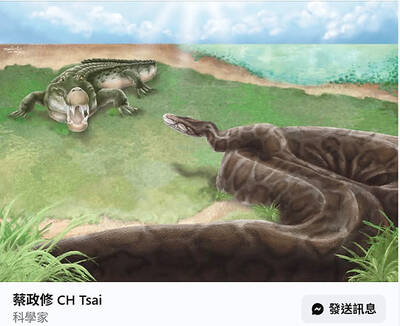
Taiwanese paleontologists have discovered fossil evidence that pythons up to 4m long inhabited Taiwan during the Pleistocene epoch, reporting their findings in the international scientific journal Historical Biology. National Taiwan University (NTU) Institute of Ecology and Evolutionary Biology associate professor Tsai Cheng-hsiu (蔡政修) led the team that discovered the largest snake fossil ever found in Taiwan. The single trunk vertebra was discovered in Tainan at the Chiting Formation, dated to between 400,000 and 800,000 years ago in the Middle Pleistocene, the paper said. The area also produced Taiwan’s first avian fossil, as well as crocodile, mammoth, saber-toothed cat and rhinoceros fossils, it said. Discoveries

Taiwanese paleontologists have discovered fossil evidence that pythons up to 4m long inhabited Taiwan during the Pleistocene epoch, reporting their findings in the international scientific journal Historical Biology. National Taiwan University (NTU) Institute of Ecology and Evolutionary Biology associate professor Tsai Cheng-hsiu (蔡政修) led the team that discovered the largest snake fossil ever found in Taiwan. A single trunk vertebra was discovered in Tainan at the Chiting Formation, dated to between 800,000 to 400,000 years ago in the Middle Pleistocene, the paper said. The area also produced Taiwan’s first avian fossil, as well as crocodile, mammoth, sabre-toothed cat and rhinoceros fossils, it said. Discoveries

Whether Japan would help defend Taiwan in case of a cross-strait conflict would depend on the US and the extent to which Japan would be allowed to act under the US-Japan Security Treaty, former Japanese minister of defense Satoshi Morimoto said. As China has not given up on the idea of invading Taiwan by force, to what extent Japan could support US military action would hinge on Washington’s intention and its negotiation with Tokyo, Morimoto said in an interview with the Liberty Times (sister paper of the Taipei Times) yesterday. There has to be sufficient mutual recognition of how Japan could provide


 RSS
RSS