


The legislature yesterday made a major breakthrough in promoting legislative transparency by passing an amendment to the Law Governing the Legislature’s Power (立法院職權行使法) that requires all closed-door negotiation sessions to be recorded.
The amendment stipulates that the legislature should make video and audio recordings and take notes of the entire cross-party negotiation process, following which the video, audio and written records must be publicized in legislative communiques.
It also obliges any legislative caucus that proposes large-scale changes to a bill that has passed committee review during closed-door meetings to specify the reasons behind its move in written form.
The reasons, along with conclusions of the meetings, should also be made public in a communique, the amendment stipulates.
The passage of the amendment marks a milestone in terms of the promotion of legislative transparency, departing from the shroud of secrecy currently obscuring cross-party negotiation sessions.
Parliamentary reform activists have long criticized the policy of only making public the conclusions of the meetings in written form, saying this kept the public in the dark regarding the legislative process.
The amendment also reduces the time provided for the legislature to negotiate bills from four months to one month. If legislative caucuses are unable to reach a consensus on any bill within one month, the bill must be put to deliberation during the plenary session, the amendment stipulates.
“Passage of the amendment is expected to have a positive influence on our political system and improve legislative efficiency,” said Chinese Nationalist Party (KMT) Legislator Ting Shou-chung (丁守中), one of 26 lawmakers who had pushed the bill.
“In the past, cross-party negotiation conclusions were similar to under-the-table deals,” KMT Legislator Wu Ching-chih (吳清池) told a media conference, adding that the legislature could finally be examined “under the sun” after the passage.
Asked for comment, Legislative Speaker Wang Jin-pyng (王金平) said he would deal with cross-party negotiations in accordance with the law.
Ting said that the KMT’s next step would be to push for legislation that would empower the Speaker to have police officers remove legislators who hinder plenary sessions.
Citizens Congress Watch executive director Ho Tsung-hsun (何宗勳) welcomed the amendment, but said more transparency was needed.
“This was a positive move by the KMT toward more transparency in the legislature,” Ho told the Taipei Times. “However, I am unhappy that lawmakers are still not allowing outside access to the video-on-demand system.”
The video-on-demand system broadcasts legislative meetings live online, but is only accessible from within the Legislative Yuan.
“Recently, some lawmakers have expressed their dismay at our release of legislative attendance records,” he said. “I have to admit that there may be defects in our releases, because we can only get information that’s open to the public. If we can access the video-on-demand system from outside the legislature, we would be better informed and there would be less misunderstanding between lawmakers and us.”
In a related development, the Democratic Progressive Party (DPP) caucus yesterday blocked a bill that would freeze the caretaker Cabinet’s power to reshuffle personnel during the transition of power.
The bill will now be negotiated by different caucuses in line with a DPP proposal.
Acting KMT caucus secretary-general Hsieh Kuo-liang (謝國樑) said the caucus respected the DPP’s decision.
Wu, however, was upset at the DPP’s move, accusing the party of trying to buy time to hide “something” from the incoming administration.

The military has spotted two Chinese warships operating in waters near Penghu County in the Taiwan Strait and sent its own naval and air forces to monitor the vessels, the Ministry of National Defense (MND) said. Beijing sends warships and warplanes into the waters and skies around Taiwan on an almost daily basis, drawing condemnation from Taipei. While the ministry offers daily updates on the locations of Chinese military aircraft, it only rarely gives details of where Chinese warships are operating, generally only when it detects aircraft carriers, as happened last week. A Chinese destroyer and a frigate entered waters to the southwest
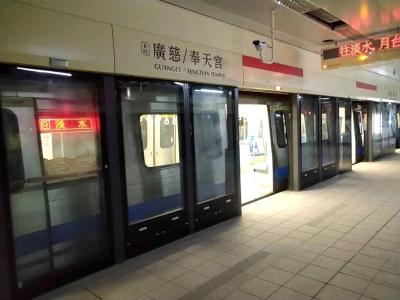
The eastern extension of the Taipei MRT Red Line could begin operations as early as late June, the Taipei Department of Rapid Transit Systems said yesterday. Taipei Rapid Transit Corp said it is considering offering one month of free rides on the new section to mark its opening. Construction progress on the 1.4km extension, which is to run from the current terminal Xiangshan Station to a new eastern terminal, Guangci/Fengtian Temple Station, was 90.6 percent complete by the end of last month, the department said in a report to the Taipei City Council's Transportation Committee. While construction began in October 2016 with an
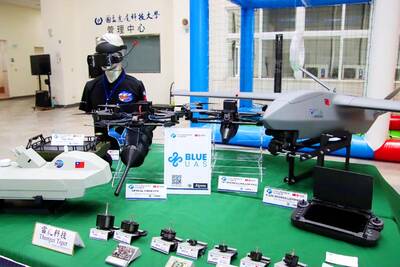
NON-RED SUPPLY: Boosting the nation’s drone industry is becoming increasingly urgent as China’s UAV dominance could become an issue in a crisis, an analyst said Taiwan’s drone exports to Europe grew 41.7-fold from 2024 to last year, with demand from Ukraine’s fight against Russian aggression the most likely driver of growth, a study showed. The Institute for Democracy, Society and Emerging Technology (DSET) in a statement on Wednesday said it found that many of Taiwan’s uncrewed aerial vehicle (UAV) sales were from Poland and the Czech Republic. These countries likely transferred the drones to Ukraine to aid it in its fight against the Russian invasion that started in 2022, it said. Despite the gains, Taiwan is not the dominant drone exporter to these markets, ranking second and fourth

Japanese Prime Minister Sanae Takaichi’s comment last year on Tokyo’s potential reaction to a Taiwan-China conflict has forced Beijing to rewrite its invasion plans, a retired Japanese general said. Takaichi told the Diet on Nov. 7 last year that a Chinese naval blockade or military attack on Taiwan could constitute a “survival-threatening situation” for Japan, potentially allowing Tokyo to exercise its right to collective self-defense. Former Japan Ground Self-Defense Force general Kiyofumi Ogawa said in a recent speech that the remark has been interpreted as meaning Japan could intervene in the early stages of a Taiwan Strait conflict, undermining China’s previous assumptions


 RSS
RSS