


Junior high school students may have the wrong idea about sex and relationships as the Internet, with its unfiltered information, has become an important source of information on the subject, Tainan City's Family Education Center director Chiang Ming-chuan (
Chiang was citing the results of a survey conducted by the center. Valid returns on the poll on sex and dating were collected from 1,164 junior high school students across the city last month, a news release from the center said.
"Through the survey, we found that the Internet is basically the whole world for junior high school students," Chiang said.
Almost 60 percent of respondents said they met friends of the opposite gender via the Internet, the survey showed. Among them, 73 percent did so through instant messaging software, 55 percent through online games and 23 percent made friends through their blogs.
Besides being a platform for making friends, the survey also showed that 48 percent considered the Internet their primary source of sex education, despite the fact that information obtained online is unfiltered and may be inaccurate, Chiang said.
Despite the "education" they receive from the Internet, a high percentage of respondents gave incorrect answers when asked about the human reproductive system, sexually transmitted diseases, sexual harassment and homosexuality, the news release said.
"Only 15 percent [of respondents] know that women can still have sex during pregnancy, while only 11 percent said that homosexuality is not a psychological disorder," Chiang said.
In addition, "a lot of them seek help from the Internet when they run into problems [with a relationship]," Chiang said.
The survey showed that 68 percent of respondents would look on the Web for help on relationships.
"The phenomenon is quite worrisome," Chiang said, adding that school and parents should shoulder the responsibility to provide children with accurate information.
The survey showed that although approximately 50 percent of the respondents' parents received higher education, 40 percent of them would not talk about sex with their children, Chiang said.
"It's natural that children become curious [about sex] as they grow up," she said. "But if parents don't talk about it and our education system doesn't teach them about it, then of course they look for help elsewhere."
In an attempt to resolve the issue, the center is planning to work with schools to set up sex education training courses for teachers and parents, Chiang said.
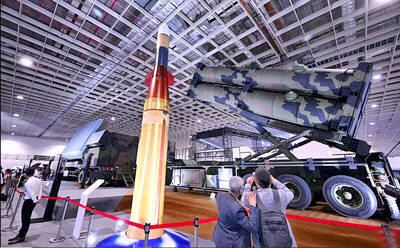
Taiwan is to commence mass production of the Tien Kung (天弓, “Sky Bow”) III, IV and V missiles by the second quarter of this year if the legislature approves the government’s NT$1.25 trillion (US$39.78 billion) special defense budget, an official said yesterday. Commenting on condition of anonymity, a defense official with knowledge of the matter said that the advanced systems are expected to provide crucial capabilities against ballistic and cruise missiles for the proposed “T-Dome,” an advanced, multi-layered air defense network. The Tien Kung III is an air defense missile with a maximum interception altitude of 35km. The Tien Kung IV and V
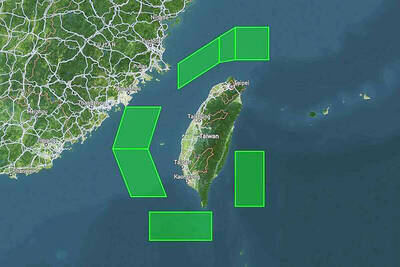
The disruption of 941 flights in and out of Taiwan due to China’s large-scale military exercises was no accident, but rather the result of a “quasi-blockade” used to simulate creating the air and sea routes needed for an amphibious landing, a military expert said. The disruptions occurred on Tuesday and lasted about 10 hours as China conducted live-fire drills in the Taiwan Strait. The Civil Aviation Administration (CAA) said the exercises affected 857 international flights and 84 domestic flights, affecting more than 100,000 travelers. Su Tzu-yun (蘇紫雲), a research fellow at the government-sponsored Institute for National Defense and Security Research, said the air
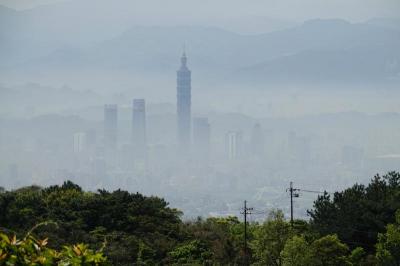
A strong continental cold air mass is to bring pollutants to Taiwan from tomorrow, the Ministry of Environment said today, as it issued an “orange” air quality alert for most of the country. All of Taiwan except for Hualien and Taitung counties is to be under an “orange” air quality alert tomorrow, indicating air quality that is unhealthy for sensitive groups. In China, areas from Shandong to Shanghai have been enveloped in haze since Saturday, the ministry said in a news release. Yesterday, hourly concentrations of PM2.5 in these areas ranged from 65 to 160 micrograms per cubic meter (mg/m³), and pollutants were
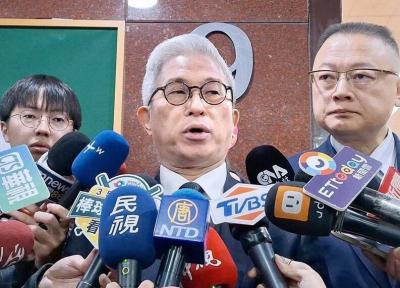
Taiwan’s armed forces have established response protocols for a wide range of sudden contingencies, including the “Wan Chun Plan” to protect the head of state, the Ministry of Defense (MND) said today. After US President Donald Trump on Saturday launched a series of airstrikes in Venezuela and kidnapped Venezuelan President Nicolas Maduro, concerns have been raised as to whether China would launch a similar “decapitation strike” on Taiwan. The armed forces regularly coordinate with relevant agencies and practice drills to ensure preparedness for a wide range of scenarios, Vice Minister of National Defense Hsu Szu-chien (徐斯儉) told reporters before a


 RSS
RSS