


The Ministry of Economic Affairs' Bureau of Standards, Metrology and Inspection (BSMI) has implemented more stringent safety measures in light of recalls in the US and around the rest of the world of toys made in China, bureau officials said yesterday.
The stricter measures were launched recently after the Consumer Product Safety Commission in the US recalled several Chinese-made toy products over concerns that paint used on them contained lead, BSMI officials said.
The toy products recalled included little wrestlers, game mats known as "Tic tac turtle toss mats," chess boards and cardboard games, the officials said.
They said the new measures were targeted at all imported toys and that the bureau would screen all imported products, batch by batch, for a period of six months to find out whether any toxic Chinese-made toys were being marketed in this country.
Lead paint is toxic and if ingested by young children can cause adverse effects to the body's neural system or trigger acute lead poisoning.
BSMI officials called on consumers to inform the bureau if they find any toys purchased on the domestic market that are cause for suspicion.
Consumers are also urged to buy only toys and other products that carry quality inspection certificates, since all toys, imported or domestically made, should pass quality inspections before they are allowed to be sold, the officials said.
China, the world's largest toy manufacturer, exported 22 billion toys in 2006, about 60 percent of the world's total.
Millions of Chinese-made toys, which were found to be potentially hazardous, have been recalled worldwide during the past year.

Yangmingshan National Park authorities yesterday urged visitors to respect public spaces and obey the law after a couple was caught on a camera livestream having sex at the park’s Qingtiangang (擎天崗) earlier in the day. The Shilin Police Precinct in Taipei said it has identified a suspect and his vehicle registration number, and would summon him for questioning. The case would be handled in accordance with public indecency charges, it added. The couple entered the park at about 11pm on Thursday and began fooling around by 1am yesterday, the police said, adding that the two were unaware of the park’s all-day live

A former soldier and an active-duty army officer were yesterday indicted for allegedly selling classified military training materials to a Chinese intelligence operative for a total of NT$79,440. The Taipei District Prosecutors’ Office indicted Chen Tai-yin (陳泰尹) and Lee Chun-ta (李俊達) for contravening the National Security Act (國家安全法) and the Anti-Corruption Act (貪污治罪條例). Chen left the military in September 2013 after serving alongside then-staff sergeant Lee, now an army lieutenant, at the 21st Artillery Command of the army’s Sixth Corps from 2011 to 2013, according to the indictment. Chen met a Chinese intelligence operative identified as “Wang” (王) through a friend in November

Minister of Digital Affairs Lin Yi-ching (林宜敬) yesterday cited regulatory issues and national security concerns as an expert said that Taiwan is among the few Asian regions without Starlink. Lin made the remarks on Facebook after funP Innovation Group chief executive officer Nathan Chiu (邱繼弘) on Friday said Taiwan and four other countries in Asia — China, North Korea, Afghanistan and Syria — have no access to Starlink. Starlink has become available in 166 countries worldwide, including Ukraine, Malaysia, the Philippines and Vietnam, in the six years since it became commercial, he said. While China and North Korea block Starlink, Syria is not
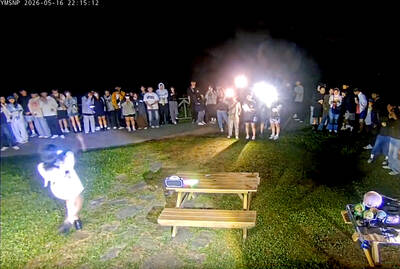
Yangmingshan National Park’s Qingtiangang (擎天崗) nature area has gone viral after a park livestream camera observed a couple in the throes of intimate congress, which was broadcast live on YouTube, drawing large late-night crowds and sparking a backlash over noise, bright lights and disruption to wildlife habitat. The area’s livestream footage appeared to show a couple engaging in sexual activity on a picnic table in the park on Friday last week, with the uncensored footage streamed publicly online. The footage quickly spread across social media, prompting a tide of visitors to travel to the site to “check in” and recreate the


 RSS
RSS