


Students and teachers staged a demonstration yesterday outside the Ministry of Education accusing it of pressuring a textbook publisher to remove pictures of demonstrations held to preserve the Losheng Sanatorium.
"No to authoritarian review systems. Defend diversity in education," demonstrators shouted as they protested.
Lee Chia-hsin (
Members of the review committee are selected by the National Institute for Compilation and Translation. Their findings are then sent to the ministry for approval.
The photos of the preservation movement were included in a section on urban development and disputes over preservation of culture in the fourth grade textbook.
"Nan-I followed the committee's suggestion and replaced them with a picture of a newspaper ad calling for the sanatorium's preservation. However, it was again advised to remove the picture," Lee said.
Chan Cheng-tao (詹政道), a member of the National Teachers' Association and a junior high school social studies teacher, condemned the ministry for "crossing the boundaries of textbook review."
"The purpose of having a textbook review is to make sure that the contents strictly follow the curriculum designed by the ministry," Chan told the crowd. "The ministry has certainly exceeded its power by asking for the removal of the pictures."
"The ministry should trust our professionalism in dealing with textbook content and leading an appropriate discussion in the classroom," said Lee Pei-hsin (李佩欣), a National Taiwan Normal University student.
Ministry officials, however, denied the allegations.
"We didn't pressure the publisher -- we always leave it to the review committee members and the publisher to discuss textbook content," deputy director Cheng Lai-chang (
Cheng said that the review committee made the suggestion about the pictures because they show "protest as the only way to resolve a controversy" and "omitted other conflict resolution methods such as public hearings, lobbying and so on."
While suggestions were made, Cheng said, "It's up to the publisher to decide what to do."

LOUD AND PROUD Taiwan might have taken a drubbing against Australia and Japan, but you might not know it from the enthusiasm and numbers of the fans Taiwan might not be expected to win the World Baseball Classic (WBC) but their fans are making their presence felt in Tokyo, with tens of thousands decked out in the team’s blue, blowing horns and singing songs. Taiwanese fans have packed out the Tokyo Dome for all three of their games so far and even threatened to drown out home team supporters when their team played Japan on Friday. They blew trumpets, chanted for their favorite players and had their own cheerleading squad who dance on a stage during the game. The team struggled to match that exuberance on the field, with
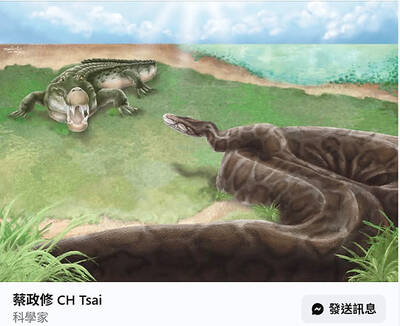
Taiwanese paleontologists have discovered fossil evidence that pythons up to 4m long inhabited Taiwan during the Pleistocene epoch, reporting their findings in the international scientific journal Historical Biology. National Taiwan University (NTU) Institute of Ecology and Evolutionary Biology associate professor Tsai Cheng-hsiu (蔡政修) led the team that discovered the largest snake fossil ever found in Taiwan. The single trunk vertebra was discovered in Tainan at the Chiting Formation, dated to between 400,000 and 800,000 years ago in the Middle Pleistocene, the paper said. The area also produced Taiwan’s first avian fossil, as well as crocodile, mammoth, saber-toothed cat and rhinoceros fossils, it said. Discoveries

Taiwanese paleontologists have discovered fossil evidence that pythons up to 4m long inhabited Taiwan during the Pleistocene epoch, reporting their findings in the international scientific journal Historical Biology. National Taiwan University (NTU) Institute of Ecology and Evolutionary Biology associate professor Tsai Cheng-hsiu (蔡政修) led the team that discovered the largest snake fossil ever found in Taiwan. A single trunk vertebra was discovered in Tainan at the Chiting Formation, dated to between 800,000 to 400,000 years ago in the Middle Pleistocene, the paper said. The area also produced Taiwan’s first avian fossil, as well as crocodile, mammoth, sabre-toothed cat and rhinoceros fossils, it said. Discoveries
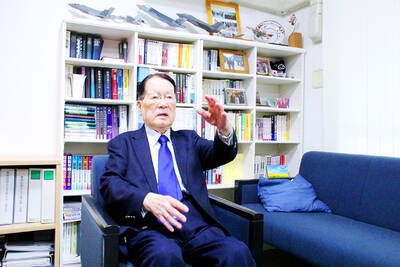
Whether Japan would help defend Taiwan in case of a cross-strait conflict would depend on the US and the extent to which Japan would be allowed to act under the US-Japan Security Treaty, former Japanese minister of defense Satoshi Morimoto said. As China has not given up on the idea of invading Taiwan by force, to what extent Japan could support US military action would hinge on Washington’s intention and its negotiation with Tokyo, Morimoto said in an interview with the Liberty Times (sister paper of the Taipei Times) yesterday. There has to be sufficient mutual recognition of how Japan could provide


 RSS
RSS