


The Taiwan Solidarity Union (TSU) is facing yet another challenge as Taipei City Councilor Chen Chien-ming (
Chen must obtain the support of a quarter of the party's 150 national representatives to make his proposal valid. He broached the subject at the party's Central Executive Committee meeting, but received a lukewarm response.
Chen Yung-hsing (
"We consider it necessary, however, to clarify any misunderstanding regarding TSU Legislator Lai Shin-yuan (賴幸媛)," he said, adding they had suggested Lai take legal action if necessary.
Former TSU Legislator David Huang (黃適卓) had demanded that the party expel Lai and nullify her candidacy for legislator-at-large, alleging that Lai was associated with members of the "red-shirt army."
The "red-shirt army" refers to members of a campaign organized last year to depose President Chen Shui-bian (陳水扁) amid corruption allegations against him, his wife and his closest aides.
TSU Chairman Huang Kun-huei (
The party's policy proposals have never deviated from the party line since, he said.
In related news, three TSU legislators yesterday asked the DPP to extend a goodwill gesture by Friday and let opinion polls decide who should represent the pan-green camp in their respective constituencies in the legislative elections in January.
The TSU plans to nominate 17 district legislative candidates to compete for the 79 slots.
Huang Kun-huei said that the party was willing to drop the nomination of Huang Chao-chan (
Huang Kun-huei, however, criticized the DPP for luring TSU members to join its ranks, including TSU Legislator Ho Min-hao (
Meanwhile, DPP Culture and Information Department Director Hsieh Hsin-ni (
The TSU also ran a half-page advertisement in yesterday's Chinese-language United Daily News, urging former TSU Legislator Liao Pen-yen (
Chen Chien-ming said it was inappropriate for the TSU to place such an ad.
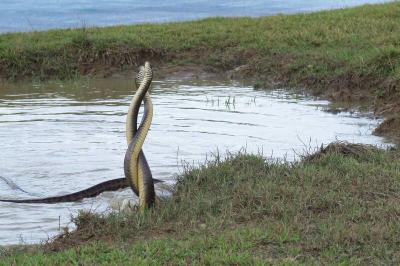
Kenting National Park service technician Yang Jien-fon (楊政峰) won a silver award in World Grand Prix Photography Awards Spring Season for his photograph of two male rat snakes intertwined in combat. Yang’s colleagues at Kenting National Park said he is a master of nature photography who has been held back by his job in civil service. The awards accept entries in all four seasons across six categories: architectural and urban photography, black-and-white and fine art photography, commercial and fashion photography, documentary and people photography, nature and experimental photography, and mobile photography. Awards are ranked according to scores and divided into platinum, gold and
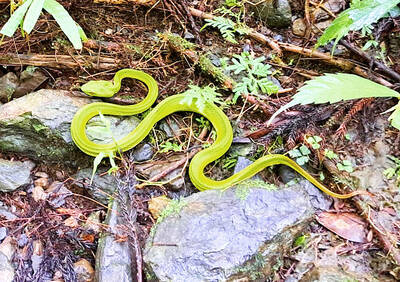
More than half of the bamboo vipers captured in Tainan in the past few years were found in the city’s Sinhua District (新化), while other districts had smaller catches or none at all. Every year, Tainan captures about 6,000 snakes which have made their way into people’s homes. Of the six major venomous snakes in Taiwan, the cobra, the many-banded krait, the brown-spotted pit viper and the bamboo viper are the most frequently captured. The high concentration of bamboo vipers captured in Sinhua District is puzzling. Tainan Agriculture Bureau Forestry and Nature Conservation Division head Chu Chien-ming (朱健明) earlier this week said that the

The Chinese Nationalist Party (KMT) caucus yesterday said it opposes the introduction of migrant workers from India until a mechanism is in place to prevent workers from absconding. Minister of Labor Hung Sun-han (洪申翰) on Thursday told the Legislative Yuan that the first group of migrant workers from India could be introduced as early as this year, as part of a government program. The caucus’ opposition to the policy is based on the assessment that “the risk is too high,” KMT caucus secretary-general Lin Pei-hsiang (林沛祥) said. Taiwan has a serious and long-standing problem of migrant workers absconding from their contracts, indicating that

SPACE VETERAN: Kjell N. Lindgren, who helps lead NASA’s human spaceflight missions, has been on two expeditions on the ISS and has spent 311 days in space Taiwan-born US astronaut Kjell N. Lindgren is to visit Taiwan to promote technological partnerships through one of the programs organized by the US for its 250th national anniversary. Lindgren would be in Taiwan from Tuesday to Saturday next week as part of the US Bureau of Educational and Cultural Affairs’ US Speaker Program, organized to celebrate the 250th anniversary of the signing of the Declaration of Independence, the American Institute in Taiwan (AIT) said in a statement yesterday. Lindgren plans to engage with key leaders across the nation “to advance cutting-edge technological partnerships and inspire the next generation of scientists and engineers,”


 RSS
RSS