


An efficient, eco-friendly technique is being used to construct a section of an overpass along the Bali-Sindian Expressway (
The 11.9km expressway is being built to ease the traffic surrounding the Port of Taipei, which is under construction in Bali.
The bureau said an incremental launching method was used for the construction of the 900m section of the Chengchou Interchange (
Chang Chung-ching (張純青), director of the bureau's first engineering office, said it was the first time the technique was being used to erect a section that would be entirely welded together.
Chang said engineers measured the distance between the two piers and determined the number of steel sections that would be needed to span them. Each block consists of seven smaller steel sections, which are of equal size and weight. These sections were then placed next to each other on a platform and welded together.
A couple of sections form a segment, and a mechanism -- such as hydraulic jacks -- will be used to push each segment forward to join the one in front, he said.
James Hu (
"Sections are transported to the construction site and are lifted up to the working platform, which leaves plenty of room on the ground," he said. "This allows construction to proceed without disrupting traffic."
Hu said that unlike concrete, steel is a recyclable material. He said if the overpass were one day torn down, the steel could be used for other purposes.
Although the project will cost twice as much as it would have if a more traditional method were used, Hu said the long-term impact of the project had to be considered.
The bureau estimated that the project will cost NT$2.78 billion (US$84.2 million).
The overpass was designed to be 22.8m wide, with two southbound lanes and two northbound lanes.
As of last month, close to 48 percent of the overpass was complete.
The bureau aims to finish the project by the end of next year.
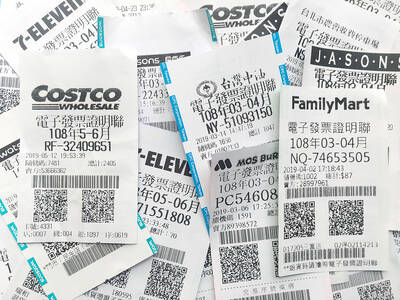
A NT$39 receipt for two bottles of tea at a FamilyMart was among the NT$10 million (US $312,969) special prize winners in the January-February uniform invoice lottery. FamilyMart said that two NT$10 million-winning receipts were issued at its stores, as well as two NT$2 million grand prizes and three NT$200,000 first prizes. The two NT$10 million receipts were issued at stores in Pingtung County and Yilan County’s Dongshan Township (冬山). One winner spent just NT$39 on two bottles of tea, while another spent NT$80 on water, tea and coffee, the company said. Meanwhile, 7-Eleven reported three NT$10 million winners — in New Taipei

Considering that most countries issue more than five denominations of banknotes, the central bank has decided to redesign all five denominations, the bank said as it prepares for the first major overhaul of the banknotes in more than 24 years. Central bank Governor Yang Chin-lung (楊金龍) is expected to report to the Legislative Yuan today on the bank’s operations and the redesign’s progress. The bank in a report sent to the legislature ahead of today’s meeting said it had commissioned a survey on the public’s preferences. Survey results showed that NT$100 and NT$1,000 banknotes are the most commonly used, while NT$200 and NT$2,000

ANNUAL EVENT: Two massive Pokemon balloons are to be set up in Daan Park, with an event zone operating from 10am to 6pm This year’s Taipei Floral Picnic is to be held at Daan Park today and tomorrow, featuring an exclusive Pokemon Go event, a themed food market, a coffee rave picnic area and stage performances, the Taipei Department of Information and Tourism said yesterday. Two massive Pokemon balloons are to be set up in the park as attractions, with an exclusive event zone operating from 10am to 6pm, it said. Participants who complete designated tasks on-site would have a chance to receive limited-edition souvenirs, it added. People could also try the newly launched game Pokemon Pokopia in the trial area, the department said. Three PokeStops are

The Centers for Disease Control (CDC) yesterday reported the first case of a new COVID-19 subvariant — BA.3.2 — in a 10-year-old Singaporean girl who had a fever upon arrival in Taiwan and tested positive for the disease. The girl left Taiwan on March 20 and the case did not have a direct impact on the local community, it said. The WHO added the BA.3.2 strain to its list of Variants Under Monitoring in December last year, but this was the first imported case of the COVID-19 variant in Taiwan, CDC Deputy Director-General Lin Ming-cheng (林明誠) said. The girl arrived in Taiwan on


 RSS
RSS