


A ban on paper cups will take effect in government institutions and in schools tomorrow, but it will not extend to the Legislative Yuan.
Ironically, of the 140 million paper cups consumed in the country on average each year, one million are used in the legislature.
"The consumption of paper cups in the legislature is excessive. An average of 5,000 paper cups are used every day during the legislative session," a legislative staffer said on condition of anonymity.
Activists have urged lawmakers to obey the regulation voluntarily, a call that has fallen on deaf ears.
The Environmental Protection Administration (EPA) said that the amount of paper cups used in all of the nation's government facilities and schools last year was 35 million, or 25 percent of the nation's total consumption.
The EPA decided to regulate the use of paper cups last month with the aim of achieving a 50 percent reduction in their use next year and a 75 percent reduction in 2009.
The regulation bans paper cups and packaged drinking water in the Executive Yuan, all government ministries and all schools, hospitals, libraries, district administration offices, culture and recreation centers and public venues owned by local governments.
Meetings in these locations are not allowed to use paper cups and packaged drinking water unless attended by more than 40 people.
Central government agencies not named in the regulations are not required to comply with the policy.
The Presidential Office, Judicial Yuan, Control Yuan and the Examination Yuan are exempt from the ban.
Tien Chiu-chin (
Tien also said that the legislature shouldn't have exempted itself from the regulation.
"For one thing, as a legislative body, it should set a good example by observing the regulations it passes," she said. "More importantly, following the regulation is a way to protect natural resources."
The 1 million paper cups consumed in the legislature each year weigh around 5,890kg. Producing that many cups emits 12.66 tonnes of carbon dioxide into the atmosphere annually -- higher than the annual carbon dioxide emissions per capita in the country -- an EPA study said.
Third-highest
The 11.9 tonnes of annual carbon dioxide emitted per capita in Taiwan in 2005 ranked third-highest in the world, following the 19.9 tonnes in the US and the 19.4 tonnes in Australia, far above the global per capita emission of 3.9 tonnes
The study also mentioned that the production of paper cups causes severe damage to forest resources, as paper cups cannot be made from recycled paper.
Papers cups are made of long-fiber wood pulp that comes from coniferous trees and shrubs, the EPA said.
The EPA suggested that government offices and schools substitute reusable cups for paper cups, saying that a cup-washing machine costs NT$60,000 to NT$100,000 and can have 1,400 reusable cups cleaned, dried at a temperature from 80oC to 90oC and sterilized in an hour.
Huang Chao-i (黃兆儀) of the Legislative Yuan's General Affairs office said it was impractical to subject the legislature to the ban on paper cups.
"The quantity of paper cups demanded is huge here," he said. "Many conferences and hearings are held and many lawmakers invite their supporters to tour the legislature. We have to receive several hundred visitors every day and the figure was once as high as 2,000 a day."
Huang said he doubted that cup-washing machines would be able to process that many reusable cups each day, which could lead to sanitary problems.
"I have sounded people out on this issue and many told me that they dare not use reusable cups here as there are too many people going in and out of the legislature," he said.
The legislature began using paper cups in place of water glasses after an incident in the early 1990s in which former legislative speaker Liang Su-yung (
Open to question
Huang also said that the Executive Yuan's method of pursuing a ban on paper cups had left it open to question.
"If it wanted to carry out the policy in earnest, why didn't it turn the regulation a piece of legislation? As an administrative order, the regulation is non-binding," he said.
Taiwan Environmental Protection Union secretary-general Ho Tsung-hsun (
"It's a good policy and thus the legislature should take the lead in obeying the regulation and putting it into operation rather than evading it with thousands of excuses," Ho said.
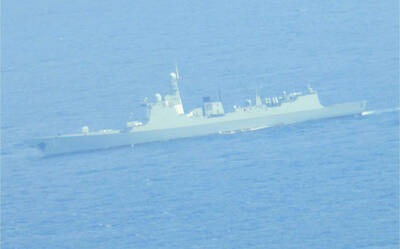
The military has spotted two Chinese warships operating in waters near Penghu County in the Taiwan Strait and sent its own naval and air forces to monitor the vessels, the Ministry of National Defense (MND) said. Beijing sends warships and warplanes into the waters and skies around Taiwan on an almost daily basis, drawing condemnation from Taipei. While the ministry offers daily updates on the locations of Chinese military aircraft, it only rarely gives details of where Chinese warships are operating, generally only when it detects aircraft carriers, as happened last week. A Chinese destroyer and a frigate entered waters to the southwest
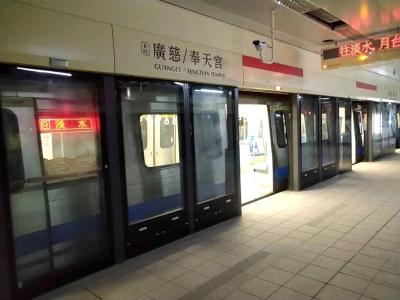
The eastern extension of the Taipei MRT Red Line could begin operations as early as late June, the Taipei Department of Rapid Transit Systems said yesterday. Taipei Rapid Transit Corp said it is considering offering one month of free rides on the new section to mark its opening. Construction progress on the 1.4km extension, which is to run from the current terminal Xiangshan Station to a new eastern terminal, Guangci/Fengtian Temple Station, was 90.6 percent complete by the end of last month, the department said in a report to the Taipei City Council's Transportation Committee. While construction began in October 2016 with an
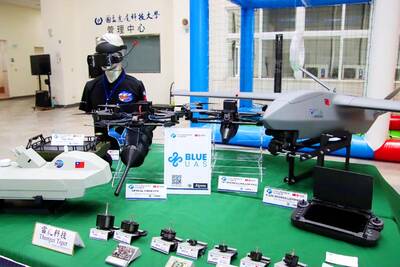
NON-RED SUPPLY: Boosting the nation’s drone industry is becoming increasingly urgent as China’s UAV dominance could become an issue in a crisis, an analyst said Taiwan’s drone exports to Europe grew 41.7-fold from 2024 to last year, with demand from Ukraine’s fight against Russian aggression the most likely driver of growth, a study showed. The Institute for Democracy, Society and Emerging Technology (DSET) in a statement on Wednesday said it found that many of Taiwan’s uncrewed aerial vehicle (UAV) sales were from Poland and the Czech Republic. These countries likely transferred the drones to Ukraine to aid it in its fight against the Russian invasion that started in 2022, it said. Despite the gains, Taiwan is not the dominant drone exporter to these markets, ranking second and fourth

Japanese Prime Minister Sanae Takaichi’s comment last year on Tokyo’s potential reaction to a Taiwan-China conflict has forced Beijing to rewrite its invasion plans, a retired Japanese general said. Takaichi told the Diet on Nov. 7 last year that a Chinese naval blockade or military attack on Taiwan could constitute a “survival-threatening situation” for Japan, potentially allowing Tokyo to exercise its right to collective self-defense. Former Japan Ground Self-Defense Force general Kiyofumi Ogawa said in a recent speech that the remark has been interpreted as meaning Japan could intervene in the early stages of a Taiwan Strait conflict, undermining China’s previous assumptions


 RSS
RSS