


After spirited debate, the legislature's Health, Environment and Social Welfare Committee yesterday agreed to extend the maximum allowable stay for foreign laborers to nine years from the previous maximum of six years.
The new limit will apply to all blue-collar and domestic workers pending second and third readings in the legislature.
The original proposal by Democratic Progressive Party (DPP) legislators Wang Sing-nan (王幸男) and Wang Shu-hui (王淑慧) called for the limit to be scrapped altogether, as the lawmakers argued that the change would increase productivity.
"We have foreign laborers to thank for the fact that we still have a manufacturing industry here in Taiwan. We have to thank them for generating jobs for Taiwanese, not taking jobs away," Taiwan Solidarity Union Legislator Huang Chung-yung (
Huang cited the case of CLC Industrial, a maker of nuts and fasteners that has remained in Taiwan while many competitors decamped for Indonesia or China.
"My business hit rock-bottom in 1990 because of the difficulty in finding enough Taiwanese workers," said Richard Chen (陳永和), general manager of CLC industrial. "I was on the verge of going out of business before I turned to foreign workers."
"Now I employ six foreign workers ... and 40 Taiwanese," Chen said.
Workers only come into their own after years of training, Chen said, meaning that Taiwanese factory owners lose highly valued employees if the workers have to leave after six years.
"I've heard that Korean factory-owners pay a US$100 a month premium for workers who have previously worked in Taiwan. They are benefiting from the workers we trained," he said.
In addition to industrial workers, Huang said the rule change was also important for Taiwanese families who employ domestic workers from abroad.
"For some elderly people, it is difficult to get used to a new caretaker," he said.
However, other legislators as well as Council of Labor Affairs (CLA) representatives were concerned that allowing foreign laborers to stay indefinitely would pose social and human-rights problems.
CLA Deputy Chairman Tsao Ai-lan (曹愛蘭) cited the situation in Germany, where he said "guest workers" had developed into a poorly integrated immigrant population.
DPP Legislator Huang Sue-ying (
"It's arrogant to say that because we have the money we can keep people away from their families for as long as we want. That is taking advantage of their economic desperation," she said.
However, she described her position as "conflicted," saying that she understood the desires of Taiwanese families and employers to hang on to their foreign employees for longer.

The military has spotted two Chinese warships operating in waters near Penghu County in the Taiwan Strait and sent its own naval and air forces to monitor the vessels, the Ministry of National Defense (MND) said. Beijing sends warships and warplanes into the waters and skies around Taiwan on an almost daily basis, drawing condemnation from Taipei. While the ministry offers daily updates on the locations of Chinese military aircraft, it only rarely gives details of where Chinese warships are operating, generally only when it detects aircraft carriers, as happened last week. A Chinese destroyer and a frigate entered waters to the southwest
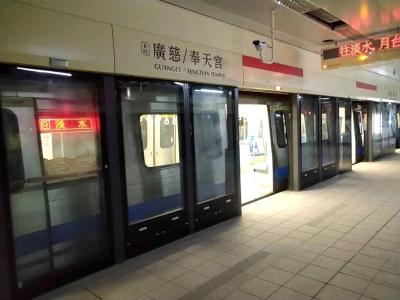
The eastern extension of the Taipei MRT Red Line could begin operations as early as late June, the Taipei Department of Rapid Transit Systems said yesterday. Taipei Rapid Transit Corp said it is considering offering one month of free rides on the new section to mark its opening. Construction progress on the 1.4km extension, which is to run from the current terminal Xiangshan Station to a new eastern terminal, Guangci/Fengtian Temple Station, was 90.6 percent complete by the end of last month, the department said in a report to the Taipei City Council's Transportation Committee. While construction began in October 2016 with an
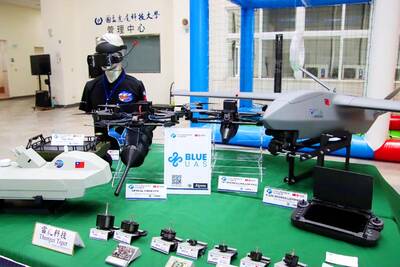
NON-RED SUPPLY: Boosting the nation’s drone industry is becoming increasingly urgent as China’s UAV dominance could become an issue in a crisis, an analyst said Taiwan’s drone exports to Europe grew 41.7-fold from 2024 to last year, with demand from Ukraine’s fight against Russian aggression the most likely driver of growth, a study showed. The Institute for Democracy, Society and Emerging Technology (DSET) in a statement on Wednesday said it found that many of Taiwan’s uncrewed aerial vehicle (UAV) sales were from Poland and the Czech Republic. These countries likely transferred the drones to Ukraine to aid it in its fight against the Russian invasion that started in 2022, it said. Despite the gains, Taiwan is not the dominant drone exporter to these markets, ranking second and fourth

Japanese Prime Minister Sanae Takaichi’s comment last year on Tokyo’s potential reaction to a Taiwan-China conflict has forced Beijing to rewrite its invasion plans, a retired Japanese general said. Takaichi told the Diet on Nov. 7 last year that a Chinese naval blockade or military attack on Taiwan could constitute a “survival-threatening situation” for Japan, potentially allowing Tokyo to exercise its right to collective self-defense. Former Japan Ground Self-Defense Force general Kiyofumi Ogawa said in a recent speech that the remark has been interpreted as meaning Japan could intervene in the early stages of a Taiwan Strait conflict, undermining China’s previous assumptions


 RSS
RSS