


Not all of his offhand proposals have met with disaster, but when Tu Cheng-sheng (
A protege of former president Lee Teng-hui (李登輝), Tu proved unpopular as head of the Ministry of Education from the start with the pan-blue camp, ruffling their feathers in 2004 with his proposal that Taiwan maps be rotated 90 degrees counter-clockwise in schools nationwide.
With the country's north no longer on top, Tu argued, students could appreciate Taiwan from a fresh, "fairer" angle.
In recent weeks, his critics have compared Tu to US President George W. Bush for his allegedly faulty command of Mandarin.
Notorious for his slips of the tongue, Bush is a model to whom Tu aspires by misquoting and making up Chinese idioms, critics alleged.
Last week, Tu defended his ministry's listing of the phrase "three little pigs" in its online classical idioms dictionary, insisting that the saying -- apparently from the Western fairy tale by the same name -- was indeed a classical Chinese idiom.
"For example, if I saw a student slacking off, I could say to him, `Don't be like the oldest of the three little pigs.' You see, that's an idiom," Tu reportedly said.
Incidentally, in the fairy tale The Three Little Pigs, the oldest pig character outsmarts a villainous wolf by being hardworking.
Tu's allegedly iffy grasp of idioms prompted pan-blue lawmakers to cook up their own "idiom" last week: "To pull a Tu Cheng-sheng," referring to verbal gaffes exposing one's ignorance.
With character-building ranking high on the education ministry's education reform agenda, Tu's ethics-based curricula have also recently met with a string of sex scandals involving teachers.
Still reeling from reports earlier this month that two Kaohsiung high school teachers had raped their students, the ministry was again hit with reports on Thursday, just as news of Tu's son broke, that a Hsinchu elementary school teacher had fondled his pupils. Another Kaohsiung teacher was suspended on Jan. 15 for encouraging his middle school students to drink alcohol.
The latest storm in which Tu was caught was on Thursday after the tabloid newspaper Apple Daily allegedly spotted Tu's 27-year-old son partying with scantily clad escort girls in a private Taipei bar.
Engaging TV reporters in an angry tug of war for their microphones after being asked to comment on the incident, Tu said: "It has nothing to do with me."
For Tu's critics, however, his son Tu Ming-yi's (
"This is a travesty of justice! Tu Ming-yi got off easy because his daddy is a minister," Chinese Nationalist Party (KMT) Legislator Lin Yu-fang (
Currently performing mandatory military service, Tu Ming-yi violated servicemen conduct codes by patronizing the bar, defense officials said.
Tu Ming-yi's superior, Political Warfare Brigade Commander Wang Tien-yang (
"Tu Cheng-sheng can't even educate his own son; how is he to improve education nationwide?" KMT Legislator Hung Hsiu-chu (
As a fierce proponent of the "de-Sinicization" of education, Tu enjoys support from pan-green lawmakers, who are now speaking up on behalf of the embattled minister.
"Tu Ming-yi is an adult, and this a family matter," Democratic Progressive Party (DPP) Legislator Lin Shu-fen (
"Minister Tu should give Tu junior a good spanking, and let that be the end of it," DPP Legislator Wang Sing-nan (
With his meetings canceled following reports that Tu Ming-yi used his father's credit card during his controversial outing, Minister Tu is laying low.
The education head hasn't returned to his office since commandeering eight microphones from a mob of reporters on Thursday, and his ministry has yet to issue a statement on the matter.
When asked for comments yesterday, Premier Su Tseng-chang (
Su said Tu Cheng-sheng had phoned him and told him that he was troubled by his son's problem.
It is understandable how a father would feel given the trouble caused by his son, Su added.
Additional reporting by Jimmy Chuang

FUKUOKA SITUATION: Japanese media reported that the pathogen is expected to be identified by the summer, while the CDC downplayed the idea that it was hMPV A “mysterious cold-like illness” reported in Japan’s Fukuoka Prefecture does not seem to be a new disease, but Japanese authorities have been asked about the situation, the Centers for Disease Control (CDC) said yesterday. The Fukuoka Prefectural Medical Association on Wednesday told a news conference that a “mystery cold” that has become a hot topic on social media is “highly likely to be caused by some kind of viral infection,” Japan’s KBC News reported. “Many people are experiencing symptoms starting with a sore throat, followed by a runny nose, phlegm and a severe cough,” KBC News reported, citing association officials. Health authorities are

Nvidia Corp CEO Jensen Huang (黃仁勳) arrived in Taiwan yesterday ahead of upcoming AI and technology events, saying he plans to meet with clients and Taiwan Semiconductor Manufacturing Co Chairman C.C. Wei (魏哲家) during his visit. After landing at Taipei Songshan Airport, Huang posed for photos with fans and handed out Yakult drinks to reporters and supporters waiting at the scene, saying he has “a lot to do” during the trip. Asked about reports that Nvidia’s planned headquarters site in Taipei’s Beitou Shilin Technology Park could break ground on May 27, Huang said that if the company holds an event, he would

The Ministry of Finance this afternoon announced the winning numbers for the March-April uniform invoice lottery. The winning number for the NT$10 million (US$318,060) special prize is 19531471, and the winning number for the NT$2 million grand prize is 85941329. Three numbers were drawn for the NT$200,000 first prize: 07225810, 20231230 and 83518781. Those with receipts matching the last seven digits of any of the first-prize numbers will win the NT$40,000 second prize, while those matching the last six digits will win the NT$10,000 third prize. Those whose receipts match the last five digits of the first-prize numbers can claim the NT$4,000 fourth prize,
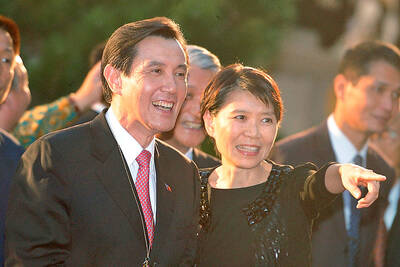
Former president Ma Ying-jeou (馬英九) yesterday expressed “shock and regret” over a statement issued by his wife without his consent, and rejected her assertion that his eldest sister, Ma Yi-nan (馬以南), would manage his medical care or act as his spokesperson amid an ongoing embezzlement probe into his foundation. Ma Ying-jeou in a statement said he was shocked by a statement by his wife, Chou Mei-ching (周美青), regarding his affairs. Ma Yi-nan “must not” be in charge of his healthcare and other personal affairs, nor can she be allowed to represent the Ma family, the former president said. He said he was also


 RSS
RSS