

The number of women smokers has risen and more girls under the age of 15 are lighting up, with psychological factors such as low self-esteem to blame, the Department of Health has found.
According to Bureau of Health Promotion figures, 4.76 percent of women over the age of 18 smoked regularly last year, while up to 5.84 percent had smoked in the past.
Although only a slight increase from the 4.54 percent figure recorded in 2004, bureau officials were concerned because the number of female smokers has been rising steadily over the years.

PHOTO: LO PEI-DER, TAIPEI TIMES
Deputy Director of the health department Wang Hsiu-hong (王秀紅), speaking at a press conference to address the issue, said women were plagued with smoking-related illnesses not only from smoking, but also because the high percentage of male smokers in the country, at 39.88 percent, means women are victims of secondhand smoke.
Wang added that cigarette companies are now targeting women, which was another reason for the increase in female smokers.
Bureau figures also showed that 54.20 percent of women smokers wanted to quit. In addition, 37.29 percent said they were exposed to secondhand smoke at home, while 25.54 percent said they were exposed at work.
The bureau also found that 4.2 percent of junior high school girls between the ages of 13 and 15 smoked, a rate almost as high as that of adults.
Up to 38 percent of junior high school students had tried their first cigarette before the age of 10, it found.
Chang Ching-ching (
Of these smokers, most came from blue-collar families, had bad parent-child relationships, were depressed or had low self-esteem, Chang said.
This differentiated them from high school boys, as Chang said the reasons high school boys smoke usually do not include low self-esteem.
Girls who smoke are mainly affected by psychological issues and need more support from parents and teachers, she said.
Also, 55.6 percent of the 1,415 girls polled said they had purchased cigarettes from convenience stores, Chang said.
Chao Kun-yu (
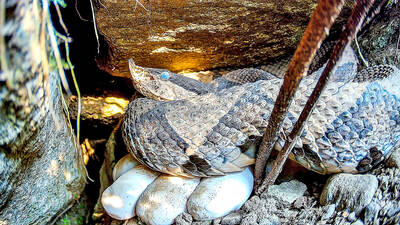
NATURE TAKES ITS COURSE: The agency’s head said he felt a sense of loss watching red-banded snakes eat the babies, as they had decided on non-intervention The Forestry and Nature Conservation Agency yesterday released a documentary on a hundred-pace viper that had incubated 16 eggs, all of which hatched, but only a baby viper escaped after they were attacked by red-banded snakes. The agency’s Taichung branch last year launched the viper reproduction monitoring project soon after forest rangers Lin Chun-yu (林俊佑) and Chou Chia-cheng (周家成) spotted a pregnant hundred-pace viper in a grass-covered burrow near a parking lot in Tbulan Village (松鶴部落). The Atayal village, in Taichung’s Heping District (和平), is headed by Ecyang Yapu, who was positive about the project and assisted in access control and power

The Coast Guard Administration (CGA) yesterday said that it had deployed vessels to “monitor” Chinese ships operating in waters off the east coast. The CGA said it dispatched vessels in response to a China Coast Guard announcement that it had carried out another “routine law-enforcement patrol” in waters off the east coast. “The CGA firmly rejects China’s cognitive warfare campaign of ‘law enforcement in name, jurisdictional expansion in practice,’” it said on X. As of 11am yesterday, two China Coast Guard ships were “loitering and drifting” about 105 nautical miles (195km) and 74 nautical miles east of Green Island (綠島) respectively, it said. It
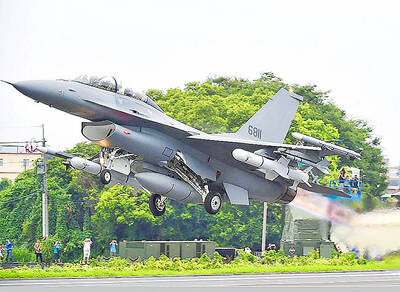
A sharp rise in compensation to be paid by air force officers who leave before completing their required service could indicate an increase in pilots leaving the military early, an analyst said on Friday, warning that the trend could worsen a shortage of experienced personnel. Chieh Chung (揭仲), a researcher at the Association for Strategic Foresight, issued the warning even though the number of volunteer military personnel is expected to increase next year. The planned headcount for volunteer military personnel, covering officers, noncommissioned officers (NCO) and enlisted soldiers, is 158,223 for next year, up 4,258 from 153,965 this year, Chieh said. The increase
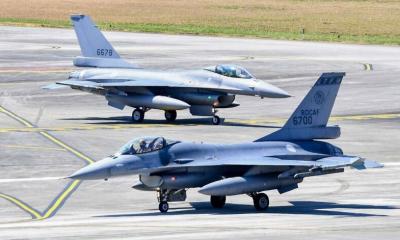
The first two F-16V Block 70 jets Taiwan purchased from the US were spotted unexpectedly turning back after departing from Hawaii yesterday, potentially further delaying delivery of the aircraft. Taiwan has purchased 66 of the F-16 C/D Block 70 jets to be deployed at Chihhang Air Base (志航基地) in Taitung County and operated by the air force's 7th Tactical Fighter Wing to defend Taiwan’s eastern region. Two single-seat jets, bearing serial No. 6727 and 6728, were spotted taking off from Hickam Field in Hawaii yesterday, observers said. Based on the precedent set during the delivery of Taiwan's older F-16 Block 20s, the new


 RSS
RSS