


A magnitude 6.2 earthquake struck early yesterday morning in Taitung County, waking people up as far away as central and southern Taiwan, the Central Weather Bureau (CWB) reported.
According to the Seismology Center, the earthquake rattled eastern Taiwan for about 30 seconds at 6:40am.
The epicenter of the jolt was said to have been located 19.9km northeast of Taitung.
The quake occurred at a depth of 11.7km beneath the surface of the sea, seismologists said.
Because the quake occurred in a relatively shallow area, it was felt in almost every area in eastern, central and southern parts of the island.
The shock waves penetrated beneath the Central Mountain Range to reach as far as Penghu Island.
As of 9am yesterday, no damage or injuries had been reported, although officials were still checking to see if the tremor caused any landslides or falling rocks.
The quake is the second with a magnitude greater than 6 to rattle the nation in the last two weeks.
According to Kuo Kai-wen (郭鎧紋), director of the Seismology Center, as the geological structure underneath and offshore of the eastern coast is uniquely complex, earthquakes in those areas could be the results of both squeezing and rupturing actions when the Pacific Plate and the Eurasian Plate collide, and when another deep-sea fault is broken.
The earthquake had an intensity of 5 in Taitung and Hualien counties, 4 in Taitung City, 3 in Taichung, Nantou and Yunlin counties as well as in Chiayi, Tainan, Kaohsiung and Pingtung counties, 2 in Yilan County, Miaoli County and Tainan City, and 1 on Penghu Island.
Earlier the US Geological Survey had put the quake's magnitude at 5.8, with its epicenter 260km south of Taipei.
At least 51 people were injured by falling objects when an earthquake with a magnitude of 6.4 jolted Taitung on April 8.
Taiwan lies near the junction of two tectonic plates and is regularly shaken by earthquakes.
The country's worst, a magnitude 7.6 quake, killed some 2,400 people in September 1999.
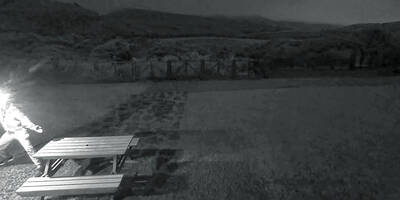
Yangmingshan National Park authorities yesterday urged visitors to respect public spaces and obey the law after a couple was caught on a camera livestream having sex at the park’s Qingtiangang (擎天崗) earlier in the day. The Shilin Police Precinct in Taipei said it has identified a suspect and his vehicle registration number, and would summon him for questioning. The case would be handled in accordance with public indecency charges, it added. The couple entered the park at about 11pm on Thursday and began fooling around by 1am yesterday, the police said, adding that the two were unaware of the park’s all-day live

A former soldier and an active-duty army officer were yesterday indicted for allegedly selling classified military training materials to a Chinese intelligence operative for a total of NT$79,440. The Taipei District Prosecutors’ Office indicted Chen Tai-yin (陳泰尹) and Lee Chun-ta (李俊達) for contravening the National Security Act (國家安全法) and the Anti-Corruption Act (貪污治罪條例). Chen left the military in September 2013 after serving alongside then-staff sergeant Lee, now an army lieutenant, at the 21st Artillery Command of the army’s Sixth Corps from 2011 to 2013, according to the indictment. Chen met a Chinese intelligence operative identified as “Wang” (王) through a friend in November

Minister of Digital Affairs Lin Yi-ching (林宜敬) yesterday cited regulatory issues and national security concerns as an expert said that Taiwan is among the few Asian regions without Starlink. Lin made the remarks on Facebook after funP Innovation Group chief executive officer Nathan Chiu (邱繼弘) on Friday said Taiwan and four other countries in Asia — China, North Korea, Afghanistan and Syria — have no access to Starlink. Starlink has become available in 166 countries worldwide, including Ukraine, Malaysia, the Philippines and Vietnam, in the six years since it became commercial, he said. While China and North Korea block Starlink, Syria is not
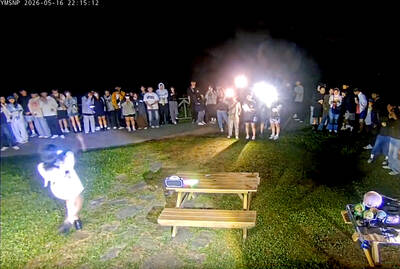
Yangmingshan National Park’s Qingtiangang (擎天崗) nature area has gone viral after a park livestream camera observed a couple in the throes of intimate congress, which was broadcast live on YouTube, drawing large late-night crowds and sparking a backlash over noise, bright lights and disruption to wildlife habitat. The area’s livestream footage appeared to show a couple engaging in sexual activity on a picnic table in the park on Friday last week, with the uncensored footage streamed publicly online. The footage quickly spread across social media, prompting a tide of visitors to travel to the site to “check in” and recreate the


 RSS
RSS