


Chinese Nationalist Party Chairman (KMT) Ma Ying-jeou (
Ma made the remarks in a news conference at CKS International Airport yesterday morning upon his return from Europe.
Ma and a team of of Taipei City Government administrators went to Europe for 13 days to attract foreign investment for Taipei, visiting the UK, Belgium, Italy, Switzerland, Germany and Ireland.
Although the trip was for the city government, Ma consistently discussed cross-strait relations, which sparked criticisms back home.
To resolve the controversy over whether the KMT is in favor of Taiwan's independence or not, Ma spent some time at the news conference explaining that the party has never seen independence as an option, although some Taiwanese people may disagree.
"The people of Taiwan have different views on the political spectrum and each can have his or her say in a democratic society," Ma said. "The KMT maintains the status quo."
"I have never changed my stance on cross-strait relations. Ten years ago, I said that we should neither pursue immediate reunification nor permanent separation. Ten years later, I still hold the same opinion," Ma said.
"Taiwan should maintain the status quo and I don't think we can achieve either independence or reunification at this point," he said.
"Reunifying [with China] has to wait until the conditions of both sides turn mature and has to be consented by the people of Taiwan," Ma said.
The KMT leader also proposed a new political viewpoint for Taiwan -- "maintaining the status quo, calling a truce over the question of independence or reunification, opening up links with China and all of the people of Taiwan working together on these goals."
The KMT leader said he had come up with the viewpoint during his European trip.
"I think the bottom line of the status quo is President Chen Shui-bian's (
"I also opposed China's `Anti-Secession' Law, which is a change in the status quo," he said.
"Both sides should not change the status quo unilaterally. This is a policy that is supported by the US, Japan and China." Ma said. "I wonder why Taiwan is opposed to it. Wouldn't it be odd to create a surprise for our friends and make China feel strange?" Ma said.
He warned that Chen will have to accept the consequences of abolishing the National Unification Council as the opposition parties cannot do much about the proposal.
"Even though we are the opposition, we don't want to mess up Taiwan," Ma said.
"The US has made it clear that the president might have to take responsibility for the aftermath [of abolishing the council]. We hope to see the government stick to its five noes commitment and expend its energies on interaction between Taiwan and China," he said.
Legislative Speaker Wang Jin-pyng (
"[Ma and I] both believe that the status quo is the best choice for the country. As for options either for unification or for independence, it should be decided by the people in the future," he said.
People First Party (PFP) Legislator Chang Hsien-yao (
Democratic Progressive Party caucus whip Chen Chin-jun (陳景峻), however, said that Ma should realize the fact that China will never offer Taiwan its goodwill even though Taiwan reiterates the "four noes and one not" pledge.
"How many times has the president made the pledge since he took office in 2000? Regardless, China passed its Anti-Secession Law last year," Chen said. "We don't have to lower ourselves by sticking to the pledge."
Ma on unification
Dec. 13, 2005
In an interview in "Newsweek," Ma says the Chinese Nationalist Party's (KMT) eventual goal is to unify Taiwan with China although the KMT has no time line for that goal.
Feb. 11
When asled by a student at a forum at Cambridge Universtiy, Ma says he agreed that Taiwan should not negotiate with China if Beijing does not remove the missiles targeted at Taiwan.
Feb. 13
Ma says he will not stop his efforts to seek peace with China, even though there are 700 missiles aimed at Taiwan. Only with continuous negotiations can a breakthrough be made in cross-strait peace, he says.
Feb. 14
The KMT runs a newspaper ad stating that "the KMT firmly believes that there are many options for Taiwan's future, be it reunification, independence or the status quo. Taiwan's future should be determined by its people.
Feb. 15
Ma defends the ad, saying that for some people in Taiwan, independence is an option, but it is not the choice of the KMT, which upholds "maintaining the status quo." "We would discuss the unification issue when the conditions become mature," Ma says.
Feb. 19
Ma says the KMT has never seen Taiwan's independence as an option and has been upholding "maintaining the status quo," which is not to pursue immediate unification or permanent separation.
Additional reporting by Shih Hsiu-chuan
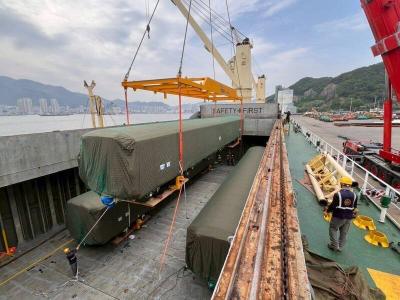
The first of 10 new high-capacity trains purchased from South Korea’s Hyundai Rotem arrived at the Port of Taipei yesterday to meet the demands of an expanding metro network, Taipei Rapid Transit Corp (TRTC) said yesterday. The train completed a three-day, 1,200km voyage from the Port of Masan in South Korea, the company said. Costing NT$590 million (US$18.79 million) each, the new six-carriage trains feature a redesigned interior based on "human-centric" transportation concepts, TRTC said. The design utilizes continuous longitudinal seating to widen the aisles and optimize passenger flow, while also upgrading passenger information displays and driving control systems for a more comfortable

AGING: While Japan has 22 submarines, Taiwan only operates four, two of which were commissioned by the US in 1945 and 1946, and transferred to Taiwan in 1973 Taiwan would need at least 12 submarines to reach modern fleet capabilities, CSBC Corp, Taiwan chairman Chen Cheng-hung (陳政宏) said in an interview broadcast on Friday, citing a US assessment. CSBC is testing the nation’s first indigenous defense submarine, the Hai Kun (海鯤, Narwhal), which is scheduled to be delivered to the navy next month or in July. The Hai Kun has completed torpedo-firing tests and is scheduled to undergo overnight sea trials, Chen said on an SET TV military affairs program. Taiwan would require at least 12 submarines to establish a modern submarine force after assessing the nation’s operational environment and defense
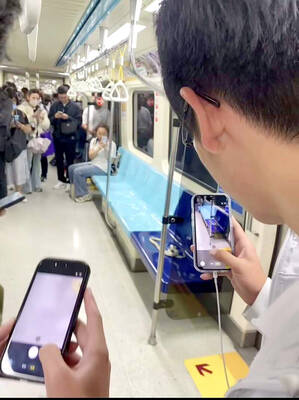
A white king snake that frightened passengers and caused a stir on a Taipei MRT train on Friday evening has been claimed by its owner, who would be fined, Taipei Rapid Transit Corp (TRTC) said yesterday. A person on Threads posted that he thought he was lucky to find an empty row of seats on Friday after boarding a train on the Bannan (Blue) Line, only to spot a white snake with black stripes after sitting down. Startled, he jumped up, he wrote, describing the encounter as “terrifying.” “Taipei’s rat control plan: Release snakes on the metro,” one person wrote in reply, referring
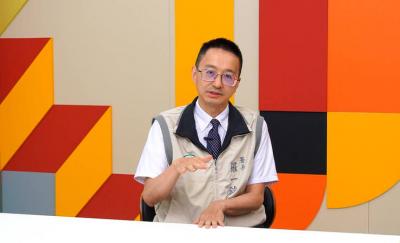
Taiwan’s two cases of hantavirus so far this year are on par with previous years’ case numbers, and the government is coordinating rat extermination work, so there should not be any outbreaks, Centers for Disease Control (CDC) Director-General Philip Lo (羅一鈞) said today in an interview with the Liberty Times (the Taipei Times’ sister newspaper). An increase in rat sightings in Taipei and New Taipei City has raised concerns about the spread of hantavirus, as rats can carry the disease. In January, a man in his 70s who lived in Taipei’s Daan District (大安) tested positive posthumously for hantavirus, Taiwan’s


 RSS
RSS