


Warning that Chinese Nationalist Party (KMT) Chairman Lien Chan's (連戰) visit to China might have grave repercussions, Vice President Annette Lu (呂秀蓮) yesterday said that China's invitation was an arrangement aimed at unification but cloaked in the name of peace.
She said people should pay close attention to the development of cross-strait relations, not on the commotion at CKS International Airport.
"Cross-strait relations have changed a lot since Beijing passed the `Anti-Secession' Law. It is confusing and stunning for the KMT to switch its political stance from opposing communism to leaning toward communism," Lu said at the DPP Central Standing Committee's weekly meeting yesterday afternoon.
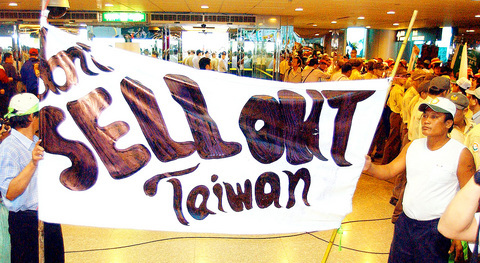
PHOTO: AFP
"The first part of the Anti-Secession Law is to facilitate unification. Inviting the opposition leaders to visit China is just part of its [Beijing's] ploys in the name of peace," Lu said.
"The second half of the law will be objecting to Taiwan's independence with force. We have to use a lot of caution in dealing with the new cross-strait situation," she said.
"Comparing with the changing cross-strait situation, the conflicts that broke out at the airport this morning were a petty thing," Lu said.
Lu said the KMT's U-turn -- with its leaders rushing to China -- reminded her of the recent train accident in Japan after the train took a sudden turn.
"Although Lien has stressed that his trip is a peace journey, the so-called `peace' in China's eye is to demand that Taiwan accept that it is part of China," Lu said. "I'm worried that Lien's visit might have the same outcome as the Japanese train accident -- major casualties."
Meanwhile, DPP Deputy Secretary-General Yen Wan-ching (
"Lien and Soong's trips have created great contention and controversy in Taiwan," Yen said. "We hope that this will remind them not to violate the voice of the majority in Taiwan."
Taiwan Solidarity Union TSU Secretary-General Chen Chien-ming (
"The police's security was full of loopholes and their blockade strategy was not effective at all," Chen said angrily at a news conference at the TSU's headquarters after its protesters returned from the airport.
"The TSU supporters stayed in the areas set out by the police. However, many pan-blue supporters -- who we suspect are gangsters -- hid in the throng and attacked us," Chen said.
He said about five TSU supporters had suffered bloody head injuries and were believed to have been assaulted by gangsters wearing rings with a tiger-head design.
Chen also pointed a finger at DPP Legislator Wang Shih-chien (王世堅), accusing him of inciting his supporters to clash with the pan-blue crowds. Chen said TSU's supporters were being scapegoated.
In response, Yen said that this was not the time for the pan-green camp to start blaming one another.

NATIONAL SECURITY: Authorities are working to confirm the identities of the military personnel involved and investigating possible illegal conduct and regulatory violations Authorities are probing possible national security implications after Kinmen police and immigration officers on Sunday found a Chinese woman allegedly posing as a tourist while engaging in prostitution involving more than 10 military personnel. The woman, surnamed Chen (陳), has since been deported, authorities said, adding that investigators are still working to confirm the identities of those implicated, as the records only listed code names and aliases. The case stemmed from a report received by the Kinmen District Prosecutors’ Office on Friday last week from the Jinhu Precinct of the Kinmen County Police Bureau. On Sunday, police, along with the National Immigration

GLOBALGIVING: ‘ Caving to external pressure is not acceptable for an organization that has cultivated justice reform and human rights for 30 years,’ one NGO said A slew of non-government organizations (NGOs) have withdrawn from the GlobalGiving fundraising platform after it announced it would use “Chinese Taipei” instead of “Taiwan” from next month. The Taiwan Good Rice Association wrote on Facebook on Friday that it was informed on April 28 via a teleconference call of the change, which was made because the platform wanted to operate in China. Taiwan Good Rice is to terminate all cooperative relationships with GlobalGiving in response to the platform’s “unilateral and non-negotiable” decision to remove references to Taiwan, the NGO said. “Taiwan is in the official name of Taiwan Good Rice Association and the

HEAVY WEATHER: Typhoon Jangmi is due to crash straight into the Ryukyus as airlines look to shift flights to larger aircraft or cancel flights to Okinawa entirely Taiwan’s international air carriers announced flight adjustments over the weekend as Typhoon Jangmi is forecast to hit the Ryukyu Islands today and tomorrow. The Central Weather Administration (CWA) upgraded Jangmi from a tropical storm to a typhoon at 8am yesterday, with the eye located 580km south of Naha city. It was moving north at 19kph. Today, China Airlines’ CI-120, CI-121, CI-122 and CI-123 flights between Taoyuan and Naha, Okinawa, have been canceled as well as CI-132 and CI-133 between Kaohsiung and Naha. EVA Air’s BR-112, BR-113, BR-186 and BR-185 flights between Taoyuan and Naha are also canceled. Low-cost carrier Tigerair Taiwan canceled IT-230,
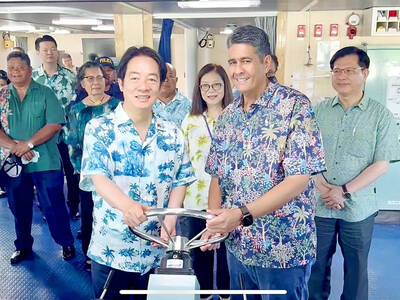
MULTIPRONGED APPROACH: China has sought to pressure Palau across a number of fronts, but the island nation has staunchly resisted overtures to ditch Taiwan Palau has been firm in backing Taiwan despite Chinese pressure that uses tourism economics, cyberattacks and criminal infiltration as tools to threaten the Pacific ally into renouncing its recognition of Taiwan as a sovereign state. The Presidential Office yesterday announced that Vice President Hsiao Bi-khim (蕭美琴) would visit Palau from Saturday to Wednesday next week at the invitation of Palauan President Surangel Whipps Jr. Whipps in April said in an interview that China had outspokenly asked Palau to “denounce Taiwan.” “And we have said: ‘We have no enemies, but nobody tells us who our friends are,’” he said. Whipps has told reporters multiple times


 RSS
RSS