


The government will invest NT$500 million next year to send the nation's top students abroad for advanced study in 12 designated fields to avert a projected shortage of manpower in the science and technology sectors of major industries, the National Science Council (NSC) announced yesterday.
NSC Chairman Wu Maw-kuen (
Yu agreed to have the project launched on Dec. 15, when application brochures will be made available on the Web sites of relevant government agencies.
The deadline is Jan. 20 next year.
It is estimated that grants will be given to 874 students next year, with each student receiving up to NT$1.3 million. The results will be announced on March 30.
The budget allocated to the program is expected to be progressively increased, and officials hope to be able to help around 1,000 students by 2008.
The project was triggered by anxiety in the government as well as industrial circles about a dramatic decline in Taiwanese studying state-of-the-art technology overseas.
In 2002, the government announced the "Two Trillion, Twin Stars" economic development project to support the semiconductor and computer-display industries. According to projections, these two industries will reach an annual production value of above NT$1 trillion each within a few years. However, warning signals about a shortage of professionals have started to flicker.
Late last month, Wu joined university principals and high-ranking officials from the Council for Economic Planning and Development (CEPD) and the Ministry of Education on a fact-finding mission to San Francisco, where they attended a strategic meeting with college deans and professionals associated with the Academia Sinica.
At the meeting, 12 major fields were identified in which the country should promote study. They are basic science; biotechnology; graphic design; digital content; information and communication; semiconductor technology; energy; environmental and marine sciences; nanotechnology; the service industry (especially in the financial sector); international law; and the humanities and arts.
"We will also ask for donations from the industrial sector, because the project is designed to meet industry demand to a certain extent," CEPD Vice Chairman Hsieh Fa-ta (
According to Hsieh, any student determined to pursue a masters or doctoral degree can file an application, whether they have an admission letter from an overseas institution or not.
NSC Deputy Chairman Liao Chun-chen (
"For those who are awarded grants without being accepted at overseas schools, the NSC might even arrange possible destinations at world-class research institutes that have good relations with Taiwan," Liao said.
Students receiving financial support from the program will be obliged to return to Taiwan for a certain period of time after graduation.

Actor Darren Wang (王大陸) was sentenced to six months in prison, commutable to a fine, by the New Taipei District Court today for contravening the Personal Data Protection Act (個人資料保護法) in a case linked to an alleged draft-dodging scheme. Wang allegedly paid NT$3.6 million (US$114,380) to an illegal group to help him evade mandatory military service through falsified medical documents, prosecutors said. He transferred the funds to Chen Chih-ming (陳志明), the alleged mastermind of a draft-evasion ring, although he lost contact with him as he was already in detention on fraud charges, they said. Chen is accused of helping a

SECURITY: Starlink owner Elon Musk has taken pro-Beijing positions, and allowing pro-China companies to control Taiwan’s critical infrastructure is risky, a legislator said Starlink was reluctant to offer services in Taiwan because of the nation’s extremely high penetration rates in 4G and 5G services, the Ministry of Digital Affairs said yesterday. The ministry made the comments at a meeting of the legislature’s Transportation Committee, which reviewed amendments to Article 36 of the Telecommunications Management Act (電信管理法). Article 36 bans foreigners from holding more than 49 percent of shares in public telecommunications networks, while shares foreigners directly and indirectly hold are also capped at 60 percent of the total, unless specified otherwise by law. The amendments, sponsored by Chinese Nationalist Party (KMT) Legislator Ko

‘SAME OLD TRICK’: Even if Beijing resumes individual travel to Taiwan, it would only benefit Chinese tourism companies, the Economic Democracy Union convener said China’s 10 new “incentives” are “sugar-coated poison,” an official said yesterday, adding that Taiwanese businesses see them clearly for what they are, but that Beijing would inevitably find some local collaborators to try to drums up support. The official, speaking on condition of anonymity, made the remark ahead of a news conference the General Chamber of Commerce is to hold today. The event, titled “Industry Perspectives on China’s Recent Pro-Taiwan Policies,” is expected to include representatives from industry associations — such as those in travel, hotels, food and agriculture — to request the government cooperate with China’s new measures, people familiar with
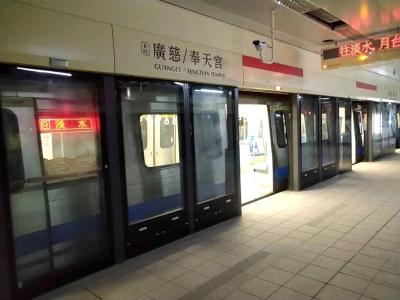
The eastern extension of the Taipei MRT Red Line could begin operations as early as late June, the Taipei Department of Rapid Transit Systems said yesterday. Taipei Rapid Transit Corp said it is considering offering one month of free rides on the new section to mark its opening. Construction progress on the 1.4km extension, which is to run from the current terminal Xiangshan Station to a new eastern terminal, Guangci/Fengtian Temple Station, was 90.6 percent complete by the end of last month, the department said in a report to the Taipei City Council's Transportation Committee. While construction began in October 2016 with an


 RSS
RSS