


With no response yet from the Athens Olympic Organizing Com-mittee to the nation's protest against the removal of its advertisements, Taiwan is scheduled to launch a new promotional campaign via alternate channels today, the first day of the Games.
"It's very important not to give up, especially when we're in a politically difficult situation," said David Lee (李南陽), director of the Department of International Information Services under the Government Information Office (GIO).
"If we give up and cave in to the pressure of China, we're bound to lose our voice in the international arena and diminish the nation's profile," he said.
Meanwhile, two European human rights groups have voiced their support for the nation and lodged a complaint to Olympics officials.
Olympic Watch, based in the Czech Republic, has said the groups are "extremely concerned" that China's pressure may have prompted airport officials to block or remove Taiwan's promotional posters and billboards. The Germany-based International Society for Human Rights has denounced China's bullying behavior and said that Taiwan's freedom of speech should be safeguarded.
According to Lee, the GIO has commissioned CNN International to air a 30-second promotional commercial on its Europe channel from today through Aug. 29, and on the Asia channel today and tomorrow. It is estimated that the two channels will reach an audience of over 102 million.
The GIO also plans to run a half-page ad in the International Herald Tribune on Aug. 17. The paper, delivered to more than 180 countries every day, boasts a worldwide circulation of about 264,000.
The GIO reported yesterday that the Olympic organizing committee had asked that Taiwan's advertisements and publicity posters be removed. The GIO said that it believed the request came after pressure from China.
The ads are part of the GIO's 150,000-euro publicity campaign during the Olympics. In addition to placing posters on 500 luggage carts at Athens International Airport and the exteriors of 50 of the city's electric trams, the GIO had also planned on having large outdoor billboards erected along the expressway from the international airport to downtown Athens.
While the ads on the 500 luggage carts have already been removed, Lee said that some posted on the 50 electric trams still remained as of yesterday.
"This is not the first case of China suppressing our diplomatic space, and it's definitely not the last one," Lee said.
The country's representative office in Greece yesterday told the Taipei Times that despite the incident it will make efforts to increase the nation's visibility.
"We have mapped out a contingency plan to promote Taiwan, such as accepting local media interviews, running ads in the broadcast media and other possibilities which I am not allowed to reveal now for fear of further oppression from China," said Eric Chiang (蔣昌成), director of the information section of Taiwan's representative office in Italy, which has been assigned to help resolve the advertisement controversy.
Chiang told the Taipei Times that the organizing committee adopted an arbitrary manner. When asked what the reason was, a committee member responded, "I am not obliged to give you any reason," according to Chiang.
The GIO has made it clear that it would withhold the 150,000-euro campaign fee should the committee not honor the contract signed with Taiwan.
With no sign of seeing the contract honored, Lee said that the GIO will use the money to pay for the ads run on CNN and in the International Herald Tribune, as well as for the full-page color ad run in the Olympics special report of Time Europe, due out next Monday.
The money will also pay for the same ad appearing in the September issue of BBC On Air magazine, which has a circulation of 20,000.

UPGRADE: The Kang Ding-class frigate is replacing its Chaparall missiles with Tien Chien II and Hua Yang VLS, which would provide it with long-range, 360° air defense Taiwan plans to produce 1,200 to 1,376 Hai Chien II missiles (海劍二, Sea Sword II) — also known as TC-2N — to serve as the standard air defense system of the navy’s surface combatant fleet, a source said yesterday. Last week, the Hai Chien II, the naval version of the Tien Kung II missile (天劍二, Sky Sword II), completed a live-fire test in waters off the National Chungshan Institute of Science and Technology’s Jiupeng facility (九鵬) in Pingtung County’s Manjhou Township (滿州). The MIM72 Chaparral and other dated air defense missiles that currently arm Taiwanese ships have inadequate range to combat Chinese

REASONS FOR TRAVEL: An assistant professor said that proposed amendments to penalize drivers if they used drugs overseas would not deter people from traveling People who operate a motor vehicle under the influence of marijuana would have their driver’s license revoked, even if they used the substance while overseas, the Ministry of Transportation and Communications said yesterday, citing proposed amendments to the Road Traffic Management and Penalty Act (道路交通管理處罰條例). The amendments would also authorize the government to revoke the licenses of people determined to have used Category 1 or Category 2 narcotics, even if they were not operating a vehicle while under the influence of drugs, as well as ban them from taking the license test for three years, the ministry said. People aged 18 or
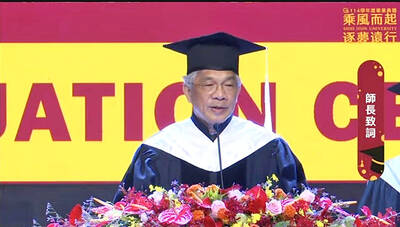
Shih Hsin University President Chen Ching-he (陳清河) yesterday issued a public apology for comments made in his commencement speech last week, stating that he has asked the school to suspend his duties and halt his wages for two months as a show of contrition. At the commencement ceremony on May 30, Chen said, “If you don’t manage your time well, or your own emotions, or your health, then I am telling every one of you — put a quick end to ‘you,’ because the world has no need for ‘you.’” The comments have sparked significant controversy online, and Chen through an open

Johanne Liou (劉喬安), a Taiwanese woman who shot to unwanted fame during the Sunflower movement protests in 2014, returned to Taiwan last night after being deported from the US. She is to stand trial in Taiwan for charges involving embezzlement, fraud and drug crimes. The Criminal Investigation Bureau (CIB) said it took her into custody at Taiwan Taoyuan International Airport and would first question her before transferring her to the New Taipei District Prosecutors’ Office. She was arrested upon disembarking a flight from San Francisco that landed shortly before 7pm. Liou absconded to the US in 2019 after jumping bail


 RSS
RSS