


A US expert on China affairs said yesterday that he thinks President Chen Shui-bian (
Ross Terrill, a professor at Harvard University's Fairbank Center for East Asian Research, is in Taipei to attend a seminar on Northeast Asia's future political and military development. Terrill was scheduled to meet with Chen today.
Terrill said that he would suggest that Chen slow the pace of drafting and introducing a new constitution because "writing a new constitution is not as simple as giving the people a new car or a new house."
Chen has said on several occasions since his March 20 re-election that he will honor his campaign promise to write a new constitution in 2006, for implementation in 2008 through a referendum. Beijing has blasted Chen's plan and regards it as a step toward declaring Taiwan's independence -- a move that could provoke a military attack by Beijing.
If Beijing does attack Taiwan, Terrill said, it would inflict grave losses on China, a worst-case scenario that is unlikely to happen in the foreseeable future.
Nevertheless, he said, Taiwan must maintain its capability to defend itself.
Since Chen has pledged to be a president for all the Taiwanese people, Terrill said, he must take the well-being and opinion of all Taiwanese people into account while carrying out his reform agenda.
Terrill said that even though Taiwan needs a new constitution suitable to its present status, Beijing's leaders do not necessarily understand this need.
For China, Terrill said, changes to the Constitution would affect Beijing's theory that Taiwan is an integral part of China.
For Taiwan's long-term development, Terrill said that Chen should give priority for the moment to addressing Taiwan's social and economic development issues.
Terrill said that although Chen won re-election, he must ascertain the people's true wishes before moving toward writing a new constitution.
Terrill said that he does not think the US government will forever insist on the "one China" policy.
He said developments in Hong Kong under Beijing's rule have prompted some politicians in Washington to dislike the idea of "one China."
Terrill said the US government has consistently stressed that Taiwan's future, regardless of unification or independence, should be determined by the people of Taiwan themselves.

The military has spotted two Chinese warships operating in waters near Penghu County in the Taiwan Strait and sent its own naval and air forces to monitor the vessels, the Ministry of National Defense (MND) said. Beijing sends warships and warplanes into the waters and skies around Taiwan on an almost daily basis, drawing condemnation from Taipei. While the ministry offers daily updates on the locations of Chinese military aircraft, it only rarely gives details of where Chinese warships are operating, generally only when it detects aircraft carriers, as happened last week. A Chinese destroyer and a frigate entered waters to the southwest
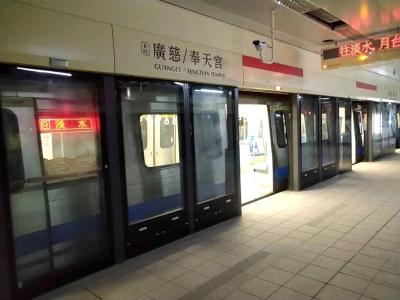
The eastern extension of the Taipei MRT Red Line could begin operations as early as late June, the Taipei Department of Rapid Transit Systems said yesterday. Taipei Rapid Transit Corp said it is considering offering one month of free rides on the new section to mark its opening. Construction progress on the 1.4km extension, which is to run from the current terminal Xiangshan Station to a new eastern terminal, Guangci/Fengtian Temple Station, was 90.6 percent complete by the end of last month, the department said in a report to the Taipei City Council's Transportation Committee. While construction began in October 2016 with an
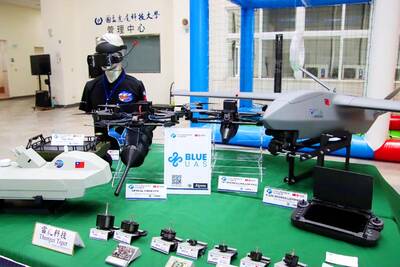
NON-RED SUPPLY: Boosting the nation’s drone industry is becoming increasingly urgent as China’s UAV dominance could become an issue in a crisis, an analyst said Taiwan’s drone exports to Europe grew 41.7-fold from 2024 to last year, with demand from Ukraine’s fight against Russian aggression the most likely driver of growth, a study showed. The Institute for Democracy, Society and Emerging Technology (DSET) in a statement on Wednesday said it found that many of Taiwan’s uncrewed aerial vehicle (UAV) sales were from Poland and the Czech Republic. These countries likely transferred the drones to Ukraine to aid it in its fight against the Russian invasion that started in 2022, it said. Despite the gains, Taiwan is not the dominant drone exporter to these markets, ranking second and fourth

Japanese Prime Minister Sanae Takaichi’s comment last year on Tokyo’s potential reaction to a Taiwan-China conflict has forced Beijing to rewrite its invasion plans, a retired Japanese general said. Takaichi told the Diet on Nov. 7 last year that a Chinese naval blockade or military attack on Taiwan could constitute a “survival-threatening situation” for Japan, potentially allowing Tokyo to exercise its right to collective self-defense. Former Japan Ground Self-Defense Force general Kiyofumi Ogawa said in a recent speech that the remark has been interpreted as meaning Japan could intervene in the early stages of a Taiwan Strait conflict, undermining China’s previous assumptions


 RSS
RSS