


■ Society
Weather blamed for crime
Social order was generally good during the Lunar New Year holiday, statistics released yesterday by the Criminal Investigation Bureau (CIB) showed. Bureau officials said that during the six-day period, there were 81 major criminal cases reported, down 22 from 103 cases the previous year. There were 51 rob-beries and 16 burglary cases. There were also 11 man-slaughter cases, up nine cases from last year's holi-day, police said. They attributed the rise to the coldest holiday period in 11 years, so that when friends and relatives gathered they often lost control of them-selves under the influence of alcohol. The number of cases of rape and major burglaries were both fewer than 10, police reported.
■ Society
Whale's penis arouses envy
Scores of men have visited Tainan's Sutsao Wild Life Reservation Area where professors, students and volunteers were working on the corpse of a male whale, because they were curious about the whale's genitalia. The whale's penis measures 1.6m in length and it looks like a thick water pipe. More than 100 Tainan City resi-dents, mostly men, have reportedly gone to see the corpse to "experience" the size of its penis. The 60-tonne whale was found dead on the seashore of Yunlin County on Sunday. The county government sent the corpse to the National Cheng Kung University, whose biology professors wanted to preserve it as a specimen.
■ Health
NTUH prohibits bribes
National Taiwan University Hospital has set issued a code of conduct to regulate the widespread practice of giving red envelopes to doctors to ensure optimal health care. According to the new code, the first of its kind in the nation, hospital staff and workers are prohibited from accepting any red envelopes containing cash, gift certificates, or securities. However, gifts valued under NT$2,000 can be accepted. Doctors are also barred from encouraging patients to donate red envelopes to specific foundations. Hos-pital workers in charge of purchasing medical supplies are also prohibited from accepting bribes from medi-cal and pharmaceutical companies. Taiwan Health Care Reform Foundation chairwoman Chang Li-yun (張苙雲) yesterday said that while she supported the hospital's efforts, patients would have to stop giving red envelopes for the policy to be successful. The money in red envelopes given to doctors can reportedly amount to as much as NT$60,000 to NT$80,000 for organ-transplant operations.
■ Politics
Yu pledges clean vote
Premier Yu Shyi-kun said yesterday that his admin-istration will brook no violence or corruption in the March 20 presidential election. During the weekly Cabinet meeting, Yu said the fierce competition has given rise to allegations of vote-buying. In order to prevent the country from plunging again into the grip of "black gold" politics, Yu urged law-enforcement agencies to go all-out to maintain a clean, fair and just election. He said anyone found buying votes will be prosecuted regard-less of rank, status or political affiliation. Yu said the Ministry of Justice has opened a hotline (0800-024099) for tips on election irregularities. Police officers have also been asked to give special attention to prevent election-fixing, Yu said. The police department estimated that police officers will have to go on 100,000 election-related missions before March 20.

NATIONAL SECURITY: Authorities are working to confirm the identities of the military personnel involved and investigating possible illegal conduct and regulatory violations Authorities are probing possible national security implications after Kinmen police and immigration officers on Sunday found a Chinese woman allegedly posing as a tourist while engaging in prostitution involving more than 10 military personnel. The woman, surnamed Chen (陳), has since been deported, authorities said, adding that investigators are still working to confirm the identities of those implicated, as the records only listed code names and aliases. The case stemmed from a report received by the Kinmen District Prosecutors’ Office on Friday last week from the Jinhu Precinct of the Kinmen County Police Bureau. On Sunday, police, along with the National Immigration

GLOBALGIVING: ‘ Caving to external pressure is not acceptable for an organization that has cultivated justice reform and human rights for 30 years,’ one NGO said A slew of non-government organizations (NGOs) have withdrawn from the GlobalGiving fundraising platform after it announced it would use “Chinese Taipei” instead of “Taiwan” from next month. The Taiwan Good Rice Association wrote on Facebook on Friday that it was informed on April 28 via a teleconference call of the change, which was made because the platform wanted to operate in China. Taiwan Good Rice is to terminate all cooperative relationships with GlobalGiving in response to the platform’s “unilateral and non-negotiable” decision to remove references to Taiwan, the NGO said. “Taiwan is in the official name of Taiwan Good Rice Association and the

HEAVY WEATHER: Typhoon Jangmi is due to crash straight into the Ryukyus as airlines look to shift flights to larger aircraft or cancel flights to Okinawa entirely Taiwan’s international air carriers announced flight adjustments over the weekend as Typhoon Jangmi is forecast to hit the Ryukyu Islands today and tomorrow. The Central Weather Administration (CWA) upgraded Jangmi from a tropical storm to a typhoon at 8am yesterday, with the eye located 580km south of Naha city. It was moving north at 19kph. Today, China Airlines’ CI-120, CI-121, CI-122 and CI-123 flights between Taoyuan and Naha, Okinawa, have been canceled as well as CI-132 and CI-133 between Kaohsiung and Naha. EVA Air’s BR-112, BR-113, BR-186 and BR-185 flights between Taoyuan and Naha are also canceled. Low-cost carrier Tigerair Taiwan canceled IT-230,
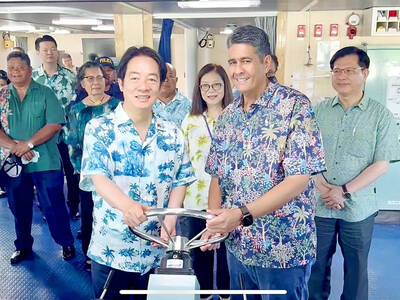
MULTIPRONGED APPROACH: China has sought to pressure Palau across a number of fronts, but the island nation has staunchly resisted overtures to ditch Taiwan Palau has been firm in backing Taiwan despite Chinese pressure that uses tourism economics, cyberattacks and criminal infiltration as tools to threaten the Pacific ally into renouncing its recognition of Taiwan as a sovereign state. The Presidential Office yesterday announced that Vice President Hsiao Bi-khim (蕭美琴) would visit Palau from Saturday to Wednesday next week at the invitation of Palauan President Surangel Whipps Jr. Whipps in April said in an interview that China had outspokenly asked Palau to “denounce Taiwan.” “And we have said: ‘We have no enemies, but nobody tells us who our friends are,’” he said. Whipps has told reporters multiple times


 RSS
RSS