

Some of the world’s fastest gamers could soon be driving Formula One’s future, literally, by testing ideas on virtual racetracks.
The sport is facing major change after 2020, when current agreements expire, and owners Liberty Media along with the governing body are looking into how to make racing more competitive and exciting.
Pat Symonds, who is on a panel of experts set up last year under motorsport managing director Ross Brawn, said that e-sport could help provide the answers.
The engineer cited the starting grid, with the cars lined up in a staggered two by two formation, as an example.
“In the old days you had four, three [cars abreast], all sorts of things,” Symonds said. “What we want to know is: If we do that [with modern cars and tires], what’s likely to happen? Are you going to get a much more exciting first lap or are you just going to get a lot of accidents on the first corner and therefore a boring race afterward?”
“And although you could develop AI [artificial intelligence] to do that, it’s actually better to do it using elite gamers. Those guys are pretty damn good at what they do. Can we use them to inform us as to how proposed regulations might work out?” he added.
F1 last year established an e-sport championship and has refined it further.
All the F1 teams, apart from Ferrari, are competing and are due to select drivers next month from a pro draft of 40, with the finals during the Abu Dhabi Grand Prix in November.
“What we can do is say: ‘Right, all you guys are in the final. Come in for two days and we’re going to do 100 races’ — of course we don’t need to do the whole race, we can do the first two laps or whatever we decide,” Symonds said. “We’ll try and use different layouts and we’ll see what happens. We can then do a statistical analysis and we can decide whether overall it’s a good thing or a bad thing.”
Codemasters, partners in the e-sports championship along with Gfinity, had been working on the technology, Symonds added.
“We have got the ability now to alter grid layouts and all we need to do is add the statistical analysis and a few other things, but I’m certainly hoping that this year we’ll be able to do that sort of thing,” he said.
F1 has had plenty of knee-jerk reactions in the past to dull races, with qualifying undergoing numerous formats and sometimes at short notice, and Liberty wants future changes to be fully assessed.
AI simulations mean cars could race each other hundreds of times with changing tire characteristics and conditions, Symonds said, adding that circuit configurations could also be modified virtually to see how that affects the racing.
“We need to evolve the simulation a bit further. I think people fail to realize what an incredibly important part tires play in close racing. We’ve got work to do on our tire model yet,” Symonds said.
Funding constraints are also something of a brake on the pace of progress.
“It’s a huge amount of work to do on a minute budget compared to a Formula One team, and with a miniscule number of people ... so it’s tough,” Symonds said.
“The artificial intelligence bit of it we are very close to running now,” he added. “The e-game is part of it. I mentioned the grid simulation, we’ve done all the graphics and the coding necessary to alter grid layouts.”
“All of that exists, all of that is running. We haven’t done the bit that pulls all the statistics out yet, nor have we actually engaged the e-gamers. We need to develop the product first, but it’s all doable,” he said.

Reigning champions South Korea yesterday struck with eight minutes left to seal a 2-1 win over a “proud” China to reach the Asian Games men’s soccer final. The South Koreans are to face either hosts Japan or Uzbekistan for gold on Saturday as they pursue a fourth consecutive title. Uzbekistan and Japan were tied 1-1 as of press time last night. Bae Jun-ho was their hero, ghosting in at the back post to head in a dramatic 82nd-minute winner at Nagai Stadium. Men’s soccer at the Asian Games consists of under-23 squads with three overage players. “We were expecting a challenging match but we persevered,”
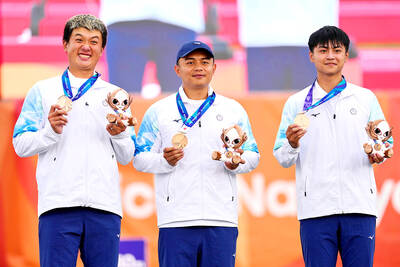
COURT STARS: Taiwan tennis sensations Hsieh Su-wei and Liang En-shuo advanced to the women’s doubles quarter-finals, along with Chan Hao-ching and Wu Fang-hsien Taiwan yesterday picked up two more bronze medals at the Asian Games in Japan, bringing their medal total to 39, including three golds and 10 silvers, to rank 14th in the overall standings. Lin Yu-ting guaranteed herself at least a silver medal in boxing after she outclassed Uzbekistan’s Sitora Turdibekova 5-0 in their women’s 60kg semi-final at the Nishio Gymnasium, putting the Taiwanese Olympic champion just one win from a second Asian Games gold. Lin is tomorrow to face China’s Yang Chengyu in the gold-medal showdown. The 30-year-old thanked the medical team afterwards for treating the cut to her nose she sustained in

The Football Association of Ireland (FAI) has found itself divided ahead of their two Nations League clashes with Israel, with the players disagreeing over whether to boycott the first game today and goalkeeper Gavin Bazunu withdrawing from the squad. After hours of fraught meetings among the players and occasionally involving coaches and officials, FAI chief executive officer David Courell said at a news conference that had been delayed by several hours that a “significant majority” of the squad had agreed to play the game in Hungary, but it was far from a unanimous decision. The handful of Irish journalists present questioned Courell
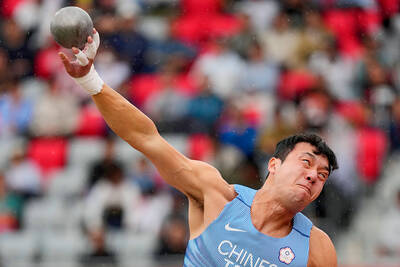
CONFUSION, DISORDER: Late-coming entrants and insufficient logistics have given this year’s Games a shoddy execution, the organizing committee’s head said The chief organizer of the Asian Games apologized yesterday for the logistical headaches plaguing the event, saying a late influx of athletes and officials had made it difficult to run smoothly. The number of participants at the continental showpiece ballooned to 17,000 following a flurry of late entries — about 2,000 more than the organizing committee had initially projected. The unexpected surge strained accommodation and transport networks, prompting complaints from athletes and team officials over cramped rooms, small beds and travel delays. “There have been mistakes in accommodation and transport, for various reasons,” AINAGOC secretary-general Satoshi Murate told a press conference. “Whatever the


 RSS
RSS