


With the flame comes the Games.
After years of preparation and months of buildup, London’s Olympic moment finally arrived on Friday night.
Royal Marine Martyn Williams carried the Olympic torch as he rappelled down from a Royal Navy Sea King helicopter into the Tower of London on the shore of the River Thames. The commando’s grand entrance plunged the symbol of the Games into the city’s historic heart, bringing Olympic pageantry to the British capital that last held the event in 1948.
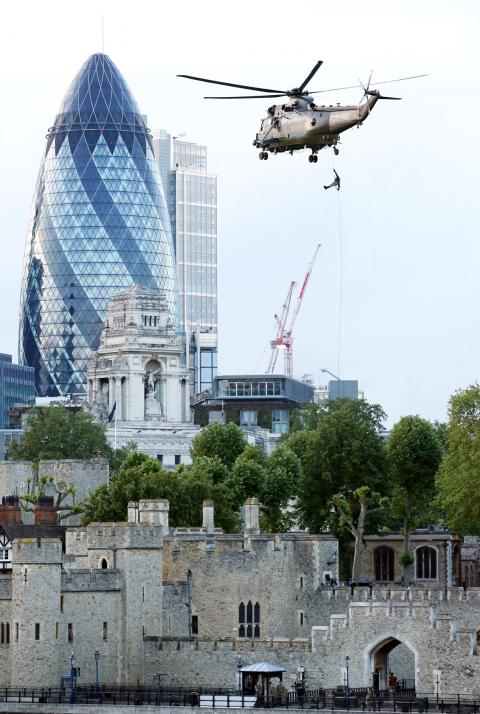
Photo: EPA
Crowds lined the city’s famed river banks to see the torch arrive, while Yeoman warders — the ceremonial Tower guards, popularly known as Beefeaters — looked on from inside the landmark’s grounds.
For Londoners, the arrival of the torch ignites a time of excitement — as well as four weeks of extreme crowds and transport strains.
Organizers have tried to smooth the way. London Underground subway lines are festooned with large magenta-and-pink signs pointing routes to the Olympic venues. Cartoony ads with wide-eyed horses and beefy musclemen warn commuters to remember that Olympic competitions are taking place and to rethink their daily journeys. Barriers are being erected to mark the special traffic lanes for Olympic vehicles — disparagingly dubbed “Zil lanes,” after the limousines granted exclusive use of special lanes on Soviet-era highways.
Londoners who already struggle to get to work on any given weekday are not convinced all will be well — and have not been shy about saying so. The atmosphere of gloom has been segmented by the never-ending rain and a constant stream of headlines about the failure of security contractor G4S to provide enough guards.
The mayor has a message for the naysayers: “Put a sock in it.”
Speaking at a ceremony at the Tower of London, London Mayor Boris Johnson said the arrival of the torch would “dispel any last remaining clouds of dampness and anxiety.”
“It will spread the crackling bushfire of Olympic enthusiasm throughout this city and the country,” he said, as Kelly Holmes, a British double gold-medal winner in 2004, toured the ramparts of the landmark, with the torch held aloft.
Ready or not, the Games are a reality. Olympic banners in hot pink, acid yellow and lime green have painted London in neon. The tubby Cyclops-like mascots, Wenlock and Mandeville, are dancing around central London tourist attractions in a desperate bid to be huggable. The city’s famous red double-decker buses are sporting ads flogging the last of the unsold Olympic soccer tickets.
The stadiums themselves are nearly ready. At the athletes village, Cuba and Denmark have been the first to drape flags off their balconies. The Olympic clock ticking down the days in Trafalgar Square has reached single digits.
Olympic historian David Goldblatt, co-author of How to Watch the Olympics, said the flame’s arrival in London marks a key turning point.
“I think it signifies the moment when everyone, whether for, against or indifferent, is thinking: ‘Oh Lord let’s just get the bloody thing started,’” he said.
It was only weeks ago that celebrations marking Queen Elizabeth II’s Diamond Jubilee sent Britons into a spasm of patriotic flag-waving and God Save the Queen-singing as they watched a flotilla of 1,000 boats on the River Thames.
Will the flame’s arrival inspire the famously inhibited British to do it all again — to cheer and wave and weep and be inspired — as the torch relay winds through the city’s 33 boroughs? Could be — if the first 62 days of the torch’s travels are any indication.
The 12,900km torch relay has already been a cultural happening across the length of Britain, drawing crowds out to meet it wherever it goes.
Spectators in rain ponchos have flash-mobbed to its side, hoping for that once-in-a-lifetime chance to touch a bit of history. Some have even stood by the side of the road to see the trucks that carry the torch between cities, as it fulfills a promise to travel within 16km of 95 percent of Britain’s population.
“Both the Diamond Jubilee and the Olympics are like carnivals or tribal festivals,” Kate Fox, the author of Watching the English, wrote in a British Airways survey on the Games. “We behave in ways we wouldn’t normally behave — dancing in the streets and waving flags and shouting and cheering and indulging in other wildly disinhibited acts, such as maybe even talking to strangers.”
Britons were even more committed to the flame before the last London Olympics in 1948, when the torch was actually run in a relay from the site of ancient Olympia in Greece. Janie Hampton, author of London Olympics: 1908 and 1948, said runners traveled continuously, day and night. Crowds emerged to see the 1948 flame even in the middle of the night.
In Britain it was such a draw that police outriders had to push people back as the flame neared the stadium to light the cauldron, Hampton said.
“There is one event in the Games which has captured the imagination — the carrying of the lighted torch from distant Olympia to the Stadium at Wembley,” the Times newspaper said on July 28, 1948. “The torch itself, quite apart from its symbolism, is something which, like a lance or a banner, a coat of mail or a jerkin of Lincoln green we can love purely for its own sake. It has a somber glory.”
This time the flame has been to every corner of the UK ahead of its showcase moment at the Olympics’ opening ceremony next Friday. Friday last week was Day 63 of its 70-day journey, which has included travel on boats, planes, horses and hot-air balloons.
It has been carried by Olympians and Paralympians. The queen’s granddaughter, Olympic equestrian competitor Zara Phillips, has shared the honor with 84-year-old Moira Starkey, who walks with two canes and was honored for completing a marathon last year by walking around her town hall 1,876 times to raise money for charity.
If the Beijing relay set up the 2008 Summer Games as China’s coming-out party on an international stage, London’s relay has set up Britain as the community Olympics — not flashy or dashy, not big or spectacular, but warm and well-attended.
Organizers had always assumed the world would be excited about the Games, but were not sure what people in Britain would think — particularly given that taxpayers will be paying £9.3 billion (US$14.5 billion) to host the event at a time of economic austerity.
There is also the matter that so much activity is focused on Olympic Park in London. There had to be some sense that other parts of the country were involved — that the Olympics also belonged to Scotland, Wales and Northern Ireland.
The numbers — about 9 million people have viewed the torch so far — speak for themselves.
Whether they are coming just because it is a local happening, or because people are moved by the fairy dust of the Games, it is hard to say. A torch leg features sponsor buses blaring music, streamers and tambourines, cameras and media, cheerleaders shout: “Go torchbearer!”
It is not really clear how the capital will respond to the hoopla. This is a place where major events happen with some frequency.
However, one thing is for sure. Flame equals Olympics.

Former reality TV star Jessie Holmes on Tuesday night cruised to a repeat victory in the Iditarod, the about 1,609km sled dog race in Alaska. Holmes guided his dog team across the finish line in the old Gold Rush town of Nome, a Bering Sea coastal community. The race started on March 8 in Willow, a day after the ceremonial start in Anchorage. The course took dog teams and their mushers over two mountain ranges, along the frozen Yukon River and across the unpredictable Bering Sea ice. Holmes, a former cast member on the National Geographic reality show Life Below Zero, is the

Taiwanese boxer and Olympic gold medalist Lin Yu-ting has been approved to compete in the Asian Boxing Elite Championships, the Chinese Taipei Boxing Association (CTBA) said yesterday. The championships start on Saturday next week in Ulaanbaatar, Mongolia. At the 2024 Paris Olympics, Lin became entangled in a gender controversy, despite the International Olympic Committee confirming her eligibility to compete as a female boxer. In August last year, World Boxing mandated a new regulation that required all athletes to undergo a polymerase chain reaction. genetic test to determine their sex at birth and their eligibility. Since the introduction of the test, Lin has missed several

The Taoyuan Pauian Pilots on Sunday fell short in their bid for a first East Asia Super League (EASL) title after a 90-81 loss to Japan’s Utsunomiya Brex in Macau. The defeat marked the second straight year the defending P.League+ champions missed out on the EASL crown, but they remain the first team to reach back-to-back championship games in the league’s three-year history. The outcome was largely decided by long-range shooting. The Pilots struggled from beyond the arc, hitting just five of 20 attempts, while the Brex converted 19 three-pointers, shooting 46.3 percent from long range. Seven of the eight Brex players

ONE MORE CHANCE: While North Korea denied Taiwan in Australia, Taiwan, who last played in the World Cup in 1991, could still qualify via inter-confederation playoffs Taiwan yesterday lost 4-0 to a dominant North Korea in the AFC Women’s Asian Cup playoffs, closing off an avenue to qualify for the FIFA Women’s World Cup. Hong Song-ok scored a hat-trick in the match to determine the last of the confederation’s qualifiers from the tournament for next year’s World Cup in Brazil. With their victory over Taiwan, North Korea has qualified for the first time since a doping saga in 2011 led to their long absence from top-tier international tournaments. Angela Beard and Jaclyn Sawicki scored in a six-minute span to help the Philippines secure a World Cup spot with a


 RSS
RSS