

He has been acknowledged for possessing a special trait: grace under pressure. The image of Lenny Wilkens, the old (at 66) new New York Knicks coach, is just that: stoic as a statue. On the sideline during a game, his seemingly calm but mindful eyes and expressionless face above his knotted tie and natty suit are unchanging whether the whistle is for or against his team, whether the scoreboard shows his team losing or winning.
He's up on his feet, prowling the alley in front of the bench, sometimes crossing his arms to indicate his mood has changed. But scream, bellow, kick a chair or pound a scorer's table? Never. Not Cool Hand Lenny.
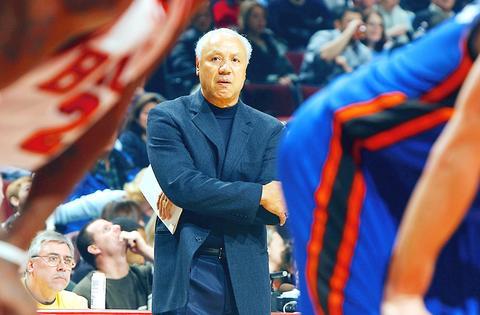
PHOTO: AFP
But from where, one wonders, has this apparently placid persona derived?
It might have been that day at the basketball court at PS 35 in Bedford-Stuyvesant, Brooklyn. Little Lenny Wilkens, not yet grown to 6 feet 1 inch and so skinny he might have fit through a picket fence, was playing ball with some friends. The game was abruptly interrupted by a gang wielding zip guns, knives and tire irons.
"I realized I couldn't panic," Wilkens said Friday morning, hours before his debut as the Knicks' coach in Madison Square Garden against Seattle. "If I ran or even tried to fight back, I knew one of two things would probably happen: I'd get a good butt-whuppin', or I'd get killed. I thought, `If I stay calm, maybe I'll find a way out.'"
It turned out that one of the gang recognized Wilkens as another gang member's cousin. They departed, leaving Lenny and his pals shaken but in one piece.
"You remember things like that; those things help," Wilkens said. "I found that it was better to keep your composure than lose it. As a player it helped, and as a coach it's helped for me to be in control of me."
What goes up ...
In his first year in the National Basketball Association, however, as a first-round draft pick by the St. Louis Hawks in 1960, Wilkens remembers disputing a referee's call and throwing the ball into the air.
"`Rookie,'" he recalled the referee, Bob Duffy, telling him, "`if that ball comes down, you'll get a technical and a fine.'"
Wilkens said: "The fine for a technical in those days was US$25. I tried to catch the ball before it landed, but didn't."
He said he learned two things: "Why blow US$25 when I didn't have to, and I hurt the team with the technical."
But Cool Hand Lenny still had something to learn about temperament. In the 1978-1979 season, when he guided Seattle to an NBA title, Wilkens recalls getting about eight technical fouls. "But one resulted in me being thrown out of a game," he said, "and we won that one."
Despite the cheerful result, Wilkens has not duplicated it. That is the only time he has been tossed from a game in his 30-year coaching career with Seattle, Portland, Cleveland, Atlanta and Toronto, and two games with the Knicks. He has won -- and lost -- more games than any other coach in NBA history, and was inducted into the Hall of Fame as both a coach and a player.
The Einstein of hoops
What you don't see but can almost hear as Wilkens paces the sideline is the whirring of his brain. Someone in the NBA has said that Wilkens runs only eight or nine plays, and always has. If that's true, it's reminiscent of something Einstein said: "Everything should be made as simple as possible, but not simpler."
Wilkens said: "I run plays that I have to run depending on the personnel. I don't fit them to my style. I fit my style to them."
Even as a player, he was creative with his abilities. Some years back, when both Wilkens and Walt Frazier were retired as players, I was going to do an article on Wilkens. I asked Frazier, who had often guarded the left-handed Wilkens, if he had a question for him.
"Yeah," he said. "Ask him this: How was it that I always knew he was going left, but he always suckered me in?"
Wilkens pondered the question for a moment. "Well," he said, "he always knew I was going left, but he never knew when."
Some have been critical of the Knicks' hiring of Wilkens, saying his manner is too mild to light a fire under the players.
The sense in New York is that Wilkens understands clearly, as always, what it takes to unequivocally get his points across to a player, and that the Knicks' main man, Stephon Marbury, hungry to prove himself a winner in his hometown and a point guard like Wilkens, will embrace him. And as Marbury goes, so go the Knicks.
Wilkens surely knows that little will happen overnight. Some 20 years ago, I was with him in Los Angeles when he ran into his old friend Rodney from Brooklyn.
"Lots of teams going good this year: LA, Philly, Boston, Phoenix," his friend said. "Won't be easy."
"Rodney," Wilkens replied, "when was it ever?"

After Carlos Alcaraz and Jannik Sinner split last year’s Grand Slams, the two superstars were expected to continue their see-saw rivalry this year. That has not happened. Instead, injuries have foreclosed the possibility of a clash between the two champions in three of the four Grand Slams, with the Spaniard missing the French Open and Wimbledon due to a wrist injury and the Italian absent from New York because of a knee injury. Alcaraz and Sinner are far from alone among top players missing big tournaments this year due to injury, a trend that has been a source of growing

TIGHT TIES: Throwing the opening pitch for the Nats game is the latest in a series of efforts by the Taiwanese-American astronaut to celebrate Taiwan and the US Taiwan-born astronaut Kjell Lindgren threw the ceremonial first pitch at the Washington Nationals’ Taiwan Heritage Day at Nationals Park on Saturday before the game against the Miami Marlins. Speaking before the Nationals’ second Taiwanese Heritage Day, Lindgren said throwing the first pitch was “right up there in terms of anxiety-provoking” with some of his past accomplishments, including two rocket launches, two atmospheric reentries and two spacewalks. “But I’m really excited to be a part of this celebration of Taiwan heritage,” he said, adding that it was “an opportunity to really celebrate the relationship, the partnership, the history between the United States and

England forward Ollie Watkins has left Aston Villa to join Al Hilal, his new Saudi club announced on Sunday. The deal is worth a reported £50 million (US$67.7 million) and follows Villa’s signing of Senegal eseforward Nicolas Jackson from Chelsea. Al Hilal said the 30-year-old Watkins had signed a three-year deal and would be in line to play in their league match against Al Ahli today. He joins a squad including former Ballon d’Or winner Karim Benzema and Crysencio Summerville, who signed from West Ham United earlier in the transfer window. Watkins has scored seven goals in 24 appearances for England. Villa coach Unai Emery

Influencers and content creators armed with smartphones and ring lights have featured prominently in the stands at this year’s US Open, as they try to grab the spotlight away from the on-court action at one of tennis’ marquee events. About 100 content creators were given credentials for the tournament, organizers said, with 20 of those dedicated to providing coverage of the food and beverage scene alone, where caviar-topped chicken nuggets and the famed “Honey Deuce” cocktail promise viral attention. Thousands more amateur social media hounds could be found throughout the plaza and in the stands — after shelling out for their own


 RSS
RSS