


An important milestone in the construction the north-south High Speed Railway was reached yesterday, as the first giant boxgirder was set on its pedestal. The event completed the first phase of construction for the biggest build-operate-transfer project in the world.
"The corporation is proud to present the biggest boxgirder in Asia, which allows for a deviation of within 1cm," chairman and CEO of the Taiwan High Speed Rail Corp, Nita Ing (殷琪), said at the girder's launching ceremony.
Also on hand were Premier Chang Chun-hsiung (
Ing said that the firm has successfully coordinated engineers from 16 countries within less than 16 months in order to reach this stage.
She said that she hopes that the project will stand as a proud example of partnership between the government and the private sector.
Chang agreed with Ing, saying that the railway's completion would be a turning point in the country's economic development.
"With its high passenger capacity and speed, the railway will be a transportation hub used to expand government services [to more areas]," Chang told the crowd.
"The government has put top priority on local investments made in areas where the high-speed railway will reach, as well as related infrastructure construction," Chang said.
Citing one of the sites chosen for the yet to-be-built science park in central Taiwan -- Yunlin County's Huwei township, Chang said that the location was chosen because the railway will stop there and that National Taiwan University would establish a branch at that location.
The railway is scheduled to begin service in four years. Upon completion, travel time between Taipei and Kaohsiung will be shortened to 90 minutes.
Meanwhile at yesterday's ceremony, Chang's hoarse voice as he delivered his speech raised concern for his health. Before flying to Taichung, Cabinet officials said that the premier had paid a visit to National Taiwan University Hospital, citing a soar throat. Chang acquired his soar throat stumping for the DPP's legislative candidates at campaign rallies last weekend.
Taichung County Commissioner Liao said that he hoped Chang would tend to his voice, as, according to Liao, the premier was needed on the campaign trail.

National Taiwan University (NTU) yesterday said it disqualified a person from an entrance examination for using AI smart glasses to cheat, along with two others for making untruthful statements in their curriculum vitae. The three applicants were given null scores, Taiwan’s highest-ranked university said, calling on prospective students to be honest in the admissions process. NTU registrar Lee Hung-sen (李宏森) said that the cheating applicant wore a hat and thick-rimmed glasses to the second written exam for medical school, claiming that they felt cold. Suspicions were aroused when the applicant stared oddly at the test for long stretches while steadily bringing the paper
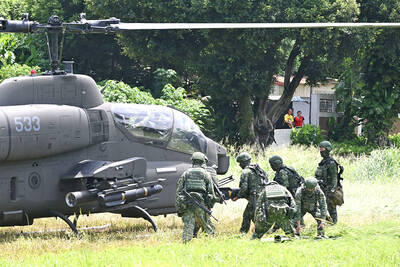
MILITARY ISSUES: A partisan divide between the Cabinet and the legislature ‘raised questions about Taiwan’s ability to adequately fund its defense,’ the report said Taiwan’s defense budget, military personnel numbers and resilience are challenges to its ability to meet national defense goals, the US Naval Institute said in a report published on Tuesday. In response to the perception of a growing military threat posed by China, Taiwan has embarked on an effort to enhance the capabilities needed to deter an attempt by Beijing to annex the nation by force, the institute said in the US Congressional Research Service report, titled Taiwan: Defense and Military Issues, which was filed on Thursday last week. Taiwan’s defense budget increased by about 7.5 percent from 2024 to last year, it
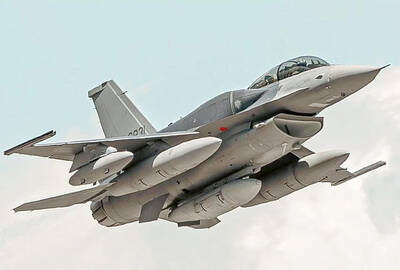
66 FIGHTER JETS: The aircraft is likely undergoing preparations for its transfer to Taiwan — a significant step forward in the nation’s modernization program, a lawmaker said The first of Taiwan’s order of F-16V Block 70 aircraft has been sighted in Texas ahead of delivery, Democratic Progressive Party (DPP) Legislator Wang Ting-yu (王定宇) said. Taiwan’s first F-16V Block 70 two-seat aircraft, tail number 6831, was seen flying from Lockheed Martin’s production facility in Greenville, South Carolina, to Naval Air Station Joint Reserve Base Fort Worth in Texas, Wang wrote on Facebook yesterday. The plane is likely undergoing preparations for its transfer to Taiwan, marking a significant step forward in the Republic of China Air Force’s modernization program, Wang said, citing military analysts. The F-16V Block 70 is a new-build version

NOT JUST NUMBERS: What matters to intelligence work is crucial, reliable information, so even a few credible leads can be highly valuable to national security, a legislator said The National Security Bureau (NSB) yesterday said it has finished the establishment of an information-reporting channel for Chinese nationals, the aim of which is to broaden intelligence gathering on China’s political, military, economic and social developments. Chinese nationals can submit information on the Web page, https://report.nsb.gov.tw, the NSB said in a statement. The move aims to expand the bureau’s diverse intelligence sources and is pursuant to the National Intelligence Services Act (國家情報工作法), it said, adding that it referenced practices adopted by intelligence agencies in the US, the UK and Israel. An increasing number of people are approaching Taiwanese agencies to provide information, as


 RSS
RSS