


The DPP's Hsinchu City chapter appealed to the party's headquarters yesterday to prevent Hsinchu Mayor Tsai Jen-chien (
"A verdict has not even been made by the court in Tsai's case. Besides, it is not within the local chapter's authority to get involved in the mayoral election," Hsu Yang-ming (許陽明), party deputy secretary-general, said at a press conference yesterday.
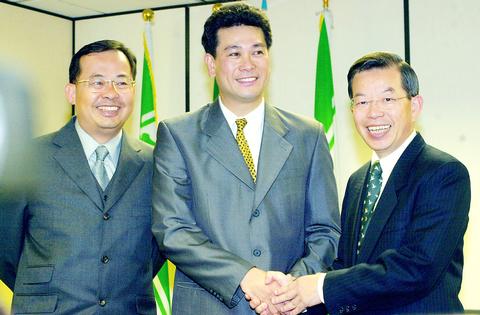
PHOTO: CHEN CHENG-CHANG, TAIPEI TIMES
Hsu added that the party's Central Standing Committee would send a letter admonishing the Hsinchu chapter for stepping out of bounds.
Tsai was charged on Saturday for forcing United Microelectronics Corp (
Prosecutors are seeking a two-and-a-half year sentence for Tsai.
"The indictment against Tsai has damaged the party's reputation," argued Yang Lung-yuan (楊隆源), director of the DPP's Hsinchu chapter, who endorsed yesterday's appeal along with six other members.
"We urge the central party headquarters to review Tsai's qualifications for participating in the party's primary," said Yang.
But Yang added that it was up to the party's central review committee to decide whether Tsai should have his party membership suspended, be expelled or be given an oral warning.
Yang also said that the central headquarters had the option to sit back and do nothing until the outcome of Tsai's case was determined.
Tsai, in response to the appeal, expressed his regret over the matter but refused to comment further.
Hsinchu Deputy Mayor Lin Cheng-chieh (
Other DPP officials said the move was meant to "embarrass Tsai."
Meanwhile, the DPP's Justice Alliance faction (
Chen, accompanied by faction leaders Yu Cheng-hsien (
Yu and Kao believe that Chen's fame will help him win office and help the party win votes from Aboriginal groups.
"Even if Chen is called up to run as the party's candidate, it will still be a tough battle," Hsieh told Chen yesterday morning. The DPP has long had a low support rate among Aboriginal groups.
"I will do my best," Chen responded.
"Chen's nomination would become possible if no one is interested in registering [during the primary] since our party will have only one nominee," Liu I-te (劉一德) said. Liu added there was a great possibility that this would happen but it was still too early to tell.

CREDIT-GRABBER: China said its coast guard rescued the crew of a fishing vessel that caught fire, who were actually rescued by a nearby Taiwanese boat and the CGA Maritime search and rescue operations do not have borders, and China should not use a shipwreck to infringe upon Taiwanese sovereignty, the Coast Guard Administration (CGA) said yesterday. The coast guard made the statement in response to the China Coast Guard (CCG) saying it saved a Taiwanese fishing boat. The Chuan Yu No. 6 (全漁6號), a fishing vessel registered in Keelung, on Thursday caught fire and sank in waters northeast of Diaoyutai Islands (釣魚台). The vessel left Keelung’s Badouzih Fishing Harbor (八斗子漁港) at 3:35pm on Sunday last week, with seven people on board — a 62-year-old Taiwanese captain surnamed Chang (張) and six
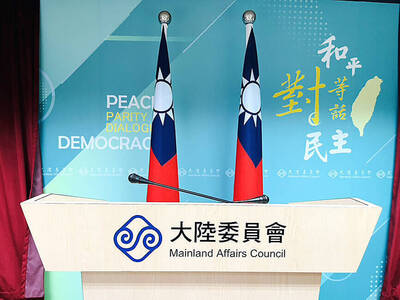
RISKY BUSINESS: The ‘incentives’ include initiatives that get suspended for no reason, creating uncertainty and resulting in considerable losses for Taiwanese, the MAC said China’s “incentives” failed to sway sentiment in Taiwan, as willingness to work in China hit a record low of 1.6 percent, a Ministry of Labor survey showed. The Directorate-General of Budget, Accounting and Statistics (DGBAS) also reported that the number of Taiwanese workers in China has nearly halved from a peak of 430,000 in 2012 to an estimated 231,000 in 2024. That marked a new low in the proportion of Taiwanese going abroad to work. The ministry’s annual survey on “Labor Life and Employment Status” includes questions respondents’ willingness to seek employment overseas. Willingness to work in China has steadily declined from

The Legislative Yuan’s Finance Committee yesterday approved proposed amendments to the Amusement Tax Act (娛樂稅法) that would abolish taxes on films, cultural activities and competitive sporting events, retaining the fee only for dance halls and golf courses. The proposed changes would set the maximum tax rate for dance halls and golf courses at 50 and 20 percent respectively, with local governments authorized to suspend the levies. Article 2 of the act says that “amusement tax shall be levied on tickets sold or fees charged by amusement places, facilities or activities” in six categories: “Cinema; professional singing, story-telling, dancing, circus, magic show, acrobatics

INFLATION UP? The IMF said CPI would increase to 1.5 percent this year, while the DGBAS projected it would rise to 1.68 percent, with GDP per capita of US$44,181 The IMF projected Taiwan’s real GDP would grow 5.2 percent this year, up from its 2.1 percent outlook in January, despite fears of global economic disruptions sparked by the US-Iran conflict. Taiwan’s consumer price index (CPI) is projected to increase to 1.5 percent, while unemployment would be 3.4 percent, roughly in line with estimates for Asia as a whole, the international body wrote in its Global Economic Outlook Report published in the US on Monday. The figures are comparatively better than the IMF outlook for the rest of the world, which pegged real GDP growth at 3.1 percent, down from 3.3 percent


 RSS
RSS