


As legislators from different political camps were debating the Fourth Nuclear Power Plant (核四廠) at the Legislative Yuan last week, energy experts from developed countries were disseminating the newest concepts of energy at an international conference in Taipei.
One of the keynote speakers, Christopher Flavin, president of the World Watch Institute, a research-oriented environmental organization in the US, outlined a new energy economy for the future -- one that may be highly efficient and decentralized, using a range of sophisticated electronics.
"The primary energy resources for this new system may be the most abundant ones on Earth: the sun, the wind, and other `renewable' sources of energy," Flavin said.
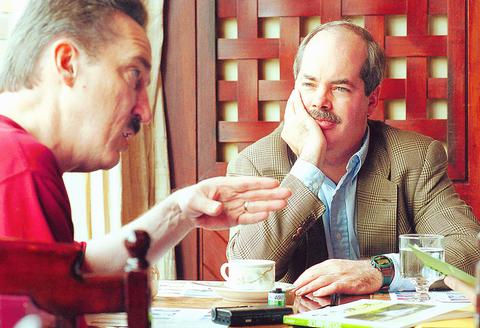
PHOTO: CHIANG YING-YING, TAIPEI TIMES
And over time, Flavin argued, hydrogen -- the lightest and most abundant element in the universe -- may become the main fuel for the 21st century, derived at first from natural gas and agricultural residues, but later produced from water using solar and other renewable energy sources.
"The implications of a shift to a solar-hydrogen economy are profound. A solar-hydrogen economy would be based on resources that are more abundant and more evenly distributed," Flavin said, adding that the world would be freed from dependence on oil, for example, finally ending the geopolitical nightmare that has preoccupied national security planners for the last half-century.
Practical Information for Taiwan
According to Flavin, access to petroleum was the underlying factor behind many of the 20th century's international conflicts -- from the Japanese attack on Pearl Harbor in 1945 to the Persian Gulf War in 1991 -- and has become synonymous with the power balances among Western economies, the Middle East and the developing world.
Energy experts, however, say that new technologies in the energy sector might rearrange the distribution of political and economic powers on the world map.
Examples from many countries around the world where these new technologies are used in economical and competitive ways were discussed last week at the International Conference on Sustainable Energy and Environmental Strategies: Taiwan and the World, held by the Institute for National Policy Research (
"If it [adopting new technologies] can work in all of these places, surely it can work also in Taiwan," John Byrne, director of CEEP, told the Taipei Times.
Byrne said that Japan is beginning to use these technologies, while many European countries, the US and Australia have made more aggressive efforts.
"It's time for Taiwan to join the new generation," Byrne said, adding that both the research capability of the high-technology industry in Taiwan and the business management administration system here form a firm basis for transforming Taiwan into a more competitive country.
Although practical information regarding cost-effective, renewable energy and energy efficient technologies was provided at the conference, experts said that whether Taiwan would eventually benefit from these developments was still uncertain.
Byrne said that the most difficult part for Taiwan in moving forward to join the class of competitive countries was in making proper energy policies. "For example, opening the market for electricity at customer levels will be the first step," Byrne said.
"The market should be opened at the local distribution level not the wholesale level," Flavin told the Taipei Times, arguing that if Taiwan only opens the market at the wholesale level, Taipower (
In a localized system, a region generates its own electricity. The advantage of this is that if excess energy is produced, it can be sold on the market for use in other areas.
"In your building, if you generate more electricity than is needed, you would be able to sell it back to the grid at a fair price," Flavin said, adding that Germany, Denmark and over 20 states in the US already have such systems.
Monopoly an obstacle
Byrne cited the perceived high cost of sustainable energy as one factor that has prevented Taiwan from taking up the newer technologies. The high cost, however, was due to the electricity monopoly in Taiwan, he said.
In addition, he added that "Most economists in the world agree that electricity generated from renewable energy should be more expensive than that from fossil fuels. The reason for this is that such technologies don't bring pollution that the conventional systems do," Byrne said.
Byrne added that when sustainably produced energy is introduced in Taiwan, energy generated from both new and old technologies should be offered to customers at the same price.
Byrne also said that the liquefied natural gas (LNG) market in Taiwan should be opened as soon as possible. "It is unreasonable that the LNG price in Taiwan is 20 percent higher than that in Japan, because Taiwan is closer to Indonesia, where both countries import the energy," said Byrne.
The recommendation made by the Ministry of Economic Affairs last Saturday, suggesting that the Fourth Nuclear Power Plant project be scrapped, also revealed the first signs of the opening of the market for LNG.
Minister of Economic Affairs Lin Hsin-yi (林信義) suggested that once the Fourth Nuclear Power Plant project was terminated, LNG use should be increased in order to meet the electricity demands of industry. According to 1999 statistics from the Energy Commission under the economic affairs ministry, only 6 percent of total energy supply in Taiwan currently comes from LNG.
Experts said that they are uncertain whether increasing the country's dependency on LNG would result in the liberalization of the market. At the least, experts said, emphasizing alternatives to nuclear energy was the first step in the so-called "right direction" in the energy sector.
"The economic affairs ministry's decision [to recommend abandoning nuclear energy] helps Taiwan to move forward into the 21st century. East Asia is currently the only place where the technology is still in use," Byrne said.
Based on talks with officials from the ministry, Byrne said that some officials are aware of the importance of new technologies, such as fuel cell technology and micro-turbine technology.
A focus on new technologies
"The Energy Commission has many talented and analytical people in engineering and economics, who are now being given the chance to focus their efforts on new technologies," Byrne said.
Byrne said that the commission has proposed a law to open the electricity market and the Legislative Yuan should act quickly on that.
Flavin told the Taipei Times that the decision would be a turning point for Taiwan.
Flavin added that it was the 1979 Three Mile Island accident in the US that prompted renewable energy research in the 1980s while the 1986 Chernobyl accident initiated renewable energy research in Europe.
SECURITY: Taipei presses the US for arms supplies, saying the arms sales are not only a reflection of the US security commitment to Taiwan but also serve as a mutual deterrent against regional threats Taiwan is committed to preserving the cross-strait “status quo” and contributing to regional peace and stability, the Presidential Office said yesterday. “It is an undeniable fact that the Republic of China is a sovereign and independent democratic nation,” Presidential Office spokeswoman Karen Kuo (郭雅慧) reiterated, adding that Beijing has no right to claim sovereignty over Taiwan. The statements came after US President Donald Trump warned against Taiwanese independence. Trump wrapped up a state visit to Beijing on Friday, during which Chinese President Xi Jinping (習近平) had pressed him not to support Taiwan. Taiwan depends heavily on US security backing to deter China from carrying
The subsidiary of Taiwan Semiconductor Manufacturing Co (TSMC, 台積電) in Kumamoto, Japan, turned a profit in the first quarter of this year, marking the first time the first fab of the unit has become profitable since mass production started at the end of 2024. According to the contract chipmaker’s financial statement released on Friday, Japan Advanced Semiconductor Manufacturing Inc (JASM), a joint venture running the fab in Kumamoto, posted NT$951 million (US$30.19 million) in profit in the January-to-March period, compared with a loss of NT$1.39 billion in the previous quarter, and a loss of NT$3.25 billion in the first quarter of

RESOLUTE BACKING: Two Republican senators are planning to introduce legislation that would impose immediate sanctions on China if it attempts to invade Taiwan US House of Representatives Speaker Mike Johnson on Sunday reaffirmed US congressional support for Taiwan, saying the US and “all freedom-loving people” have a stake in preventing China from seizing Taiwan by force. Johnson made the remarks in an interview with Fox News Sunday on US President Donald Trump’s summit with Chinese President Xi Jinping (習近平) last week. In an interview that aired on Friday on Fox News, just as Trump wrapped up a high-stakes visit to China, he said he has yet to green-light a new US$14 billion arms package to Taiwan and that it “depends on China.” “It’s a very good
US President Donald Trump yesterday said he would speak to President William Lai (賴清德) as his administration considers whether to move ahead with a US$14 billion weapons sale to Taiwan — a potential arms deal that has drawn criticism from China. “Well, I’ll speak to him. I speak to everybody,” Trump told reporters yesterday when asked if he had any plans to call his counterpart, although he did not offer a time frame for when such a conversation could take place. Trump previously said he would speak to the person “that’s running Taiwan,” without specifying who he meant. “We have that situation very


 RSS
RSS