


Near sightedness among Taiwanese children has reached a new high. According to a new survey, released this month by the Health Promotion Administration, the percentage of six-grade elementary students with near sightedness has risen to 70.6 percent. Third-grade junior high students fared the worst, with the figure as high as 89.3 percent.
The administration is urging parents to keep infants under the age of two away from any "computer, communication and consumer" (3C) electronics such as smartphones. It also recommends that children above two not be allowed to use electronic devices for more than one hour a day, and should play outdoors every day.
Meanwhile, a new study conducted by San Francisco State University in the US shows that smartphone overuse may have effects similar to “opium addiction” on the brain. The study suggests that people put their smartphones aside more often and take part in non-screen-based leisure activities.
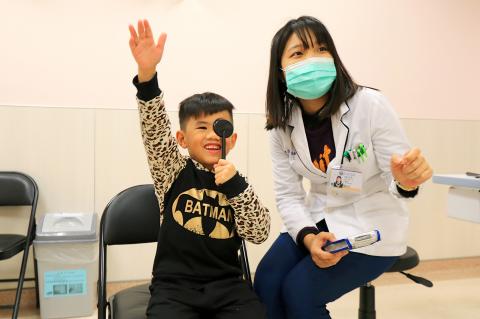
Photo: Chen Chien-chih, Liberty Times
照片︰自由時報記者陳建志
(CNA and Liberty Times, translated by Eddy Chang)
台灣兒童平均近視率創新高!根據國民健康署本月的最新調查指出,國小六年級學生近視率上升至百分之七十‧六,而國三生的情況最嚴重,近視率高達百分之八十九‧三。
國健署呼籲家長,應避免未滿兩歲的幼兒接觸智慧型手機等3C電子產品,兩歲以上的兒童每天接觸不得超過一小時,且每天都應從事戶外活動。
此外,美國舊金山州立大學一項新研究亦指出,人們對智慧型手機的過度使用,會對大腦產生與「鴉片成癮」類似的影響。該研究因此建議大家放下手機,多從事其他非3C產品的休閒活動。
(中央社、自由時報)

In English, “name idioms” are part of what makes English fascinating. Let’s put a few examples under the microscope. Doubting Thomas This expression stems from the Bible. Thomas, one of Jesus’s disciples, refused to believe Jesus had been resurrected from the dead. He declared he wouldn’t accept it until he could see the nail marks in Jesus’s hands and touch his wounds himself. Today, this idiom refers to someone who won’t believe something without concrete evidence. For instance, if your friend’s expertise is reliable, but you’re still suspicious, you might be a “doubting Thomas.” Smart Aleck The origin of this phrase likely comes from

A: Hey, the world’s major dictionaries just unveiled their words of the year for 2025. B: Yup, the Cambridge Dictionary chose the word “parasocial,” which refers to a connection that someone feels between themselves and a famous person they don’t really know. A: One-sided parasocial relationships with celebrities, influencers and even AI chatbots have clearly become more common. B: The Oxford Dictionary picked “rage bait” — online content designed to elicit anger by being frustrating, provocative or offensive in order to increase traffic to Web sites or social media accounts. A: The Collins Dictionary picked “vibe coding.” Let’s

A: Apart from the world’s major dictionaries, the online Dictionary.com actually picked “67” as its word of the year. B: What does “67” even mean? A: Even the dictionary wasn’t exactly sure about its meaning. The slang term’s origin might be traced to US rapper Skrilla’s song Doot Doot (67). Aren’t Taiwanese media outlets choosing the Mandarin word for 2025? B: Yeah and after hearing the song Good-for-Nothing, adapted from some catchphrases of Legislator Wang Shih-chien, I’m going to vote for the character “tsung” (hasty) from the lyrics. A: Hopefully, in the new year, we’ll be calm as the

Sea star wasting disease (SSWD) is a strange and serious illness affecting sea stars, or starfish. This disease causes sea stars to develop painful lesions, lose their arms, and eventually turn into a gooey, melted mess. Since it was first observed in 2013, millions of sea stars along the Pacific coast of North America have died from this __1__. Although viruses were once considered a possible cause, researchers now believe that environmental stressors and microorganisms are primarily __2__ for sea star wasting disease. One of the main environmental triggers appears to be warmer ocean water. When the water heats


 RSS
RSS