


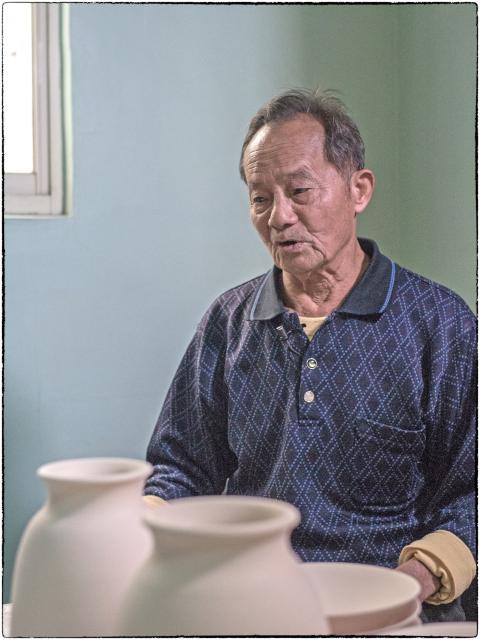
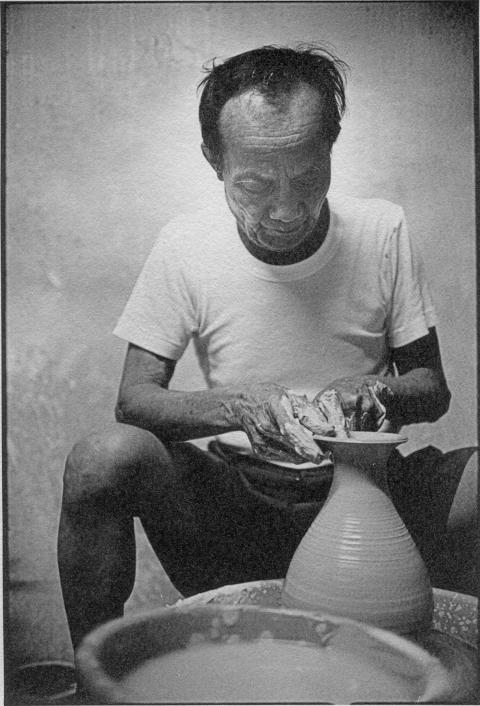
Wu Yao-cheng is an Yingge potter specializing in eggshell pottery. Born in Guangdong, China, he came to Taiwan in 1954.
Q: Is throwing eggshell pots your specialty?
拉薄胚是你的專長嗎?
Photos: Paul Cooper, Taipei Times
照片:台北時報記者古德謙攝
A: My specialty is throwing thin bodies and small vases. The technique is an issue of trimming the thrown piece. Nobody else can make the ceramics so thin. When they try to trim it down to that thin it breaks.
我的專長是拉薄胚和小花瓶。這個做法是修胚的問題,別人沒辦法修這麼薄,他們修太薄就破掉了。
Q: Where were you born?
Photos: Paul Cooper, Taipei Times
照片:台北時報記者古德謙攝
你在哪裡出生?
A: I was born in Fengxi Town, Chaozhou City, Guangdong province on Jan. 11, 1932.
我於民國二十一年一月十一日在廣東省潮州市楓溪鎮出生。
Q: Do they make porcelain in Chaozhou?
潮州有做瓷器嗎?
A: They’ve been making porcelain in Chaozhou for centuries, since the Song dynasty and the Yuan dynasty. I come from a line of potters, my grandfather was a potter, my father began working with porcelain instead. He would make vases.
潮州自古以來就是做瓷器的,從宋朝元朝就是做瓷器的。我家裡就是做瓷器的,我的祖父是做陶器,父親改做瓷器,父親是做花瓶類的。
Q: How many generations of your family have been involved in ceramics?
你們家大概做這個幾代?
A: As far as I know, three generations. They made pottery where I came from. During the war of the Second Sino-Japanese War, the Japanese attacked Chaozhou, so we had to leave. That would have been 1942; the Japanese came to Chaozhou in 1942. We escaped to a place where there was a factory making bowls: we went to Dapu County in Guangdong. Dapu was by a mountain, I was 11 when we escaped there, and 12 when I started throwing pots. After two years of throwing I could throw anything small, I had mastered throwing and trimming. After I had learned throwing I started learning how to trim. Actually, trimming is a more important skill than throwing, because it is more difficult. You have to master the use of the trimming blades.
在我知道就是三代,我們家鄉都是做瓷器。在抗戰時候日本打到了潮州,所以我們就跑走了。那時候是民國三十一年,三十二年日本才打到潮州。我們就逃到另一個地方的做碗的工廠,我們逃到廣東大埔縣,大埔縣靠山,我十一歲逃到那邊,十二歲開始學拉胚,拉胚拉了兩年,小的東西都會做了,拉胚修胚都學會了。學拉胚之後就開始學修胚,其實學修胚的工夫比較重要,因為修胚比較難,因為要操作修胚刀。
Q: When did you come to Taiwan?
你什麼時候搬到台灣來?
A: I didn’t come to Taiwan until 1954. After I finished school I served in the army, and in 1973, when I was 42 years old, I asked to be demobbed.
In 1983, tea drinking was all the rage. Tea houses were popping up everywhere, and tea drinking paraphernalia were selling well. I have been producing and selling these for 30 years, and it all started in the 1980s.
到民國四十三年才回到台灣來。畢業後在陸戰隊服務,到了民國六十二年,四十二歲,申請退伍。
我在民國七十二年搬來這裡,一直做到現在。生意都一直很好,民國七十三年的時候大家很風行茶藝,很多地方都開茶藝館,茶具銷路很好,我就賣了三十年,大概在民國七十幾年的時候。
(paul cooper, taipei times)
(台北時報記者古德謙整理)


★ Bilingual Story is a fictionalized account. 雙語故事部分內容純屬虛構。 Lucas was already on the ground before he fully understood what was happening. “Hurry! Kneel down!” someone shouted. The asphalt was warm against his knees. Around him, dozens of people lay flat in the narrow street outside Jenn Lann Temple in Dajia. Some pressed their hands together in prayer. Others closed their eyes. Lucas had only come to look at the temple. An hour earlier he had stepped into the noisy courtyard out of curiosity. Inside the main hall, people held incense sticks, bowed three times,

You might think knitting is only for grandmas, but surprisingly, many young people are embracing so-called “grandma hobbies.” On social media platforms, activities such as home cooking, embroidery and gardening are becoming popular among teenagers and young adults who are drawn to their relaxing and creative nature. “Grandma hobbies” typically refer to activities that are slow-paced, handmade and nostalgic. Common examples include knitting scarves, baking cookies, sewing clothes and growing plants. These hobbies were once part of everyday life for many women in previous generations, but today they provide an escape from the fast-paced digital world. The appeal

A: Isn’t the 2026 Coachella Valley Music and Arts Festival — a massive music event held every April — about to open in California? B: Yeah the festival is set to take place over two weekends, from April 10 to 12 and 17 to 19, US time. A: I heard this year’s main stage headliners include Sabrina Carpenter, Justin Bieber, Karol G and EDM DJ Anyma. B: The K-pop army is also making an appearance, with legendary group BigBang, SHINee member Taemin and girl group Katseye debuting for the first time. A: Isn’t Coachella also live-streamed on its YouTube

Visitors walking down the streets of London and other major English cities might notice a curious sight. Many of the old __1__ have some of their windows boarded up. What’s even stranger is that there doesn’t appear to be any consistent pattern as to which windows get covered. This architectural __2__ dates back over 300 years during a time when “coin clipping” was a common crime in England. Back then, silver coins had simple designs with __3__, unmarked edges. Without any pattern extending to the coins’ rims, it was difficult to tell if the edges had been __4__. This


 RSS
RSS