

Beitian Temple in Hualien County’s Jian Township held a ceremony to bring blessing to locals last Saturday. A 33-meter-high ladder, about the height of a 12-storey building, whose rungs were made with 108 swords, was erected on the main square. Ten worshipers who applied to take a test to be Taoist masters at the ceremony climbed the ladder’s steps one after another under the supervision of a temple official and a senior Taoist master.
One of the examinees was Lin Ji-chi, a 33-year-old cosmetologist. Lin’s mother is an attendant at the Kanling Temple in Ji-an Township. Lin said that Ji Gong, a divinity who is also known as the “Mad Monk,” had hinted to her mother three to four years ago that she had to take this test. Lin successfully passed her trial last Saturday.
This is the sixth consecutive year that the Beitian Temple blessing ceremony has been held. This year seven men and three women took the sword ladder test. A temple official first climbs up through the “heavenly gate” and onto the dizzyingly high platform at the top of the ladder, where he prays to the gods to grant blessings to local people and throws pieces of paper with auspicious Taoist spells to worshippers on the ground. After praying, he asks the gods’ permission to start the ceremony by casting divination blocks.
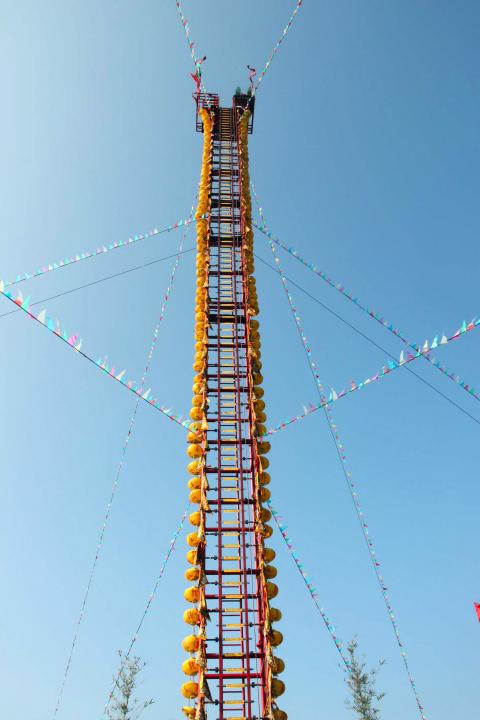
Photo: Lin Hsin-han, Liberty Times
照片:自由時報記者林欣漢
After the ceremony, the 10 worshipers who had to climb the sword ladder did so one step at a time, guided by the senior master. After reaching the platform at the top and worshiping the gods, they cast their divination blocks to the ground until they obtained “divine approval,” a sign that they had passed the test. Thereupon they officially became Taoist masters.
The first person to climb the ladder was Chen Pao-chu, a 55-year-old woman. With bare feet, she started to ascend the ladder of swords. She was almost exhausted halfway, and took a rest while holding on to the ladder, but eventually she succeeded in climbing to the top.
Kang Lai-fa, a temple official, said that Chen had passed the test last year but had kept it secret from her husband. Since her secrecy was contradictory to one of the traditional wifely virtues, which is to help one’s husband and teach the children, she was disqualified. That is why she came back from Kaohsiung to climb the sword ladder again this year.
(LIBERTY TIMES, TRANSLATED BY TAIJING WU)
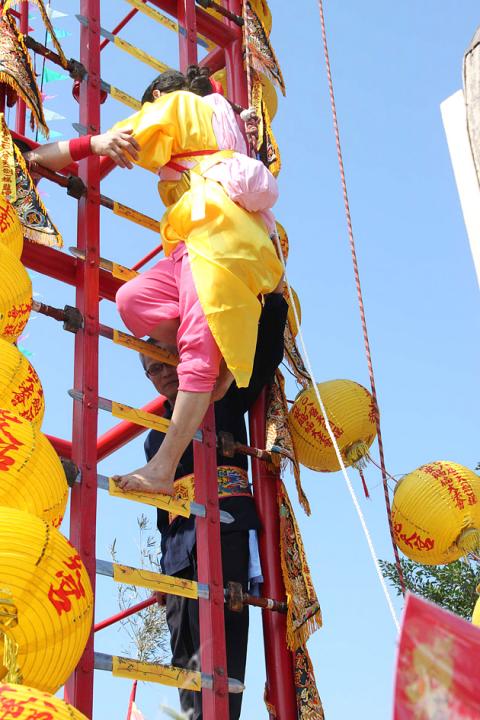
Photo: Lin Hsin-han, Liberty Times
照片:自由時報記者林欣漢
花蓮縣吉安鄉北天宮上週六舉行祈安賜福法會,廣場架起三十三公尺、約十二層樓高的一百零八層劍梯,法會中十名參加登劍梯考取法師資格的信徒,在先鋒官和老道長的引導下,一步步完成儀式登頂。
三十三歲的美容師林濟琦則是「指定考生」,三、四年前濟公就透過她在吉安鄉感靈宮服務的母親,示意要她參加考試,上週六也順利通過考驗。
北天宮祈安賜福法會已是連續第六年舉辦,今年共有七男三女參加登劍梯儀式,由先鋒官經「通天門」,攀上高聳入雲的天壇,奏請上蒼賜福地方,並撒下平安符給信眾,擲筊請示上天應允。
祭拜儀式後,十名參加登劍梯儀式的信徒,在資深道長的帶領下,一步步向上爬,登上天壇祭拜後,還需向地面擲得聖筊才算通過考驗,成為法師。
第一個參加登劍梯考驗的是五十五歲的女性陳寶珠,她赤腳開始爬上劍梯,中間幾度體力耗盡,環抱著劍梯休息,最後仍成功登頂。
北天宮住持康來發說,陳寶珠去年已通過試驗,卻因將此事瞞著丈夫,違反相夫教子原則,被取消資格,這次從高雄再來爬一次劍梯。
(自由時報記者林欣漢)

Effective presentations focus on delivering a clear perspective rather than simply listing facts and numbers. To achieve this, you must prioritize logic and visual simplicity over information overload. Successful speakers follow the principle that every slide should focus on a single core concept. If your content feels crowded, it’s better to split the information across multiple slides so that your audience can grasp the main point within seconds. Furthermore, opt for visuals instead of lengthy descriptions, as a meaningful photo or a clear chart communicates much more effectively than a crowded table. Additionally, maintaining consistency by using the same font, limiting

A: The 2026 Nagoya Asian Games will open on Sept. 19 and run through Oct. 4. B: How many athletes will Taiwan send to the games? A: It will send 482 athletes to compete in 34 sports this time, including 45-year-old senior shooter Lin Yi-chun, an eight-time Asian Games veteran. B: And the news says that several Olympic gold medalists — including badminton superstar Wang Chi-lin, weightlifter Ko Hsing-chun and boxer Lin Yu-ting — will also compete in the games. A: Taiwan actually won 19 gold medals at the 2023 Hangzhou Asian Games, ranking sixth on the medal tally.

Sitting down with a cup of coffee is one of life’s simple pleasures. However, many people are not fully aware of the actual differences between different types of coffee beyond their names. For example, what exactly is espresso? Although the name may sound like “express,” it is more closely related to the Italian idea of coffee being “pressed out” under pressure. That, however, is only part of the story. What makes this more confusing is that all espresso is coffee, but not all coffee is espresso. The differences largely come down to the type of roast and how the
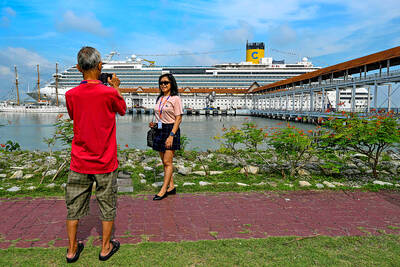
A: Wow, the 20th Asian Games will open tomorrow in Nagoya, Japan, with over 11,000 athletes from 45 countries and regions competing in 43 sports. B: To save costs, instead of building an athletes’ village, Nagoya’s renting a cruise ship and some container houses. The quality and quantity of accommodation have drawn criticism. A: Are there any new sports in this year’s games? B: There are three new events: mixed martial arts, padel, and teqball. A: And in baseball, defending gold medalist South Korea and previous silver medalist Taiwan will meet in their first match next Monday. Let’s


 RSS
RSS