


The first global hotel Keys Selection by the Michelin Guide includes four hotels in Taiwan, Michelin announced yesterday.
All four received the “Michelin One Key,” indicating guests are to experience a “very special stay” at any of the locations as the establishments are “a true gem with personality. Service always goes the extra mile, and the hotel provides much more than others in its price range.”
Of the four hotels, three are located in Taipei and one in Taichung.
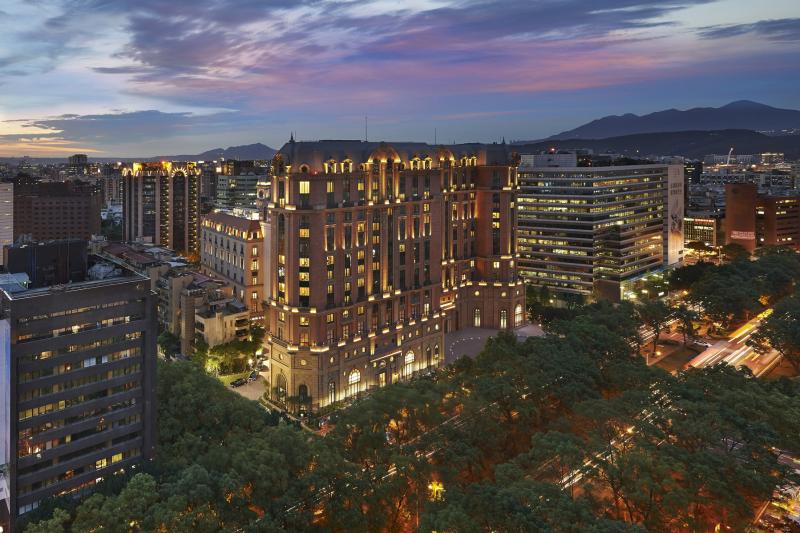
Photo courtesy of Mandarin Oriental Taipei
In Taipei, the One Key accolades were awarded to the Capella Taipei, Kimpton Da An Taipei and Mandarin Oriental Taipei.
Capella Taipei was described by Michelin as being featured for being a property designed by Hong Kong’s world-renowned hotel architect Andre Fu (傅厚民), which combines a luxury hotel experience with a luxe private residence feel.
It was also selected for providing panoramic views of the capital city and surrounding hills.
Kimpton Da An Taipei was selected as a boutique-hotel that cares for the culinary preferences of its customers.
With its flagship restaurant, Tavernist, run by a former alumnus of Chef Rene Redzepi’s gastronomic mecca Noma, the hotel offers a fine-dinning culinary experience that is further spotlighted by the pairing of the establishment’s “daily social hour,” where guests are treated to wine, tapas and casual conversations with fellow residents.
The Mandarin Oriental was picked for its luxury hotel amenities.
In addition to the lavish comforts accentuated by attentive service from the staff, the hotel is included on the Michelin list with its spa and wellness program, together with eateries that are so diverse the hotel even offers a specialized cake shop.
The sole One Key awarded outside Taipei went to Taichung’s Hoshinoya Guguan for the hot spring baths made famous by the hotel’s Japanese parent company the Hoshinoya hotel group.
By selecting the valley in the central mountains of Taiwan, the Japanese company is able to run the establishment like a Japanese ryokan, offering tranquil and luxurious rooms that pair with the location’s scenery.
As with the 2,457 establishments listed in the Michelin Keys guide, all four Taiwanese hotels were judged for their “excellence in design, architecture, service and personality.”
Much like the Michelin Stars for restaurants, the Michelin Keys is a three-tier award given to hotels.
Where One Key awards given to Taiwan indicates that a property is a very special stay, Two Keys means an establishment is “an exceptional stay” that is unique in every way, while Three Keys indicates a hotel is “an extraordinary stay” where patrons are to experience “the ultimate in comfort and service, style and elegance.”
Although the Michelin company had long included hotels in its guides, the catalogue only started distinguishing properties with its Michelin Keys accolades last year, initially focusing on hotels in western countries.
On Wednesday, the company officially revealed the 2,457 hotels selected for this year as the first official listing for Michelin Keys.
“125 years after its creation as a guide for discerning travelers, The Michelin Guide is once again redefining excellence — this time in the world of hospitality,” said Michelin Guide head Gwendal Poullennec.
“Just as Michelin Stars celebrate the world’s most exceptional restaurants, Michelin Keys now honor hotels that offer truly remarkable stays, where design, service and location come together to create unforgettable moments,” Poullennec added.

Considering that most countries issue more than five denominations of banknotes, the central bank has decided to redesign all five denominations, the bank said as it prepares for the first major overhaul of the banknotes in more than 24 years. Central bank Governor Yang Chin-lung (楊金龍) is expected to report to the Legislative Yuan today on the bank’s operations and the redesign’s progress. The bank in a report sent to the legislature ahead of today’s meeting said it had commissioned a survey on the public’s preferences. Survey results showed that NT$100 and NT$1,000 banknotes are the most commonly used, while NT$200 and NT$2,000

The Centers for Disease Control (CDC) yesterday reported the first case of a new COVID-19 subvariant — BA.3.2 — in a 10-year-old Singaporean girl who had a fever upon arrival in Taiwan and tested positive for the disease. The girl left Taiwan on March 20 and the case did not have a direct impact on the local community, it said. The WHO added the BA.3.2 strain to its list of Variants Under Monitoring in December last year, but this was the first imported case of the COVID-19 variant in Taiwan, CDC Deputy Director-General Lin Ming-cheng (林明誠) said. The girl arrived in Taiwan on

South Korea is planning to revise its controversial electronic arrival card, a step Taiwanese officials said prompted them to hold off on planned retaliatory measures, a South Korean media report said yesterday. A Yonhap News Agency report said that the South Korean Ministry of Foreign Affairs is planning to remove the “previous departure place” and “next destination” fields from its e-arrival card system. The plan, reached after interagency consultations, is under review and aims to simplify entry procedures and align the electronic form with the paper version, a South Korean ministry official said. The fields — which appeared only on the electronic form

The Ministry of Foreign Affairs (MOFA) is suspending retaliation measures against South Korea that were set to take effect tomorrow, after Seoul said it is updating its e-arrival system, MOFA said today. The measures were to be a new round of retaliation after Taiwan on March 1 changed South Korea's designation on government-issued alien resident certificates held by South Korean nationals to "South Korea” from the "Republic of Korea," the country’s official name. The move came after months of protests to Seoul over its listing of Taiwan as "China (Taiwan)" in dropdown menus on its new online immigration entry system. MOFA last week


 RSS
RSS