


With the year of the rabbit arriving in less than a month, people have started thinking about praying for a trouble-free year ahead, and have begun to ask temple workers how to keep the god Taisui happy.
Taisui rules over all other gods. He commands respect, and it is dangerous to anger him, as this will always lead to misfortune. The lunar almanac for the year of the rabbit was published early last month, and it shows that people born in previous years of the rabbit risk offending Taisui this year. The rooster is diametrically opposite the rabbit [on the Chinese zodiac wheel], and the horse and rat command the sides of the perpendicular axis of the wheel. It is therefore advisable for people born under these four zodiac years to go to temples to worship Taisui.
Temple workers have found that in recent years young people have been praying to Taisui with specific themes, rather than the traditional generalized prayers. Some people have been asking for a better relationship with their partner, others for luck with their finances, and others for success in civil service examinations.
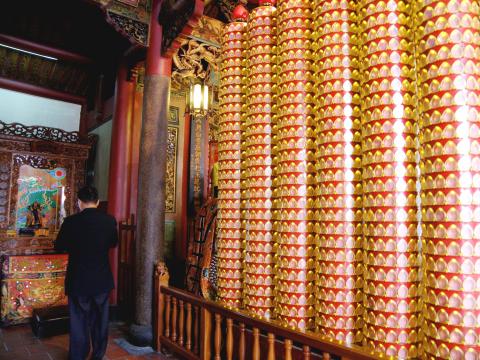
PHOTO: MENG CHING-TZU, LIBERTY TIMES 照片:自由時報記者孟慶慈
The abbot of the Grand Guanyin Pavilion Sing-ji Temple in Tainan City says that the economy really is showing signs of recovery, as people coming to the temple to pray to Taisui are no longer nit picking over the fees. Over the past two years worshippers have been asking for group discounts, or asking whether they could just light one lantern for their whole family.
The abbot discovered that the age-level of people worshipping Taisui has dropped. In the past it was mostly older people, but now quite a few people in their twenties and thirties are coming to worship Taisui on their own behalf.
Interestingly, the younger generation is very specific about what they are praying for. One young couple came to ask Taisui to help them improve their relationship. Some young people are worried their boyfriend or girlfriend has changed, that they have become a little distant, and hope that Taisui can bring back some of the original magic to the relationship.
According to the abbot, prayers to Taisui are usually done prior to the Lantern Festival, which falls on the 15th day of the first lunar month. An older woman, who was worried her business wasn’t going too well, came to pray to the Taisui of the Year of the Tiger last year and in more recent visits she appears to be in much better spirits.
According to the Web site of the Lugang Mazu Temple in Changhua County, people born under the years of the rabbit, rooster, rat, and horse should worship the Taisui of the year of the rabbit in order to pray for good fortune and avoid misfortune. The ritual of lighting lanterns is for all people, and not necessarily for those who risk offending Taisui, to pray for good health and a bright future. This involves writing down one’s name, date of birth, and address on the lantern, and then praying to the gods to bring good fortune and longevity and protection against bad luck.
(LIBERTY TIMES, TRANSLATED BY LIN YA-TI)
不到一個月就要迎接兔年,民眾為祈求來年一切順利,已經開始詢問安太歲等事宜。
太歲為百神之主,尊貴不可犯,犯者必凶。兔年農民曆都已在上個月初出版,兔年屬兔者犯太歲,屬雞者正沖,馬、鼠偏沖。因此建議這四個生肖的人,到廟裡安太歲。
廟方人員發現,近年來年輕一輩朝主題式安太歲,而非籠統求平順,有人求感情順利、求財運,也有人求公職考試順利而來安太歲。
台南大觀音亭興濟宮廟祝表示,景氣好像真的好轉,問安太歲的人不太計較費用。前兩年不乏信眾問一次安多人可否打折,或問可否全家共同安一個光明燈。
廟祝發現,安太歲者年齡層亦呈下降趨勢,過去幾乎都是年長者安太歲,現在不少廿、卅歲的民眾自己安太歲。
有趣的是,年輕人主題式安太歲。曾有小情侶為了讓彼此的感情更好而一起安太歲,也有年輕人覺得男、女朋友最近不太一樣,有點冷淡,希望藉由安太歲讓感情恢復甜蜜。
廟祝說,安太歲一般都是元宵節前安,也就是農曆正月十五日。一名輕熟女因為覺得生意不太順,去年來安虎年太歲,最近見她來廟裡祈福,神情輕快許多。
根據彰化縣鹿港天后宮的網站,兔年安太歲,適用對象肖兔、雞、鼠、馬之犯太歲民眾,為了要趨吉避凶,必須安太歲。光明燈適用於本命年犯太歲者,亦適用於非犯太歲者,以祈求身體健康,前程光明。點光明燈即是將姓名、生辰、住址書寫於燈上,拜請神明保佑,增福益壽,避免運途不順。
(自由時報記者孟慶慈)

The debate surrounding Taipower’s recent corporate identity reboot has gone well beyond the design community. The controversy began after Taipower replaced the familiar “Taiwan Power Company” wording — widely regarded as the calligraphy of Yu You-ren (1879-1964), former Control Yuan president and master calligrapher — with a modern logotype by designer Aaron Nieh’s team, Aaron Nieh Workshop. Taipower said the change was not a wholesale replacement of old signage, but an “optimization of its identity system,” aimed at meeting the needs of digital media, electronic bills, apps, social media graphics and various small-format applications. Existing physical markings, such as building

Since 2005, the third Monday in January has come to be known as “Blue Monday.” In other words, that day is believed to be the most depressing day of the year. This concept seems logical at first. After all, Monday marks the start of the school or workweek after two days of rest and fun. Also, blue is a color that is often associated with sadness. Furthermore, in many parts of the world, January is a time when the weather is cold, rainy, and gloomy. But is there any scientific proof that this January day is truly sadder than any of

Continued from yesterday(延續自昨日) https://www.taipeitimes.com/News/lang For the most part, the idea of “Blue Monday” has been rejected as a myth. Some mental health experts also say there is a danger in labeling a certain day as the most depressing time of the entire year. Some argue that if people expect to feel sadder on the third Monday in January, this belief alone may increase their anxiety. One group that is worried about the negative effect of believing in Blue Monday is Samaritans. A mental health charity based in the UK, Samaritans is working to turn Blue Monday into “Brew Monday.” In this

1. 他兩天後回來。 ˇ He will return in two days. χ He will return after two days. 註︰從現在開始,說「多久以後」,應該用 in,不用 after,例如: He plans to finish the work in three months. I am sure we will hear from him in a few days. 請注意 in a few days、in three months 許多人誤以為是「幾天內」、「三個月內」,其實是「幾天後」、「三個月後」。 如指「某個時刻或日期或事件以後」,可用 after。例如: I will be back after four o’clock.(或 after 4 August,或 after lunch)。 2. 他要在那牆上開一扇門。 ˇ He wants to put a door in that wall. χ He wants to put a door on that wall. 註︰門不是掛在牆上,也不是靠在牆上,而是開在牆裡,應該用 in。 比較下列各句: There is a painting on the wall. Why is that plank of wood leaning against the wall? The thief made a hole in the wall. 3. 我在報上看到這個消息。 ˇ I


 RSS
RSS