


California will phase out certain ultra-processed foods from school meals over the next decade under a first-in-the-nation law signed on Oct. 8 by Gov. Gavin Newsom.
The law seeks to define ultra-processed foods, the often super-tasty products typically full of sugar, salt and unhealthy fats. The legislation requires the state’s Department of Public Health to adopt rules by mid-2028 defining “ultra-processed foods of concern” and “restricted school foods.”
Schools have to start phasing out those foods by July 2029, and districts will be barred from selling them for breakfast or lunch by July 2035. Vendors will be banned from providing the “foods of concern” to schools by 2032.
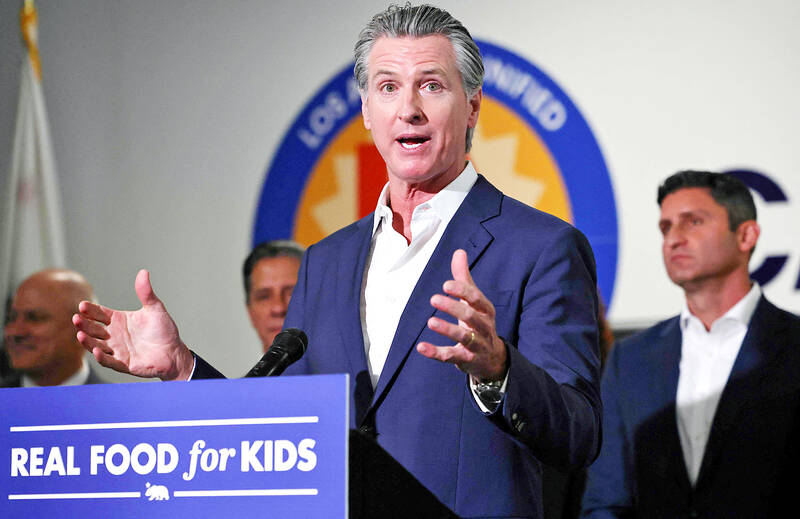
Photo: AFP 照片:法新社
Newsom issued an executive order earlier this year requiring the Department of Public Health to provide recommendations by April on limiting harms from ultra-processed foods. The Democratic governor signed a law in 2023 banning certain synthetic food dyes from school meals.
Legislatures across the country have introduced more than 100 bills in recent months seeking to ban or require labeling of chemicals that make up many ultra-processed foods, including artificial dyes and controversial additives.
Americans get more than half their calories from ultra-processed foods, which have been linked to a host of health problems, including obesity, diabetes and heart disease. However, studies haven’t been able to prove that the foods directly cause those chronic health problems.
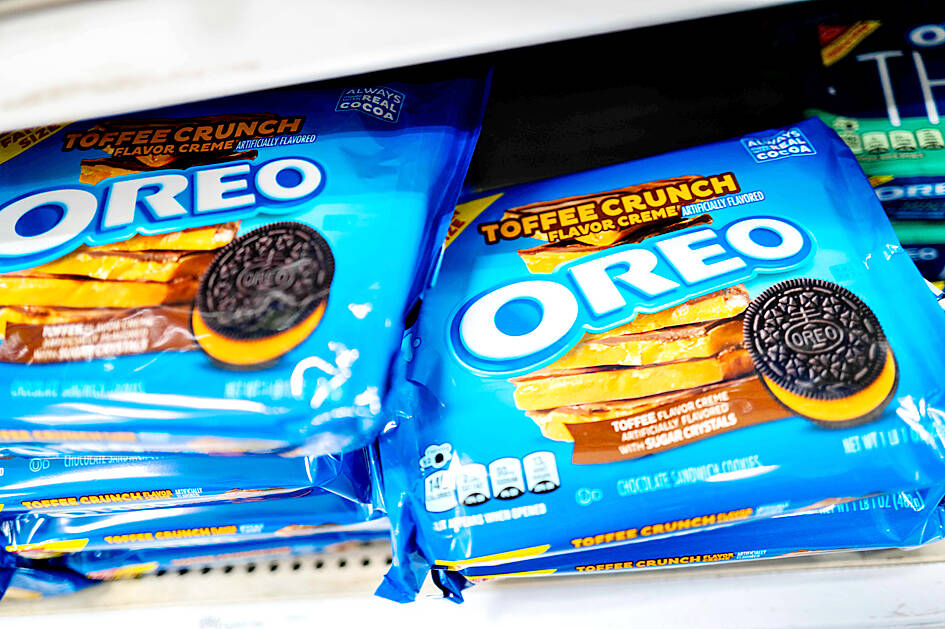
Photo: AFP 照片:法新社
DEFINING ULTRA-PROCESSED FOODS
Defining ultra-processed foods has been tricky. The most common definition is based on the four-tier Nova system developed by Brazilian researchers that classifies foods according to the amount of processing they undergo.
Researchers often describe ultra-processed foods as the types of products that contain industrially made ingredients that you won’t find in a home kitchen.
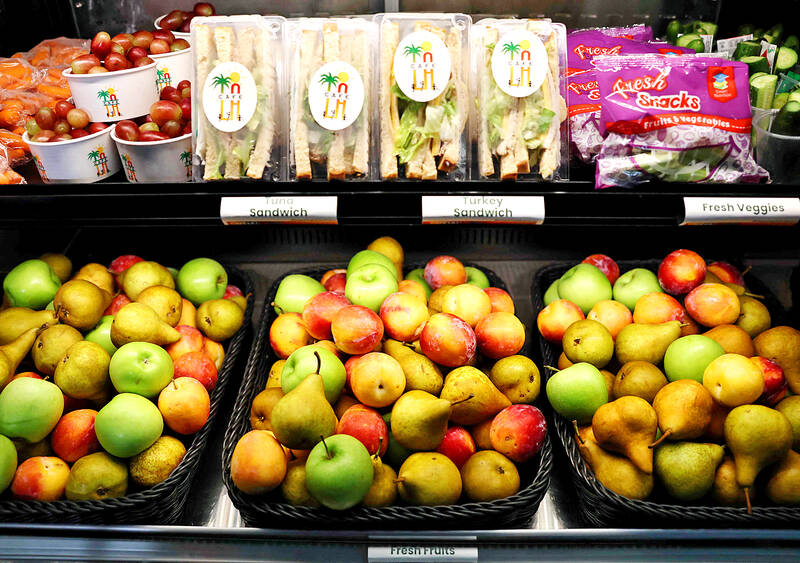
Photo: AFP 照片:法新社
But some highly processed foods — think tofu, certain types of whole-grain bread and infant formula — can be healthy. And it’s not clear whether it’s the processing of the foods or the combination of nutrients such as sugar, fat and salt that leads to poor health outcomes.
US health officials recently launched an effort to come up with a federal definition of ultra-processed foods, saying there are concerns over whether current definitions “accurately capture” the range of foods that may affect health.
SOME SAY CALIFORNIA’S BAN GOES TOO FAR
Some critics of the ban say it is too broad and could unintentionally limit access to nutritious foods.
The California School Boards Association is concerned about the cost for districts to phase out these foods in the next few years. There is no extra money attached to the bill.
“You’re borrowing money from other areas of need to pay for this new mandate,” spokesperson Troy Flint said.
The law could raise costs for school districts by an unknown amount by potentially making them purchase more expensive options, according to an analysis by the Senate Appropriations Committee.
SOME DISTRICTS ALREADY OVERHAULING SCHOOL MENUS
Some school districts in California are already phasing out foods the law seeks to ban.
Michael Jochner spent years working as a chef before taking over as director of student nutrition at the Morgan Hill Unified School District about eight years ago. He fully supports the ban.
Now they don’t serve any ultra-processed foods, and all their items are organic and sourced within about 80km of the district, Jochner said. They removed sugary cereals, fruit juices and flavored milks, and deep-fried foods such as chicken nuggets and tater tots from their menus, he said.
Ravinder Khaira, a pediatrician in Sacramento who supports the law, said at a legislative hearing that the ban will help respond to a surge of chronic conditions in children fueled by poor nutrition.
“Children deserve real access to food that is nutritious and supports their physical, emotional and cognitive development,” Khaira said. “Schools should be safe havens, not a source of chronic disease.”
(AP)
加州將在未來十年內逐步汰除學校餐食中的一些過度加工食品(又譯超加工食品),這項全美首創的法律已於10月8日由州長加文.紐森簽署生效。
這項法律旨在界定何謂「過度加工食品」,這類食品通常口感強烈、味道好,但含有大量的糖、鹽,以及不健康的脂肪。法案規定,加州公共衛生部必須在2028年年中以前制定規範,定義「有疑慮的過度加工食品」以及「必須限制的學校食品」。
學校必須在2029年7月前開始逐步淘汰這些食品,而各學區將在2035年7月起不得於早餐或午餐中販售這些食品。供應商也將在2032年前被禁止提供這些「有疑慮的食品」給學校。
紐森今年稍早已發布行政命令,要求公共衛生部在明年4月前提出建議,以減少過度加工食品所帶來的危害。這位民主黨籍州長在2023年也簽署了一項禁止學校餐點中使用特定人工食用色素的法律。
美國各州近來已提出超過100項相關法案,試圖禁用或要求標示過度加工食品中所含的化學成分,包括人工色素和具爭議的添加物。
美國人攝取的熱量中有超過一半來自過度加工食品,而這些食品已被證實與多種健康問題有關,包括肥胖、糖尿病與心臟疾病。然而,目前尚無研究能明確證明這些食品直接導致慢性病。
過度加工食品之定義仍具爭議
如何定義「過度加工食品」,一直是個難題。目前最常見的定義來自巴西研究人員開發的「Nova食品分類系統」,該系統依食品的加工程度分類成四級。
研究人員通常形容過度加工食品為含有工業製成成分的產品,而這些成分在一般家庭廚房中幾乎不會出現。
但也有些經高度加工的食品——例如豆腐、某些全穀類麵包和嬰兒配方奶粉——對健康有益。而目前尚不清楚,究竟是加工方式本身,還是糖、脂肪和鹽的營養組合,才是導致健康問題的真正因素。
美國衛生官員近期也啟動一項工作,試圖建立聯邦層級的「過度加工食品」定義,因為目前的定義是否能「準確涵蓋」那些可能影響健康的食品,仍有爭議。
部分人士認為禁令過於嚴苛
一些批評者認為這項禁令範圍過廣,可能不知不覺限縮了學生獲取營養食品的機會。
加州教育董事會協會擔憂學區在未來幾年內執行淘汰措施所需的成本,因為該法案並未提供額外的經費支援。
該協會發言人特洛伊.弗林特表示:「你必須從其他更需要資源的領域中挪用預算,來支付這項新命令的費用」。
根據加州參議院預算委員會的分析,這項法律可能會提高學區的支出,因為他們可能需要購買更昂貴的替代品,但具體增加多少仍無法預估。
部分學區已開始改變學校菜單
加州已有一些學區率先淘汰即將被禁止的食品。
麥可.喬赫納曾擔任多年主廚,約8年前成為摩根山聯合學區學生營養部門的主管。他對這項禁令表示全力支持。
喬赫納表示,他們現在完全不提供任何過度加工食品,所有食品都是有機產品,並且來源距離學區不超過80公里。他們已經將含糖穀片、果汁、調味牛奶,以及炸雞塊和炸薯餅等油炸食品移出菜單。
沙加緬度的小兒科醫師拉溫德.凱拉在立法聽證會中表示,這項禁令有助於對抗因營養不良而造成的兒童慢性病激增問題。
他表示:「孩子們應該有真正的機會獲取營養的食品,足以維持他們的身體、情緒和認知發展。學校應該是安全的避風港,而不是慢性疾病的來源」。
(台北時報林俐凱編譯)

A: South Korean supergroup BTS is finally staging a comeback tomorrow, releasing their new album in nearly four years: “Arirang.” B: And to promote their new album, BTS will hold a comeback concert at the Gwanghwamun Plaza in downtown Seoul this weekend. According to police estimates, the show could attract a crowd of at least 260,000 fans. A: What about their new world tour? When will it start? B: The upcoming world tour will kick off from Gaoyang on April 9, and Kaohsiung will be included this time. A: Really? Hurry up and tell me the dates of the Kaohsiung shows. Maybe we

A: K-pop supergroup BTS is set to tour Taiwan at the end of the year, putting on three shows in Kaohsiung on Nov. 19, 21 and 22. B: But before that, VieShow Cinemas across Taiwan will launch the “BTS World Tour ‘Arirang’ in Japan Live Viewing” from the Tokyo Dome on April 18. A: In recent years, BTS’ junior groups — Tomorrow X Together (TXT) and CORTIS, which debuted under the same label in 2019 and 2025 respectively — have also quickly become global sensations. B: I like those two groups, too. Didn’t TXT just perform at the Taipei Dome recently? Their popularity

K-pop oozes with talent, flair and hard work, but the spectacularly successful South Korean music industry also has a dark side — sometimes with tragic results. After BTS’s comeback concert on Saturday, AFP looks at the intense competition, the grueling training, the tight control over stars’ lives and the sometimes obsessive fan behavior in the industry. 300 GROUPS South Korean record labels launch dozens of new groups every year in the hope they will become the next BTS or Blackpink, but with some 300 outfits already out there, the big time is elusive. The tiny minority of the thousands of young hopefuls
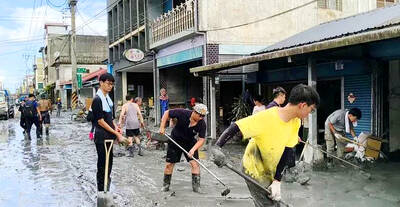
Heavy rain brought by Typhoon Ragasa caused the barrier lake above Matai’an Creek in Hualien’s Guangfu Township to overflow on Sept. 23 of last year. The sudden rush of water and mud destroyed a major bridge and swept through nearby villages, leaving significant damage in its wake. The barrier lake was formed in July, when heavy rain caused landslides and blocked the creek’s natural flow. As rainwater built up, the lake grew increasingly unstable. When Typhoon Ragasa hit, the water level rose rapidly and finally overflowed. In the aftermath, volunteers across Taiwan, known as “shovel supermen,” stepped in


 RSS
RSS