


Relax in front of the television? Be forewarned, each hour you spend there boosts chances of going to an early grave by 11 percent and chances of death from cardiovascular disease by 18 percent, a major study released has found.
The Australian study appearing in Circulation: Journal of the American Heart Association looked at the health habits of 8,800 people between 2000 and 2006.
It found that a sedentary spell on the sofa watching TV had negative effects on blood sugar and blood fats.
Whether one is obese, overweight or fit, an hour of television time a day delivers an 11 percent higher risk of early death, a nine percent higher risk of cancer death and an 18 percent higher risk of death from cardiovascular disease, the research found.
People who watch television four hours a day see their increased rate of death from any cause by 46 percent, and from cardiovascular disease it soars by 80 percent.
“The human body was designed to move, not sit for extended periods of time,” said David Dunstan, lead author of the study, with the Baker IDI Heart and Diabetes Institute in Victoria, Australia.
“Technological, social and economic changes mean that people don’t move their muscles as much as they used to — consequently the levels of energy expenditure as people go about their lives continues to shrink,” Dunstan said.
“For many people, on a daily basis they simply shift from the chair in the car to the chair in the office to the chair in front of the television,” he said.
The average time people spend watching television daily is three hours in Britain and Australia, while in the US it is 4.5 hours a day.(AFP)
在電視機前好好放鬆一下?先警告你,最近公佈的一項重要研究發現,多待在電視前一小時,英年早逝的機會就增加百分之十一,而罹患心血管疾病死亡的機率則提高百分之十八。
刊登於《血液循環:美國心臟協會期刊》上的這項澳洲研究,在二OOO年至二OO六年間調查了八千八百位民眾的健康習慣。
結果發現,長時間坐在沙發上看電視對血糖和血脂肪都有負面的影響。
該研究發現,無論是病態肥胖、過重或體型勻稱的人,一天看一小時電視,早逝的風險會提高百分之十一,死於癌症的機會增加百分之九,而死於心血管疾病的機會則增加百分之十八。
每天看四小時電視的人,死於各種疾病的機會增加百分之四十六,因心血管疾病致命的機率則飆升百分之八十。
澳洲維多利亞省貝克IDI心臟病與糖尿病研究所的該研究主持人大衛.唐斯坦說:「人的身體是用來活動,不是讓你長時間坐著不動的。」
唐斯坦說:「科技、社會和經濟變革使得人們不像從前那樣活動他們的肌肉──因此,現代人生活的方式讓身體能量的消耗逐漸減少。」
他說:「對許多人而言,他們每天只是在車子的座椅、辦公室的椅子,和電視機前的椅子間來回變換而已。」
英國人和澳洲人每天平均看電視三小時,美國人則是平均四個半小時。(法新社╱翻譯:袁星塵)

A: South Korean supergroup BTS is finally staging a comeback tomorrow, releasing their new album in nearly four years: “Arirang.” B: And to promote their new album, BTS will hold a comeback concert at the Gwanghwamun Plaza in downtown Seoul this weekend. According to police estimates, the show could attract a crowd of at least 260,000 fans. A: What about their new world tour? When will it start? B: The upcoming world tour will kick off from Gaoyang on April 9, and Kaohsiung will be included this time. A: Really? Hurry up and tell me the dates of the Kaohsiung shows. Maybe we

K-pop oozes with talent, flair and hard work, but the spectacularly successful South Korean music industry also has a dark side — sometimes with tragic results. After BTS’s comeback concert on Saturday, AFP looks at the intense competition, the grueling training, the tight control over stars’ lives and the sometimes obsessive fan behavior in the industry. 300 GROUPS South Korean record labels launch dozens of new groups every year in the hope they will become the next BTS or Blackpink, but with some 300 outfits already out there, the big time is elusive. The tiny minority of the thousands of young hopefuls

A: K-pop supergroup BTS is set to tour Taiwan at the end of the year, putting on three shows in Kaohsiung on Nov. 19, 21 and 22. B: But before that, VieShow Cinemas across Taiwan will launch the “BTS World Tour ‘Arirang’ in Japan Live Viewing” from the Tokyo Dome on April 18. A: In recent years, BTS’ junior groups — Tomorrow X Together (TXT) and CORTIS, which debuted under the same label in 2019 and 2025 respectively — have also quickly become global sensations. B: I like those two groups, too. Didn’t TXT just perform at the Taipei Dome recently? Their popularity
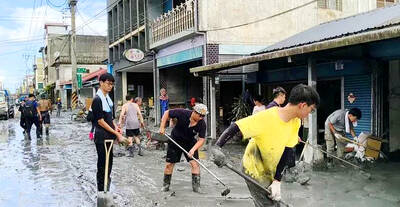
Heavy rain brought by Typhoon Ragasa caused the barrier lake above Matai’an Creek in Hualien’s Guangfu Township to overflow on Sept. 23 of last year. The sudden rush of water and mud destroyed a major bridge and swept through nearby villages, leaving significant damage in its wake. The barrier lake was formed in July, when heavy rain caused landslides and blocked the creek’s natural flow. As rainwater built up, the lake grew increasingly unstable. When Typhoon Ragasa hit, the water level rose rapidly and finally overflowed. In the aftermath, volunteers across Taiwan, known as “shovel supermen,” stepped in


 RSS
RSS