


Russian scientists will soon meet in secret to work on a plan for saving Earth from a possible catastrophic collision with a giant asteroid in 26 years, the head of Russia’s space agency announced.
“We will soon hold a closed meeting of our collegium, the science-technical council to look at what can be done to prevent the asteroid Apophis from slamming into the planet in 2036,” Anatoly Perminov told Voice of Russia radio.
“We are talking about people’s lives,” Perminov was quoted by news agencies as telling the radio station.
“Better spend a few hundred million dollars to create a system for preventing a collision than to wait until it happens and hundreds of thousands of people are killed,” he said.
The Apophis asteroid measures approximately 350m in diameter and RIA Novosti news agency said that if it were to hit Earth when it passes nearby in 2036 it would create a new desert the size of France.
Perminov said a serious plan to prevent such a catastrophe would probably be an international project involving Russian, European, US and Chinese space experts.
Interfax quoted him as saying that one option would be to build a new “space apparatus” designed solely for the purpose of safely diverting Apophis from a collision course with Earth.
“There won’t be any nuclear explosions,” Perminov said. “Everything will be done according to the laws of physics. We will examine all of this.”
In a statement dated from October and posted on its Web site, the US space agency NASA said new calculations on the path of Apophis indicated “a significantly reduced likelihood of a hazardous encounter with Earth in 2036.”
“Updated computational techniques and newly available data indicate the probability of an Earth encounter on April 13, 2036, for Apophis has dropped from one-in-45,000 to about four-in-a-million,” NASA said.
RIA Novosti said the asteroid was expected to pass within 30,000km of Earth in 2029 — closer than some geo-stationary satellites — and could shift course to hit Earth seven years after that.
(AFP)
俄羅斯太空總署署長宣告,俄國科學家短期內將秘密會晤,研討拯救地球的對策,以防止二十六年後可能發生的巨型小行星毀滅性撞擊。
阿納托里.佩米諾夫對俄羅斯之聲廣播電台說:「我們短期內將邀請科技委員會的成員參與一場閉門會議,商討該如何防止二O三六年小行星『阿波菲斯』撞上地球。」
其他新聞通訊社引述佩米諾夫在廣播中所言:「這是人命關天的事情。」
他說:「花費數億元建立一套防撞機制,總比坐以待斃讓無數民眾喪命來得好。」
阿波菲斯小行星直徑約三百五十公尺,而根據《俄新社》報導,如果二O三六年它經過地球附近時撞上地球,將會撞出一個等同法國大小的新沙漠。
佩米諾夫說,防止如此大災難,需要擬定一個嚴密周詳的計畫,而該計畫可能是集合俄羅斯、歐洲、美國和中國航太專家的跨國工程。
俄羅斯《電通社》引述他的話說,其中一項對策是打造一個新的「太空裝置」,專門用來偏轉阿波菲斯的軌跡,確保它不會撞上地球。
佩米諾夫說:「我們不會使用核爆解決。一切都將按照物理定律進行。我們會審慎思考一切。」
去年十月美國航太總署(NASA)公佈在其網站的一份聲明稿表示,根據新的阿波菲斯軌跡計算顯示,「它二O三六年撞上地球的危險性大幅下降」。
NASA指出:「最新的電腦計算技術及最近取得的資料顯示,阿波菲斯二O三六年四月十三日撞上地球的機率,已從四萬五千分之一降到二十五萬分之一。」
《俄新社》報導,這顆小行星將於二O二九年,從距離地球三萬公里之處掠過(比某些同步衛星距離地球更近),並可能在七年後改變軌道撞上地球。
(法新社╱翻譯:袁星塵)

The debate surrounding Taipower’s recent corporate identity reboot has gone well beyond the design community. The controversy began after Taipower replaced the familiar “Taiwan Power Company” wording — widely regarded as the calligraphy of Yu You-ren (1879-1964), former Control Yuan president and master calligrapher — with a modern logotype by designer Aaron Nieh’s team, Aaron Nieh Workshop. Taipower said the change was not a wholesale replacement of old signage, but an “optimization of its identity system,” aimed at meeting the needs of digital media, electronic bills, apps, social media graphics and various small-format applications. Existing physical markings, such as building
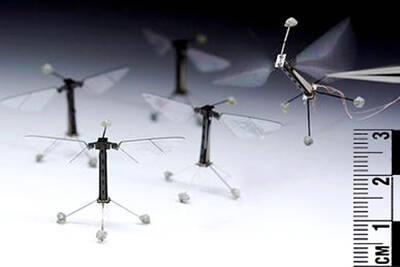
As bee populations around the world continue to decline at an alarming rate, scientists are developing an innovative solution: robotic bees. Recent advances at research institutions like Massachusetts Institute of Technology (MIT) in the US have produced tiny flying robots capable of performing pollination tasks similar to those of real bees. These tiny machines represent an impressive technological achievement. MIT’s latest models can hover in the air for over 1,000 seconds and perform complex movements, demonstrating the agility needed for successful pollination. The robots are designed to mimic the flight patterns of natural bees, offering potential support to agriculture

A: Taiwan legalized same-sex marriage on May 24, 2019, so this week marks the seventh anniversary of that milestone. By the end of 2024, a total of 32,126 LGBT couples had tied the knot. B: How many of them got married to foreign partners? A: In 2024, there were 504 cross-border same-sex marriages. By the end of that year, there were 130 cross-strait same-sex marriages between Taiwanese and Chinese — accounting for only about 0.4 percent of the total. B: I’ve heard that a seven-year marriage brings the “seven-year itch.” I bet some couples regret their decisions now. A:

A: While Taiwan is celebrating the 7th anniversary of legalizing same-sex marriage, a poll shows that the support rate for same-sex marriage rose sharply from 37.4 percent seven years ago to 69.9 percent last year. B: Actually, I’m a bit curious about the size of Taiwan’s LGBT population. A: I’m not sure. But if we take a Gallup poll in the US as an example, 9.3 percent of American adults identified as LGBT in 2024. B: Wow, is it because the Americans are relatively open? In many other countries, the figures hover around 5 percent. A: Based on this,


 RSS
RSS