


A: Actually, Brazilian jiu-jitsu is particularly good for small people like you.
B: Really? How so?
A: According to Diana Wang, a US doctor of physical therapy, the BJJ’s purpose is to help smaller, weaker people defend themselves by using various techniques, such as leverage.
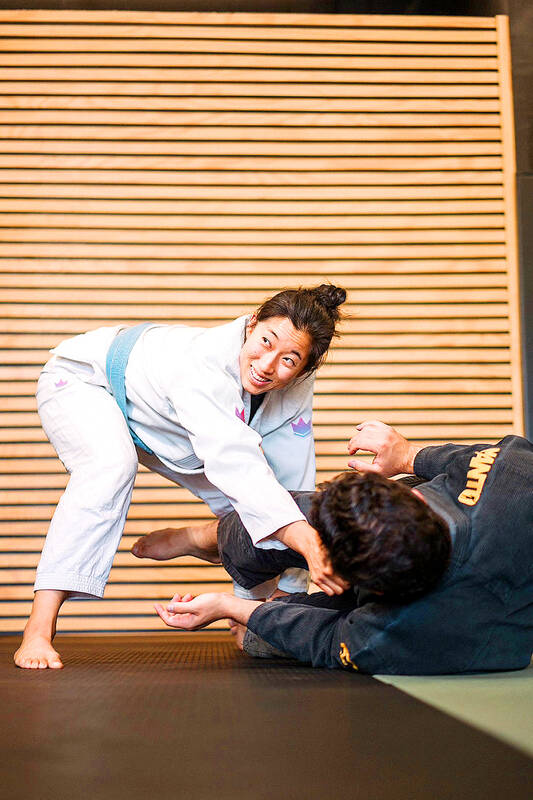
Photo: Diana Wang 照片:王幼瑞提供
B: That sounds interesting. What time does Dr Wang’s BJJ seminar begin tonight?
A: The event is scheduled for 7:30pm at PMA Brazilian Jiu-jitsu in Taipei. Admission is free, but donations are welcome.
A: 其實你的個子比較小,很適合練巴西柔術呢。
B: 真的嗎?為什麼?
A: 據美國理療醫師王幼瑞博士說,巴西柔術的概念是讓弱小的人,也能利用槓桿作用等技巧防身。
B: 真有趣,王醫師的巴柔研討會幾點開始?
A: 今晚7點半在「台北巴柔運動館」,免費入場自由樂捐唷!
(By Eddy Chang, Taipei Times/台北時報張迪)
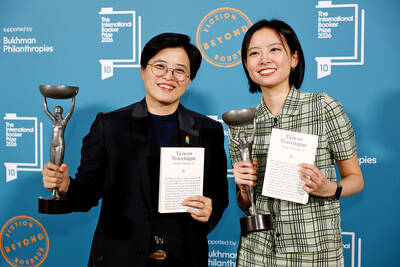
Taiwan Travelogue, the novel by Taiwanese author Yang Shuang-zi and translated into English by Lin King, won the prestigious International Booker Prize in London on May 19. It marks the first time a Taiwanese literary work has received the International Booker Prize, setting a historic milestone both for Taiwanese literature and for the award itself. Prior to this achievement, Taiwan had only once appeared on the Booker radar, when Taiwanese author Wu Ming-yi was longlisted for the Booker Prize in 2018 with The Stolen Bicycle. The International Booker Prize honors works of fiction translated into English and published in the UK or Ireland.
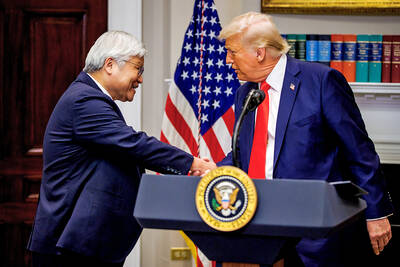
A: Time magazine recently released its list of “The 100 Most Influential People of 2026.” It’s categorized into six groups: Artists, Pioneers, Titans, Icons, Leaders and Innovators. B: TSMC chairman C.C. Wei made the list this year. Which category is he in? A: Wei is actually among the Pioneers, with figures including Disney CEO Josh D’Amaro and MrBeast — the first YouTuber ever to surpass 400 million subscribers. B: Led by Wei, Taiwan’s “silicon shield” TSMC is the sixth-largest company in the world. A: As Nvidia founder Jensen Huang wrote in his introduction, “C.C. Wei is truly one of the
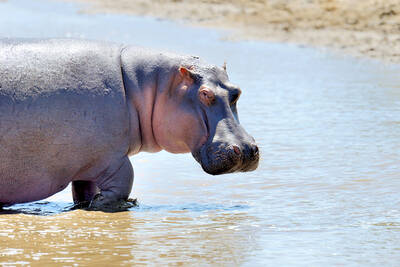
The animal kingdom is full of surprises that challenge our understanding of biology. From remarkable feeding mechanisms to extreme defense strategies, some creatures possess traits so unusual that they seem like pure fiction. Here are four fascinating examples that show nature’s endless creativity. The humble snail may appear simple, but its mouth tells a different story. Snails possess a ribbon-like tongue called a radula, densely covered with anywhere from 1,000 to 12,000 tiny teeth. This structure works like a cheese grater, allowing them to scrape and grind food with surprising efficiency. Far from being passive creatures, snails are actually
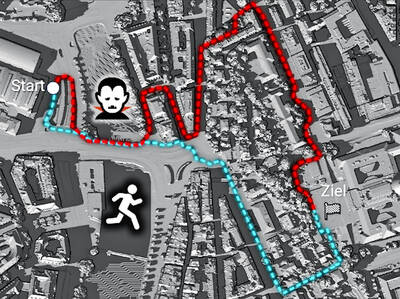
As climate change and urbanization push city temperatures higher, walking outdoors is becoming increasingly uncomfortable in many parts of the world, especially when prolonged time spent in sunlight is involved. As a result, outdoor lovers are now seeking cooler, shaded walking routes. However, most mainstream map apps still do not __1__ shaded footpaths. Enter routing.osm.ch — a Swiss web-based route planner that introduces a novel solution to this problem. Its “Vampire mode,” named after the legendary creatures’ fear of being __2__ natural light, was developed by a Swiss research team led by Professor Stefan Keller. The platform combines open data from


 RSS
RSS