


Welcome to Sunday Science! Every Sunday during the summer, we're going to guide you through some cool experiments that you can do at home. It's a good idea for you to keep a record of what you do in a Science Journal. That way you can record what you learn, compare results and maybe use them to design new experiments! Have a look at the Science Journal box for some ideas to get you started. Remember to always ask a grown-up's permission before trying out an experiment.
歡迎閱讀《週日科學版》!在暑假期間,我們每週日都要為你介紹可以在家中進行的有趣科學實驗。你可以在《科學日誌》中記錄自己做了哪些活動,這樣就可以將所學的紀錄下來,比較這些結果,也許還可以利用它們來設計新的實驗!先看一下《科學日誌》的點子再開始吧。展開實驗之前,記得要獲得大人許可喔!
Have you ever noticed how dirty some coins seem to be? This week we're going to see what kind of solution makes coins shiny again.
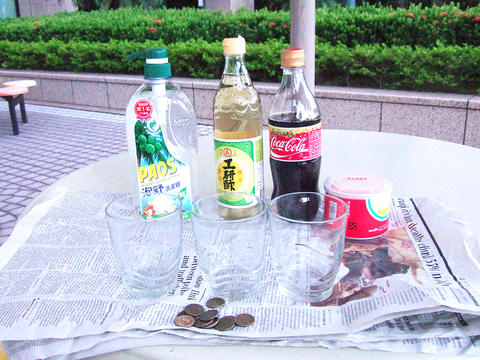
PHOTO: CATHERINE THOMAS, TAIPEI TIMES
What you will need:
Five glasses
Salt
Vinegar
Water
Cola
Dish detergent
Several dirty NT$1 coins
Barbecue tongs
A spoon (to stir the solutions with)
Old newspaper
- Place the newspaper over your working surface.
- Sort out your coins by trying to find coins which are a similar color (the dirtier the better!) This way you can judge how clean each solution makes the coins by comparing the coins.
- Place a coin in each glass.
- In the first glass, add water and detergent. Stir.
- In the second glass, add vinegar.
- In the third glass, add water and salt. Stir.
- In the fourth glass, add vingar and salt. Stir, but be very careful not to splash the mixture, it is a strong acid.
- In the fifth glass, add some cola.
- Wait for one minute then, using the tongs, remove the coins from each glass and compare. Don't forget to record your observations in your Science Journal. Remember to be careful when pouring the solutions away, and make sure that you wash the glasses thoroughly after you finish.
你曾注意過有些錢幣看起來很髒嗎?本週我們將看到讓錢幣再度閃亮的溶劑。
所需材料︰
五個玻璃杯
鹽
醋
水
可樂
碗盤清潔劑
幾枚髒的一元硬幣
烤肉鉗
一根湯匙(用來攪拌溶劑)
舊報紙
- 在工作檯面鋪一張舊報紙。
- 首先挑選顏色較相似的錢幣(越髒越好),這樣才能比較每種溶劑對錢幣的洗淨力。
- 在每個杯子內放入一枚錢幣。
-在第一杯加入水和清潔劑並攪拌。
- 在第二杯加入醋。
- 在第三杯加入水和鹽並攪拌。
- 在第四杯加入醋和鹽並攪拌,但小心別灑出來,因為混合物具強酸性。
- 在第五杯加入可樂。
- 等待一分鐘,用烤肉鉗把錢幣夾出做比較,別忘了在《科學日誌》裡記下你的觀察。記得倒掉溶劑時要小心,結束後要仔細把杯子洗乾淨。(翻譯:張愛弟)
What's the science? 科學原理
First the coins aren't just dirty. The copper in the coins reacts with air to form a layer of copper oxide. If the coins were just discolored because of dirt, the detergent would wash the dirt away and make them shiny. Because you need to remove a layer of copper oxide, you need to make a strong acid. Vinegar is an acid, but it isn't very strong. When you add salt (sodium chloride) to vinegar (acetic acid) you make a strong acid called hydrochloric acid. Cola contains phosphoric acid. Phosphoric acid is a stronger acid than acetic acid (vinegar) but weaker than hydrochoric acid.
首先呢,錢幣不只是髒了而已,錢幣中的銅和空氣起反應後,便會形成一層「銅氧化物」。如果錢幣因骯髒而變色,洗潔劑即可將它們洗淨並變得閃亮,要去除那層銅氧化物則需強酸幫忙。醋是酸性的,但還不夠強,若把鹽(氯化鈉)加進醋(乙酸)裡,就會得到強酸性的「鹽酸」。可樂裡含有「磷酸」,其酸性比醋裡的乙酸強,但比鹽酸弱。
Bonus 你知道嗎
In the US, people who have to clean up after highway accidents carry cola to clean blood off roads. Trucks carrying cola concentrate (syrup) have to carry a special warning because the concentrate is corrosive !
在美國,清理高速公路車禍現場的人都會帶可樂去清除血跡。載有可樂濃縮液(糖漿)的卡車必須有特別的警告標誌,因為這種濃縮液頗具腐蝕性。
Vocabulary 今日單字
1. solution n.
溶劑 (rong2 ji4)
2. shiny adj.
閃亮 (shan3 liang4)
3. similar adj.
類似的 (lei4 si4 de5)
4. compare v.t/v.i
比較 (bi3 jiao4)
5. acid n.
酸性 (suan1 xin4)
6. alkali n.
鹼性 (jian3 xing4)
7. copper oxide n.
銅氧化物
8. discolored adj.
褪色的 (tun4 se4 de5)
9. phosphoric acid n.
磷酸 (lin2 suan1)
10. corrosive adj.
腐蝕性 (fu3 shi2 xing4)
Science Journal 科學日誌
What do you know about detergent? What is it used for? Do you think it will make the NT$1 coins shiny? What do you know about vinegar? Can you use it for cleaning? Is it an acid or an alkali? What can you use salt for? Do you think it will make the coins shiny when mixed with water? Is cola acidic or alkaline? What do you think might happen if you put a coin in cola?
你對洗潔劑了解有多少?它是用來幹嘛的?你覺得它能讓一元硬幣變得閃亮嗎?你了解醋嗎?它能清潔物品嗎?是酸性還是鹼性?你能用鹽來幹嘛?它和水混合後能讓錢幣變得閃亮嗎?可樂是酸性還是鹼性?把錢幣放進可樂會發生什麼事?
Further ideas 進階點子
What happens if you add salt to cola? How does the cola react? Does it make the coin shiny? What about cola and detergent? Cola and vinegar? Try leaving a glass with a coin and cola and a glass with vinegar and a coin overnight. What happens to the coins? Which solutions make the coins the shiniest? Do the solutions work on NT$10 coins, too? How about NT$50 coins? Why do you think this is? Don't forget to record your observations in your Science Journal.
如果把鹽加進可樂會怎麼樣?可樂有什麼反應?它會讓錢幣閃閃發亮嗎?可樂加清潔劑呢?或可樂加醋?試著在放了一元硬幣的杯子裡加入可樂,另一杯則加入醋,放置一夜後錢幣會產生什麼變化呢?哪幾種溶劑能讓錢幣最閃亮?它們對十元硬幣也會有效嗎?五十元的硬幣呢?為什麼?別忘了在《科學日誌》裡記下你的觀察。
Next week 下週預告
For next Sunday's experiment you will need the following special items: A piece of cardboard (about 30cm by 16cm), a sheet of construction paper (about 35cm by 50cm), sellotape, a straw, a ball bearing, bb gun bullet or other small ball that will fit inside the straw.
下週日的科學實驗,你需要特別準備以下的東西︰一片硬紙板約三十公分長、十六公分寬,一張美工紙,約五十公分長、三十五公分寬,膠帶、一根吸管、小鐵球、BB槍子彈、或其它可塞入吸管裡的小球。
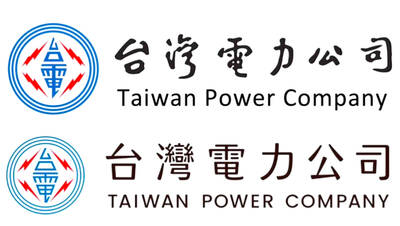
The debate surrounding Taipower’s recent corporate identity reboot has gone well beyond the design community. The controversy began after Taipower replaced the familiar “Taiwan Power Company” wording — widely regarded as the calligraphy of Yu You-ren (1879-1964), former Control Yuan president and master calligrapher — with a modern logotype by designer Aaron Nieh’s team, Aaron Nieh Workshop. Taipower said the change was not a wholesale replacement of old signage, but an “optimization of its identity system,” aimed at meeting the needs of digital media, electronic bills, apps, social media graphics and various small-format applications. Existing physical markings, such as building
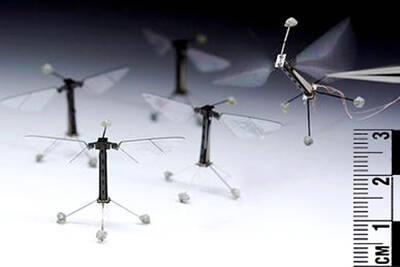
As bee populations around the world continue to decline at an alarming rate, scientists are developing an innovative solution: robotic bees. Recent advances at research institutions like Massachusetts Institute of Technology (MIT) in the US have produced tiny flying robots capable of performing pollination tasks similar to those of real bees. These tiny machines represent an impressive technological achievement. MIT’s latest models can hover in the air for over 1,000 seconds and perform complex movements, demonstrating the agility needed for successful pollination. The robots are designed to mimic the flight patterns of natural bees, offering potential support to agriculture

Continued from yesterday(延續自昨日) https://www.taipeitimes.com/News/lang For the most part, the idea of “Blue Monday” has been rejected as a myth. Some mental health experts also say there is a danger in labeling a certain day as the most depressing time of the entire year. Some argue that if people expect to feel sadder on the third Monday in January, this belief alone may increase their anxiety. One group that is worried about the negative effect of believing in Blue Monday is Samaritans. A mental health charity based in the UK, Samaritans is working to turn Blue Monday into “Brew Monday.” In this

A: Taiwan legalized same-sex marriage on May 24, 2019, so this week marks the seventh anniversary of that milestone. By the end of 2024, a total of 32,126 LGBT couples had tied the knot. B: How many of them got married to foreign partners? A: In 2024, there were 504 cross-border same-sex marriages. By the end of that year, there were 130 cross-strait same-sex marriages between Taiwanese and Chinese — accounting for only about 0.4 percent of the total. B: I’ve heard that a seven-year marriage brings the “seven-year itch.” I bet some couples regret their decisions now. A:


 RSS
RSS