


Rats are back on the menu in southern China after traders capitalized on an outbreak of the rodents in neighboring Hunan Province, according to various state press reports.
According to a July 14 report in the Information Times from Guangzhou, trucks full of rats were seen arriving late at night and being sold to a wild animal market in the city district of Baiyun.
During the SARS epidemic, which began in southern China in 2003, authorities banned the sale of many wild animals including rats amid fear that the deadly disease could be contracted from contaminated meat.
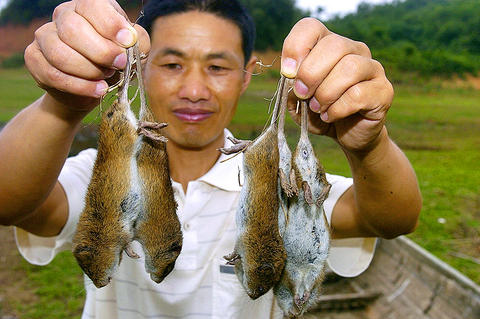
PHOTO: AP
Although the scientific community is not in agreement over whether certain animals can spread the disease, vendors in China are no longer allowed to sell wild animals.
Officials in Hunan - where floods have sparked a plague of two billion rats after water submerged their holes - denied the newspaper's undercover report.
One official quoted by the Beijing Times on July 15 dismissed the report, saying it was far too difficult to catch rats alive, while their relatively small size meant there was little meat on the bone.
But rats can make people's mouths water in southern China, and some believe that their flesh is more nutritious than pork or chicken.
A rat was fetching between 40 to 50 yuan (NT$174 to NT$217), and reports said they could be found in Guangdong's cities of Fanyu, Zhaoqing, Dongguan and Nanhai.
Earlier this year China's media also reported that civet cats were routinely finding their way back onto Guangdong dinner tables.
中國各家國營報導指出,商人利用湖南省爆發鼠患的機會,使得田鼠又出現在華南地區的菜單上。
廣州市《信息時報》七月十四日的報導,有人目睹滿載田鼠的卡車於深夜抵達,將田鼠賣到白雲區的野生動物市場。
二○○三年華南地區爆發SARS疫情時,政府官員擔心受污染的肉類會散播致命的疾病,因此禁止販賣包括田鼠等多種野生動物。
雖然科學界對哪些動物會散播疾病還沒有共識,中國小販都不准再販賣野生動物了。
湖南省因洪水淹沒鼠穴,引爆了二十億隻田鼠的鼠患,該省的官員們卻否認了上述報紙報導。
《京華時報》七月十五日引述一位官員駁斥上述報導的說法,說要活捉田鼠非常困難,而且牠們體形小,骨頭上沒什麼肉。
但田鼠還是令華南地區的居民口水直流,有人認為牠們比豬肉或雞肉更營養。
一隻田鼠要價四十至五十人民幣(合台幣一百七十四至兩百一十七元),報導說廣東省的番禺、肇慶、東莞、南海等城市都找得到。
今年稍早,中國媒體還報導麝香貓也常重回廣東居民的晚餐。
(法新社/翻譯︰張愛弟)
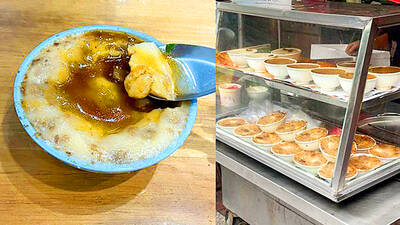
Rice is an essential ingredient in Taiwanese cuisine. Many foods are made of rice, adding more variety to our cooking, such as rice cake, or “gui.” Wagui is made by steaming rice flour batter in a bowl. The term “gui” refers to a type of food made from rice, while “wa” refers to a bowl. The pronunciation of “gui” in Taiwanese Hokkien is similar to the word for “nobility” in Chinese, so it is common for people to prepare various types of gui, including wagui, as offerings to the gods or ancestors,. 米是台灣重要的主食,用米製成的食品十分多元,豐富我們的飲食,如米做成的「粿」。粿的意思是米做成的糕點,碗粿是將在來米漿倒入碗中蒸熟,因而得名。粿因為音同「貴」,因此碗粿等粿食常用作供品祭拜神明和祖先。 nobility (n.) 高貴,高尚;貴族 offering (n.) 供品 While Taiwan may not be
Drive-through (or drive-thru) restaurants provide people with the immense convenience of being able to purchase and pick up meals without needing to leave their vehicles. These restaurants have been around for decades, and their success has spawned a number of equally handy services. The drive-through concept originated with the drive-in restaurant, the first of which was established in the US in 1921. Patrons would order and eat the food that was delivered to their cars by workers called “carhops.” Ten years later, a drive-through service was introduced, but it was not until 1947 that the first exclusively drive-through restaurant opened its

On Tuesday last week, the flame for this summer’s Paris Olympics was lit at the birthplace of the ancient Olympic Games in southern Greece in a meticulously choreographed ceremony. It will then be carried through Greece for more than 5,000km before being handed over to French organizers at the Athens venue used for the first modern Olympics in 1896. The pageantry at Olympia has been an essential part of every Olympics for nearly 90 years since the Games in Berlin. It’s meant to provide an ineluctable link between the modern event and the ancient Greek original on which it was initially modelled. Once

A: “Forbes” magazine just revealed Hollywood’s top 10 highest-paid stars of 2023. B: How much did those superstars make last year? A: Denzel Washington was at No. 10, having made US$24 million, which is about NT$771 million. B: That’s an astronomical figure to me. A: No. 9 to No. 6 were: Ben Affleck with US$38 million, Jason Statham with US$41 million, Leonardo DiCaprio with US$41 million, and Jennifer Aniston with US$42 million. A: 《富比世》最近公布了好萊塢去年的片酬排行榜。 B: 大明星的片酬到底有多高? A: 第10名是丹佐華盛頓、片酬2400萬美元,大約7.7億台幣。 B: 天啊這根本是天文數字! A: 第9到6名是︰班艾佛列克、3800萬美元,傑森史塔森、4100萬美元,李奧納多狄卡皮歐、4100萬美元,珍妮佛安妮斯頓、4200萬美元。 (By Eddy Chang, Taipei Times/台北時報張聖恩)


 RSS
RSS