


In most cultures, the heart is considered more important than the brain. This is especially true in English, where there are many phrases about the heart.
For example, if you are very mad at your friend Jim and dislike him strongly, but you change your mind and decide he is not so bad, people will say, "You had a change of heart."
If you take a test, but your grade is not very good and you want to quit studying, you can say, "I've lost heart." That means you are feeling discouraged.

PHOTO: AP
If you are a quiet person who doesn't often share your feelings, but you decide to tell your teacher or friend how you are feeling, then we say you have "opened your heart" by talking to others.
Chinese and English alike have lots of sayings about the heart. Can you think of any others? (Jason Cox, Staff Writer)
多數文化中,人們認為心比腦更重要。英文中尤其如此,許多片語都與心有關。
例如,假如你很氣你的朋友吉姆,非常討厭他,但你又改變心意,覺得他沒那麼壞,人們可能會說︰「You had a change of heart」。
假如你參加考試,但成績很不理想,你不想再讀書了,你就可以說︰「I've lost heart」,意指你感到喪志了。
假如你話不多,不常表達感情,但你打算告訴老師或朋友你的感受,我們就可以說你「打開心扉」與別人交談。
中文與英文同樣有很多關於「心」的說法。你能想到其他用法嗎?
(翻譯:賴美君)
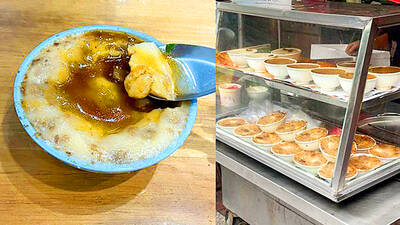
Rice is an essential ingredient in Taiwanese cuisine. Many foods are made of rice, adding more variety to our cooking, such as rice cake, or “gui.” Wagui is made by steaming rice flour batter in a bowl. The term “gui” refers to a type of food made from rice, while “wa” refers to a bowl. The pronunciation of “gui” in Taiwanese Hokkien is similar to the word for “nobility” in Chinese, so it is common for people to prepare various types of gui, including wagui, as offerings to the gods or ancestors,. 米是台灣重要的主食,用米製成的食品十分多元,豐富我們的飲食,如米做成的「粿」。粿的意思是米做成的糕點,碗粿是將在來米漿倒入碗中蒸熟,因而得名。粿因為音同「貴」,因此碗粿等粿食常用作供品祭拜神明和祖先。 nobility (n.) 高貴,高尚;貴族 offering (n.) 供品 While Taiwan may not be

Drive-through (or drive-thru) restaurants provide people with the immense convenience of being able to purchase and pick up meals without needing to leave their vehicles. These restaurants have been around for decades, and their success has spawned a number of equally handy services. The drive-through concept originated with the drive-in restaurant, the first of which was established in the US in 1921. Patrons would order and eat the food that was delivered to their cars by workers called “carhops.” Ten years later, a drive-through service was introduced, but it was not until 1947 that the first exclusively drive-through restaurant opened its

On Tuesday last week, the flame for this summer’s Paris Olympics was lit at the birthplace of the ancient Olympic Games in southern Greece in a meticulously choreographed ceremony. It will then be carried through Greece for more than 5,000km before being handed over to French organizers at the Athens venue used for the first modern Olympics in 1896. The pageantry at Olympia has been an essential part of every Olympics for nearly 90 years since the Games in Berlin. It’s meant to provide an ineluctable link between the modern event and the ancient Greek original on which it was initially modelled. Once

A: “Forbes” magazine just revealed Hollywood’s top 10 highest-paid stars of 2023. B: How much did those superstars make last year? A: Denzel Washington was at No. 10, having made US$24 million, which is about NT$771 million. B: That’s an astronomical figure to me. A: No. 9 to No. 6 were: Ben Affleck with US$38 million, Jason Statham with US$41 million, Leonardo DiCaprio with US$41 million, and Jennifer Aniston with US$42 million. A: 《富比世》最近公布了好萊塢去年的片酬排行榜。 B: 大明星的片酬到底有多高? A: 第10名是丹佐華盛頓、片酬2400萬美元,大約7.7億台幣。 B: 天啊這根本是天文數字! A: 第9到6名是︰班艾佛列克、3800萬美元,傑森史塔森、4100萬美元,李奧納多狄卡皮歐、4100萬美元,珍妮佛安妮斯頓、4200萬美元。 (By Eddy Chang, Taipei Times/台北時報張聖恩)


 RSS
RSS