


Academia Sinica yesterday denied a claim by the Chinese media that China deserved credit for the institute’s development of a rapid screening reagent for COVID-19.
“China has nothing to do with the success,” Academia Sinica President James Liao (廖俊智) said in response to media queries, adding that Taiwan on its own merit synthesized monoclonal antibodies that can identify the protein of the coronavirus that causes COVID-19.
The institute would soon collaborate with the Ministry of Health and Welfare, private companies and research bodies to quickly verify and mass produce the reagent and start clinical trials, Liao said.
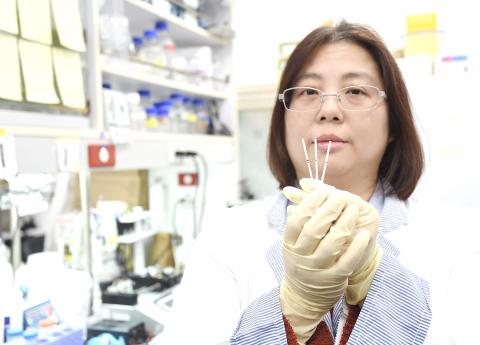
Photo: Chien Jung-fong, Taipei Times
Lawmakers at a meeting of the legislature’s Education and Culture Committee praised the institute’s achievement.
Several Democratic Progressive Party (DPP) lawmakers also called for Academia Sinica to change its name in English and other languages to avoid confusion with the Beijing-based Chinese Academy of Science and help Taiwan gain greater exposure in the international community.
“As ‘Sinica’ means ‘Chinese’ in Latin, the organization should consider altering its name to avoid possible confusion,” DPP Legislator Fan Yun (范雲) said.
Foreign academics often ask why the government does not change “Sinica” into “Taiwanica,” she said.
She asked the institute, which has used Academia Sinica as its English name since 1928, to submit a report on the issue within three months.
DPP Legislator Chang Liao Wan-chien (張廖萬堅) backed Fan’s proposal, saying that many Europeans mistook him for a Chinese national when he visited the region after COVID-19 broke out in China.
This is a good time to change the name, as the outbreak has led many Taiwanese to reshape their national identification, he added.
Liao said the institute is willing to discuss the issue, but added that the central government has the final call.
Additional reporting by CNA
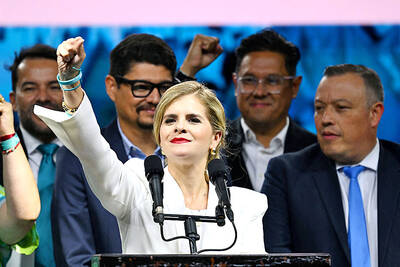
Right-wing political scientist Laura Fernandez on Sunday won Costa Rica’s presidential election by a landslide, after promising to crack down on rising violence linked to the cocaine trade. Fernandez’s nearest rival, economist Alvaro Ramos, conceded defeat as results showed the ruling party far exceeding the threshold of 40 percent needed to avoid a runoff. With 94 percent of polling stations counted, the political heir of outgoing Costa Rican President Rodrigo Chaves had captured 48.3 percent of the vote compared with Ramos’ 33.4 percent, the Supreme Electoral Tribunal said. As soon as the first results were announced, members of Fernandez’s Sovereign People’s Party
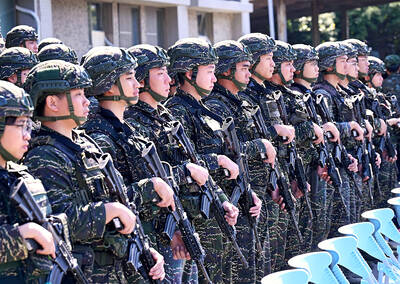
MORE RESPONSIBILITY: Draftees would be expected to fight alongside professional soldiers, likely requiring the transformation of some training brigades into combat units The armed forces are to start incorporating new conscripts into combined arms brigades this year to enhance combat readiness, the Executive Yuan’s latest policy report said. The new policy would affect Taiwanese men entering the military for their compulsory service, which was extended to one year under reforms by then-president Tsai Ing-wen (蔡英文) in 2022. The conscripts would be trained to operate machine guns, uncrewed aerial vehicles, anti-tank guided missile launchers and Stinger air defense systems, the report said, adding that the basic training would be lengthened to eight weeks. After basic training, conscripts would be sorted into infantry battalions that would take
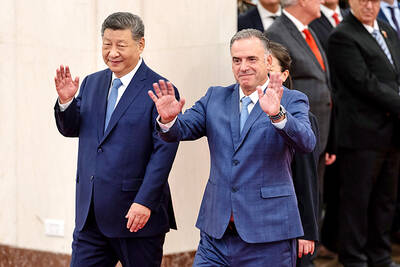
EMERGING FIELDS: The Chinese president said that the two countries would explore cooperation in green technology, the digital economy and artificial intelligence Chinese President Xi Jinping (習近平) yesterday called for an “equal and orderly multipolar world” in the face of “unilateral bullying,” in an apparent jab at the US. Xi was speaking during talks in Beijing with Uruguayan President Yamandu Orsi, the first South American leader to visit China since US special forces captured then-Venezuelan president Nicolas Maduro last month — an operation that Beijing condemned as a violation of sovereignty. Orsi follows a slew of leaders to have visited China seeking to boost ties with the world’s second-largest economy to hedge against US President Donald Trump’s increasingly unpredictable administration. “The international situation is fraught
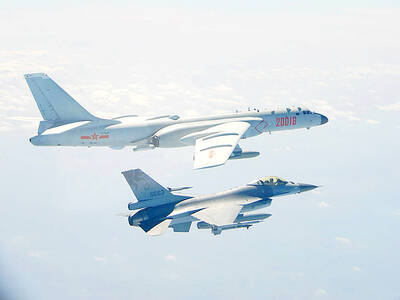
GROWING AMBITIONS: The scale and tempo of the operations show that the Strait has become the core theater for China to expand its security interests, the report said Chinese military aircraft incursions around Taiwan have surged nearly 15-fold over the past five years, according to a report released yesterday by the Democratic Progressive Party’s (DPP) Department of China Affairs. Sorties in the Taiwan Strait were previously irregular, totaling 380 in 2020, but have since evolved into routine operations, the report showed. “This demonstrates that the Taiwan Strait has become both the starting point and testing ground for Beijing’s expansionist ambitions,” it said. Driven by military expansionism, China is systematically pursuing actions aimed at altering the regional “status quo,” the department said, adding that Taiwan represents the most critical link in China’s


 RSS
RSS