


A resurgent former US vice president Joe Biden yesterday seized momentum in the race to become the Democratic challenger to US President Donald Trump with a string of Super Tuesday victories, including the key prize Texas, against his main rival, US Senator Bernie Sanders.
Sanders, a 78-year-old leftist who wants to reshape the US’ economy, had been the clear leader and was looking for a knock-out blow on the most consequential voting day on the primary calendar.
Instead, the results signaled a remarkable comeback for Biden, who was projected to win at least nine, and possibly 10, of the nomination contests held across 14 states.
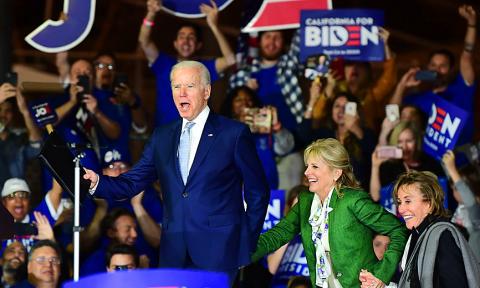
Photo: AFP
Just one week earlier, the 77-year-old saw his campaign teeter on the edge of collapse. Now he is vying once again for front-runner status.
“It’s a good night and it seems to be getting even better. They don’t call it Super Tuesday for nothing,” Biden told cheering fans in Los Angeles.
Sanders, a self-described democratic socialist, won his home state of Vermont, and was projected to win Colorado and Utah.
He was also ahead in California, the biggest delegate-rich state of all, with a nine-point lead as the count continued yesterday morning.
Biden was projected to win in Alabama, Tennessee and Massachusetts, and had won in Arkansas, North Carolina, Oklahoma, Virginia and even Minnesota — a state where Sanders had been expected to win handily.
Well after midnight, the projection was made for Biden to win Texas, the second-largest state, and by the morning he had a narrow lead in Maine with three-quarters of the vote counted.
Sanders had been polling ahead in both states.
“We expected a surge. We got a tsunami,” tweeted analyst David Axelrod, chief strategist for former US president Barack Obama’s two presidential campaigns.
“New race. Completely,” he said.
A defiant Sanders celebrated his own wins earlier in the night by tearing into Trump, calling him “the most dangerous president in the history of this country.”
However, he also attacked Biden for having voted for the invasion of Iraq and painted him as tarnished by billionaire contributors.
“We’re taking on the political establishment,” Sanders said. “You cannot beat Trump with the same-old, same-old kind of politics.”
Biden saw the results as proof that his bid to bring US politics back to the center, after four years of Trump’s right-wing populism, is on a roll.
“We are very much alive,” he told a crowd in Los Angeles. “Make no mistake about it, this campaign will send Donald Trump packing.”
A key takeaway from Biden’s long list of wins was his strong support among African Americans — vital for any Democratic presidential candidate.
He seemed to fare less well with the large Hispanic electorate, which in California reportedly went heavily for Sanders, but a victory in Texas, which also has a diverse population, suggests Biden has the capacity to build a broad coalition.
That was bolstered by Biden winning all five other southern states on the ballot on Tuesday.
Former New York mayor Michael Bloomberg, 78, and US Senator Elizabeth Warren, 70, were the other big-name candidates.
Despite spending record amounts of his own money on advertising, it was an embarrassing debut for billionaire media entrepreneur Bloomberg, who failed to win any state — although he did get a consolation victory in American Samoa.
Trump, who watched the results on television, tweeted his customary insults about the Democrats, deriding Warren for losing her state of Massachusetts.
Biden answered on Twitter: “Come November, we are going to beat you.”
Bloomberg faces calls from within Democratic circles to exit the race and not split the centrist vote.
Biden is making his third White House bid, after failed runs in 1988 and 2008.

CROSS-STRAIT COLLABORATION: The new KMT chairwoman expressed interest in meeting the Chinese president from the start, but she’ll have to pay to get in Beijing allegedly agreed to let Chinese Nationalist Party (KMT) Chairwoman Cheng Li-wun (鄭麗文) meet with Chinese President Xi Jinping (習近平) around the Lunar New Year holiday next year on three conditions, including that the KMT block Taiwan’s arms purchases, a source said yesterday. Cheng has expressed interest in meeting Xi since she won the KMT’s chairmanship election in October. A source, speaking on condition of anonymity, said a consensus on a meeting was allegedly reached after two KMT vice chairmen visited China’s Taiwan Affairs Office Director Song Tao (宋濤) in China last month. Beijing allegedly gave the KMT three conditions it had to

STAYING ALERT: China this week deployed its largest maritime show of force to date in the region, prompting concern in Taipei and Tokyo, which Beijing has brushed off Deterring conflict over Taiwan is a priority, the White House said in its National Security Strategy published yesterday, which also called on Japan and South Korea to increase their defense spending to help protect the first island chain. Taiwan is strategically positioned between Northeast and Southeast Asia, and provides direct access to the second island chain, with one-third of global shipping passing through the South China Sea, the report said. Given the implications for the US economy, along with Taiwan’s dominance in semiconductors, “deterring a conflict over Taiwan, ideally by preserving military overmatch, is a priority,” it said. However, the strategy also reiterated

‘BALANCE OF POWER’: Hegseth said that the US did not want to ‘strangle’ China, but to ensure that none of Washington’s allies would be vulnerable to military aggression Washington has no intention of changing the “status quo” in the Taiwan Strait, US Secretary of Defense Pete Hegseth said on Saturday, adding that one of the US military’s main priorities is to deter China “through strength, not through confrontation.” Speaking at the annual Reagan National Defense Forum in Simi Valley, California, Hegseth outlined the US Department of Defense’s priorities under US President Donald Trump. “First, defending the US homeland and our hemisphere. Second, deterring China through strength, not confrontation. Third, increased burden sharing for us, allies and partners. And fourth, supercharging the US defense industrial base,” he said. US-China relations under

The Chien Feng IV (勁蜂, Mighty Hornet) loitering munition is on track to enter flight tests next month in connection with potential adoption by Taiwanese and US armed forces, a government source said yesterday. The kamikaze drone, which boasts a range of 1,000km, debuted at the Taipei Aerospace and Defense Technology Exhibition in September, the official said on condition of anonymity. The Chungshan Institute of Science and Technology and US-based Kratos Defense jointly developed the platform by leveraging the engine and airframe of the latter’s MQM-178 Firejet target drone, they said. The uncrewed aerial vehicle is designed to utilize an artificial intelligence computer


 RSS
RSS