


Acknowledging a military stalemate after nearly two decades of conflict, the US on Saturday signed a peace agreement with the Taliban that is aimed at ending the US’ longest war and bringing US troops home from Afghanistan more than 18 years after they invaded in the wake of the Sept. 11, 2001, terrorist attacks.
The historic deal, signed by chief negotiators from the two sides and witnessed by US Secretary of State Mike Pompeo, could see the withdrawal of all US and allied forces in the next 14 months and allow US President Donald Trump to keep a key campaign pledge to extract the US from “endless wars.”
However, it could also easily unravel, particularly if the Taliban fail to meet their commitments.
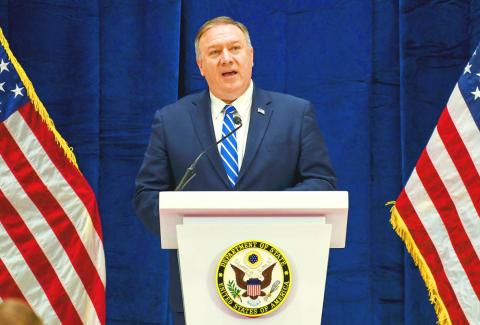
Photo: EPA-EFE
At the White House, Trump told reporters that the US deserves credit for having helped Afghanistan take a step toward peace.
He spoke cautiously of the deal’s prospects for success and warned the Taliban against violating its commitments.
“We think we’ll be successful in the end,” he said, referring to all-Afghan peace talks and a final US exit.
He said he will be “meeting personally with Taliban leaders in the not-too-distant future,” and described the group as “tired of war.”
He did not say where or why he plans to meet with Taliban leaders.
He said he thinks they are serious about the deal they signed, but warned that if it fails, the US could restart combat.
“If bad things happen, we’ll go back” in with military firepower, Trump said.
Pompeo was also cautious.
“Today, we are realistic. We are seizing the best opportunity for peace in a generation,” Pompeo said in the Qatari capital, Doha. “Today, we are restrained. We recognize that America shouldn’t fight in perpetuity in the graveyard of empires if we can help Afghans forge peace.”
Under the agreement, the US would draw its forces down to 8,600 from 13,000 in the next three to four months, with the remaining US forces withdrawing in 14 months.
The complete pullout would depend on the Taliban meeting their commitments to prevent terrorism, including specific obligations to renounce al-Qaeda and prevent that group or others from using Afghan soil to plot attacks on the US or its allies.
The deal sets the stage for intra-Afghan peace talks to begin next week, with the aim of negotiating a permanent ceasefire and a power-sharing agreement between rival Afghan groups.
It is perhaps the most complicated and difficult phase of the plan.
However, it does not tie the US’ withdrawal to any specific outcome from the all-Afghan talks, US officials said.
Pompeo said that “the chapter of American history on the Taliban is written in blood,” adding that while the road ahead would be difficult, the deal represented “the best opportunity for peace in a generation.”

CROSS-STRAIT COLLABORATION: The new KMT chairwoman expressed interest in meeting the Chinese president from the start, but she’ll have to pay to get in Beijing allegedly agreed to let Chinese Nationalist Party (KMT) Chairwoman Cheng Li-wun (鄭麗文) meet with Chinese President Xi Jinping (習近平) around the Lunar New Year holiday next year on three conditions, including that the KMT block Taiwan’s arms purchases, a source said yesterday. Cheng has expressed interest in meeting Xi since she won the KMT’s chairmanship election in October. A source, speaking on condition of anonymity, said a consensus on a meeting was allegedly reached after two KMT vice chairmen visited China’s Taiwan Affairs Office Director Song Tao (宋濤) in China last month. Beijing allegedly gave the KMT three conditions it had to

STAYING ALERT: China this week deployed its largest maritime show of force to date in the region, prompting concern in Taipei and Tokyo, which Beijing has brushed off Deterring conflict over Taiwan is a priority, the White House said in its National Security Strategy published yesterday, which also called on Japan and South Korea to increase their defense spending to help protect the first island chain. Taiwan is strategically positioned between Northeast and Southeast Asia, and provides direct access to the second island chain, with one-third of global shipping passing through the South China Sea, the report said. Given the implications for the US economy, along with Taiwan’s dominance in semiconductors, “deterring a conflict over Taiwan, ideally by preserving military overmatch, is a priority,” it said. However, the strategy also reiterated
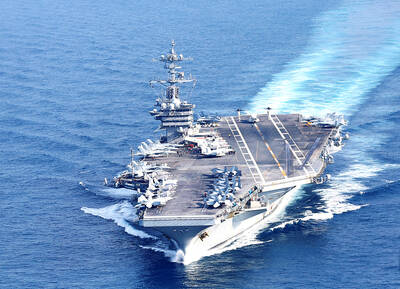
‘BALANCE OF POWER’: Hegseth said that the US did not want to ‘strangle’ China, but to ensure that none of Washington’s allies would be vulnerable to military aggression Washington has no intention of changing the “status quo” in the Taiwan Strait, US Secretary of Defense Pete Hegseth said on Saturday, adding that one of the US military’s main priorities is to deter China “through strength, not through confrontation.” Speaking at the annual Reagan National Defense Forum in Simi Valley, California, Hegseth outlined the US Department of Defense’s priorities under US President Donald Trump. “First, defending the US homeland and our hemisphere. Second, deterring China through strength, not confrontation. Third, increased burden sharing for us, allies and partners. And fourth, supercharging the US defense industrial base,” he said. US-China relations under

The Chien Feng IV (勁蜂, Mighty Hornet) loitering munition is on track to enter flight tests next month in connection with potential adoption by Taiwanese and US armed forces, a government source said yesterday. The kamikaze drone, which boasts a range of 1,000km, debuted at the Taipei Aerospace and Defense Technology Exhibition in September, the official said on condition of anonymity. The Chungshan Institute of Science and Technology and US-based Kratos Defense jointly developed the platform by leveraging the engine and airframe of the latter’s MQM-178 Firejet target drone, they said. The uncrewed aerial vehicle is designed to utilize an artificial intelligence computer


 RSS
RSS