


The US yesterday gave in to pressure from Europeans over environmental concerns, allowing the word “climate” into a joint communique at a G20 conference overshadowed by a viral outbreak that has shaken the global economy.
Delegates at the meeting of G20 finance minister and central bankers in Riyadh, Saudi Arabia, spent much of their time talking about a global slowdown exacerbated by the coronavirus outbreak, but struggled to come up with a united response, according to people familiar with the deliberations.
Countries such as Japan, and international institutions, including the Organisation for Economic Co-operation and Development, have been pushing for those with surpluses to spend more.
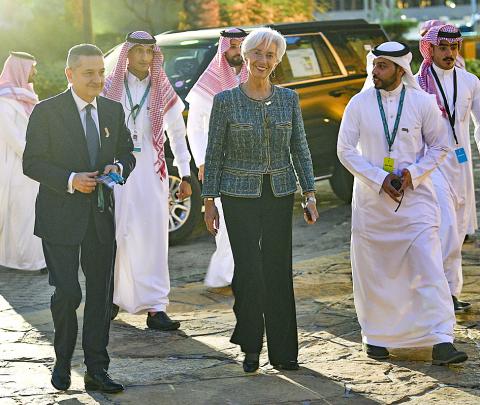
Photo: EPA-EFE
One of the main addressees of the calls for more spending is Germany. So far, the export-driven country has shown little interest in significantly boosting expenditures, arguing fiscal stimulus cannot bolster foreign demand.
On climate change, differences of opinion in the Saudi capital were starker.
The US, represented by US Secretary of the Treasury Steven Mnuchin, objected to including a reference to the subject, according to four people familiar with the communique-drafting process.
The Saudi delegation, which is hosting the event, did not show much enthusiasm for it either, according to two of them.
After several days of heated debate, including French Minister of the Economy and Finance Bruno Le Maire cornering Mnuchin late on Saturday as the G20 delegates dined, the US reluctantly agreed to a mention of climate change, according to two people familiar with the matter.
As of yesterday morning in Riyadh, it was also looking unlikely that representatives would leave Saudi Arabia with any breakthroughs on a global taxation system that would apply to multi-national companies, according to the people.
Europeans have balked at a US proposal that new global rules should be a “safe harbor” regime. Mnuchin sought to reassure his counterparts by insisting such a system would not mean the rules would be optional, but Europeans said they still needed to fully assess the proposal.
Delegates on Saturday heard a warning from the IMF that the COVID-19 outbreak would dent global growth.
The outbreak will shave about 0.1 percentage points from global growth and constrain China’s growth to 5.6 percent this year, IMF managing director Kristalina Georgieva said.
“Be we are also looking at more dire scenarios where the spread of the virus continues for longer and more globally, and the growth consequences are more protracted,” she said.

CROSS-STRAIT COLLABORATION: The new KMT chairwoman expressed interest in meeting the Chinese president from the start, but she’ll have to pay to get in Beijing allegedly agreed to let Chinese Nationalist Party (KMT) Chairwoman Cheng Li-wun (鄭麗文) meet with Chinese President Xi Jinping (習近平) around the Lunar New Year holiday next year on three conditions, including that the KMT block Taiwan’s arms purchases, a source said yesterday. Cheng has expressed interest in meeting Xi since she won the KMT’s chairmanship election in October. A source, speaking on condition of anonymity, said a consensus on a meeting was allegedly reached after two KMT vice chairmen visited China’s Taiwan Affairs Office Director Song Tao (宋濤) in China last month. Beijing allegedly gave the KMT three conditions it had to
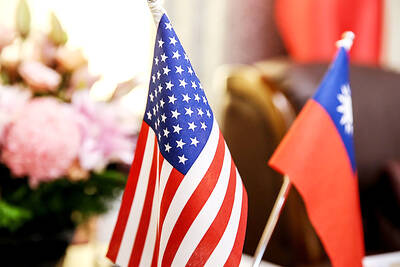
STAYING ALERT: China this week deployed its largest maritime show of force to date in the region, prompting concern in Taipei and Tokyo, which Beijing has brushed off Deterring conflict over Taiwan is a priority, the White House said in its National Security Strategy published yesterday, which also called on Japan and South Korea to increase their defense spending to help protect the first island chain. Taiwan is strategically positioned between Northeast and Southeast Asia, and provides direct access to the second island chain, with one-third of global shipping passing through the South China Sea, the report said. Given the implications for the US economy, along with Taiwan’s dominance in semiconductors, “deterring a conflict over Taiwan, ideally by preserving military overmatch, is a priority,” it said. However, the strategy also reiterated
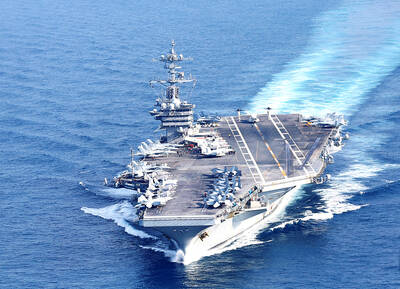
‘BALANCE OF POWER’: Hegseth said that the US did not want to ‘strangle’ China, but to ensure that none of Washington’s allies would be vulnerable to military aggression Washington has no intention of changing the “status quo” in the Taiwan Strait, US Secretary of Defense Pete Hegseth said on Saturday, adding that one of the US military’s main priorities is to deter China “through strength, not through confrontation.” Speaking at the annual Reagan National Defense Forum in Simi Valley, California, Hegseth outlined the US Department of Defense’s priorities under US President Donald Trump. “First, defending the US homeland and our hemisphere. Second, deterring China through strength, not confrontation. Third, increased burden sharing for us, allies and partners. And fourth, supercharging the US defense industrial base,” he said. US-China relations under
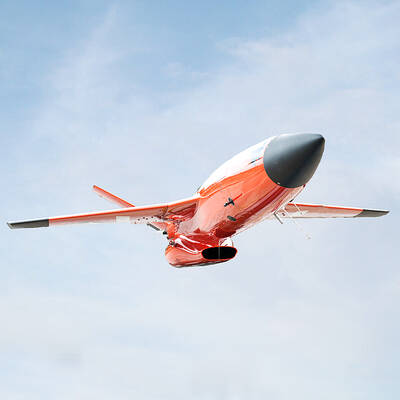
The Chien Feng IV (勁蜂, Mighty Hornet) loitering munition is on track to enter flight tests next month in connection with potential adoption by Taiwanese and US armed forces, a government source said yesterday. The kamikaze drone, which boasts a range of 1,000km, debuted at the Taipei Aerospace and Defense Technology Exhibition in September, the official said on condition of anonymity. The Chungshan Institute of Science and Technology and US-based Kratos Defense jointly developed the platform by leveraging the engine and airframe of the latter’s MQM-178 Firejet target drone, they said. The uncrewed aerial vehicle is designed to utilize an artificial intelligence computer


 RSS
RSS