


Broad-based support across age, racial and ideological groups propelled US Senator Bernie Sanders to a dominant victory in Nevada’s Democratic caucuses, tightening his grip on the front-runner spot in the race to find a challenger to US President Donald Trump.
Former US vice president Joe Biden appeared headed to a badly needed second-place finish in Nevada after poor showings earlier this month in the first two nominating contests in the Democratic presidential race ahead of the Nov. 3 election.
Sanders’ triumph on Saturday in the first racially diverse state in the campaign suggested he was reaching a broader coalition of Democratic voters with his unapologetic message of social and economic justice, including his signature pledge to provide universal healthcare for all Americans.
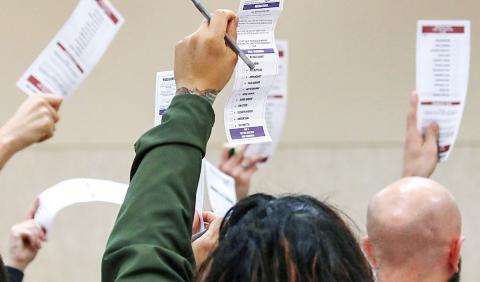
Photo: AFP
However, for Biden and other moderates who argue Sanders is too liberal to beat Trump and who have been trying to blunt his momentum, the Nevada results made the job much harder.
“We have put together a multi-generational, multiracial coalition that is going to not only win in Nevada, it’s going to sweep the country,” Sanders, a self-described democratic socialist, told cheering supporters in San Antonio, Texas.
With 50 percent of the precincts reporting, Sanders had 47 percent of the county convention delegates in Nevada.
Biden was a distant second to Sanders with 19 percent, ahead of former South Bend, Indiana, mayor Pete Buttigieg, in third with 15 percent.
US Senator Elizabeth Warren, who had been looking to jump-start her campaign after poor finishes in Iowa and New Hampshire, trailed in a disappointing fourth with 10 percent.
US Senator Amy Klobuchar and activist billionaire Tom Steyer were well back at 5 percent and 4 percent respectively.
Entrance polls showed Biden led among African Americans with 36 percent, followed by Sanders with 2 percent.
Voters poured into more than 250 caucus sites around Nevada, where Sanders was aided by strong support from the six in 10 voters who said they backed a government-run Medicare for All, the Edison entrance poll showed.
The entrance poll showed Sanders led in Nevada across all age groups except for those older than 65.
About 54 percent of Latino voters said they backed him, while 24 percent of college-educated white women and 34 percent of those who have a union member in their families supported him.
He also won with college graduates, and was the top pick of voters who consider themselves independents.
He was also favored over Biden among voters whose top priority is defeating Trump in November.

CROSS-STRAIT COLLABORATION: The new KMT chairwoman expressed interest in meeting the Chinese president from the start, but she’ll have to pay to get in Beijing allegedly agreed to let Chinese Nationalist Party (KMT) Chairwoman Cheng Li-wun (鄭麗文) meet with Chinese President Xi Jinping (習近平) around the Lunar New Year holiday next year on three conditions, including that the KMT block Taiwan’s arms purchases, a source said yesterday. Cheng has expressed interest in meeting Xi since she won the KMT’s chairmanship election in October. A source, speaking on condition of anonymity, said a consensus on a meeting was allegedly reached after two KMT vice chairmen visited China’s Taiwan Affairs Office Director Song Tao (宋濤) in China last month. Beijing allegedly gave the KMT three conditions it had to

STAYING ALERT: China this week deployed its largest maritime show of force to date in the region, prompting concern in Taipei and Tokyo, which Beijing has brushed off Deterring conflict over Taiwan is a priority, the White House said in its National Security Strategy published yesterday, which also called on Japan and South Korea to increase their defense spending to help protect the first island chain. Taiwan is strategically positioned between Northeast and Southeast Asia, and provides direct access to the second island chain, with one-third of global shipping passing through the South China Sea, the report said. Given the implications for the US economy, along with Taiwan’s dominance in semiconductors, “deterring a conflict over Taiwan, ideally by preserving military overmatch, is a priority,” it said. However, the strategy also reiterated

‘BALANCE OF POWER’: Hegseth said that the US did not want to ‘strangle’ China, but to ensure that none of Washington’s allies would be vulnerable to military aggression Washington has no intention of changing the “status quo” in the Taiwan Strait, US Secretary of Defense Pete Hegseth said on Saturday, adding that one of the US military’s main priorities is to deter China “through strength, not through confrontation.” Speaking at the annual Reagan National Defense Forum in Simi Valley, California, Hegseth outlined the US Department of Defense’s priorities under US President Donald Trump. “First, defending the US homeland and our hemisphere. Second, deterring China through strength, not confrontation. Third, increased burden sharing for us, allies and partners. And fourth, supercharging the US defense industrial base,” he said. US-China relations under

The Chien Feng IV (勁蜂, Mighty Hornet) loitering munition is on track to enter flight tests next month in connection with potential adoption by Taiwanese and US armed forces, a government source said yesterday. The kamikaze drone, which boasts a range of 1,000km, debuted at the Taipei Aerospace and Defense Technology Exhibition in September, the official said on condition of anonymity. The Chungshan Institute of Science and Technology and US-based Kratos Defense jointly developed the platform by leveraging the engine and airframe of the latter’s MQM-178 Firejet target drone, they said. The uncrewed aerial vehicle is designed to utilize an artificial intelligence computer


 RSS
RSS