


The Central Epidemic Command Center (CECC) has reported two more confirmed cases of COVID-19 infection, raising the total number of cases in the nation to 22.
The two new cases are family members who lived with the 19th confirmed patient, who became the first in the nation to die from the infection on Saturday, Minister of Health and Welfare Chen Shih-chung (陳時中), who heads the center, told a news conference last night.
The center on Sunday night said the 19th confirmed patient did not travel abroad and had not been exposed to infected cases, but added that the risk of “community spread” was low.
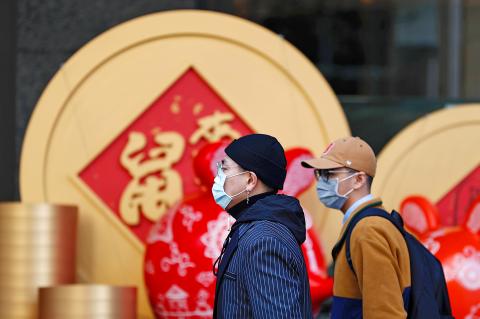
Photo: Ritchie B. Tongo/EPA-EFE
The 19th case was a 61-year-old man in central Taiwan, who was hospitalized on Feb. 3 for suspected serious flu complications with pneumonia. He died on Saturday, shortly after he tested positive for COVID-19.
Asked if the case could be deemed a case of community-
acquired infection, Chen said “it can be considered so,” but later added, “a sporadic case.”
He later added that “community spread” means people have a risk of getting infected by just walking around in communities.
The minister listed four signs of a community infection: inability to find the source of infection, a higher number of locally infected cases than imported cases, a continuous chain of infections and widespread clusters of cases.
So far, only the death case partially matches the first sign and the center is still tracking the source of infection, Chen said.
As public concern over local transmission increased, the center late on Sunday night provided a video clip of Chen elaborating on the case.
“Local transmission is defined by continuous person-to-person spread within communities, but the case we announced is only a sporadic case,” he said. “People do not have to be too worried, because so far the risk of continuous person-to-person spread within communities is very, very low.”
Chen said the man who died was an independent taxi driver, who had as passengers a large number of Taiwanese based in China who came back during the Lunar New Year holiday.
Three of those passengers have been ordered to monitor their health conditions for 14 days after returning to Taiwan, and are now being tested for COVID-2019, he said, adding that all medical professionals who treated the man tested negative.
Vice President Chen Chien-jen (陳建仁), who was the head of the Department of Health during the SARS outbreak in 2003, yesterday wrote on Facebook that the 19th case could be considered “local infected/transmitted,” and the source of infection is being investigated.
Citing the minister’s remark about the definition and signs of “community spread,” he said that the current situation in the nation does not match the other three signs, so Taiwan is not in a state of “community spread,” and the nation’s disease prevention level does not need to be raised.

KEY INDUSTRY: The vice premier discussed a plan to create a non-red drone supply chain by next year, which has been allocated a budget of more than NT$7.2 billion The government has budgeted NT$44.2 billion (US$1.38 billion) to cultivate Taiwan’s uncrewed aerial vehicle (UAV) industry over the next five years, which would make the nation a major player in the industry’s democratic supply chain in the Asia-Pacific region, Premier Cho Jung-tai (卓榮泰) said yesterday. Cho made the remarks during a visit to the facilities of Cub Elecparts Inc (為升電裝). Democratic Progressive Party (DPP) Legislator Chen Su-yueh (陳素月) and Chinese Nationalist Party (KMT) Legislator Hsieh Yi-fong (謝依鳳) also participated in the trip. Cub Elecparts has transitioned from the automotive industry to the defense industry, which is the top priority among the nation’s
SOUTH KOREA DISPUTE: If Seoul continues to ignore its request, Taiwan would change South Korea’s designation on its arrival cards, the foreign ministry said If South Korea does not reply appropriately to a request to correct Taiwan’s name on its e-Arrival card system before March 31, the government would take corresponding measures to change how South Korea is labeled on the online Taiwan Arrival Card system, the Ministry of Foreign Affairs said yesterday. South Korea’s e-Arrival card system lists Taiwan as “China (Taiwan)” in the “point of departure” and “next destination” fields. Taipei has asked Seoul to change the wording. Since March 1, South Koreans who hold government-issued Alien Resident Certificates (ARC) have been identified as from “South Korea” rather than the “Republic of Korea,” the
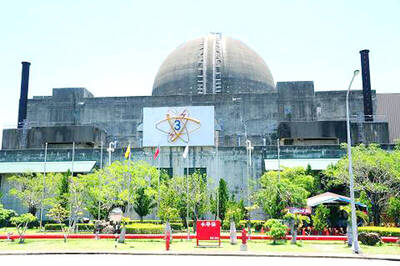
SUFFICIENT: The president said Taiwan has enough oil for next month, with reserves covering more than 100 days and natural gas enough for 12 to 14 days A restart plan for the Guosheng Nuclear Power Plant in New Taipei City’s Wanli District (萬里) and the Ma-anshan Nuclear Power Plant in Pingtung County’s Hengchun Township (恆春) would be submitted to the Nuclear Safety Commission by the end of the month, President William Lai (賴清德) said yesterday, reversing the government’s policy to abolish nuclear energy. On May 17 last year, Taiwan shut down its last nuclear reactor and became the first non-nuclear nation in East Asia, fulfilling the Democratic Progressive Party (DPP) government’s pledge of a “nuclear-free homeland.” Even without nuclear power, Taiwan can maintain a stable electricity supply until 2032,
DEROGATORY: WTO host Cameroon’s designation of Taiwan as a ‘province of China’ seriously undermines the nation’s status and rights as a WTO member, MOFA said The Ministry of Foreign Affairs (MOFA) yesterday condemned Cameroon for listing Taiwan as “Taiwan, Province of China” in visa documents for an upcoming WTO ministerial conference, a move that led to Taiwan’s withdrawal from the event. The designation “seriously undermined” Taiwan’s status and rights as a WTO member, the ministry said in a statement. It is the first time since 2001 that Taiwan has declined to attend a WTO Ministerial Conference. The conference is scheduled to take place from Thursday to Sunday next week in Yaounde, the capital of Cameroon. Taiwan had planned to send a delegation led by Minister Without Portfolio


 RSS
RSS