


The number of people infected with COVID-19 on a quarantined ship off Japan has risen to 355, Japanese Minister of Health, Labor and Welfare Katsunobu Kato said yesterday, as the US, Canada, Hong Kong, South Korea and Italy prepared to repatriate their residents on board.
The figure is a jump of 70 cases from a government tally released on Saturday and came as Kato voiced worries that the rising infection count among Japan’s general population could mean the virus’s spread has entered a new phase.
“So far, we have conducted tests for 1,219 individuals. Of those, 355 people tested positive,” Kato told a roundtable discussion for public broadcaster NHK on conditions aboard the Diamond Princess cruise ship.
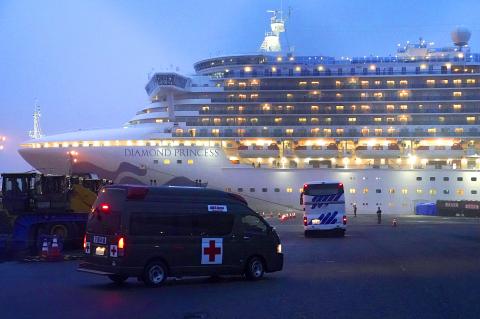
Photo: Bloomberg
The vessel has been in quarantine since Feb. 5 at the port of Yokohama, and Japan’s efforts to control the viral infections on board have prompted international concern.
The ship was carrying more than 3,700 passengers and crew when it docked and was placed in isolation, after authorities found a passenger who got off in Hong Kong during the voyage had tested positive for the virus.
Japanese officials continued to find new infections among the passengers and crew and rushed them to local hospitals, while others have been told to stay inside their cabins during the 14-day quarantine period set to end on Wednesday.
The US yesterday was preparing to evacuate some of its citizen, but said those repatriated must go through another two-week quarantine period at home.
An on-board announcement late yesterday said Americans choosing to leave should get ready, tweets from passengers said.
“Disembarkation will begin at approximately 9pm,” the announcement said, asking the group to place their luggage outside their cabin doors.
Japan’s Self-Defense Forces were to use about 20 buses to transport the evacuees to Tokyo International Airport, TV Asahi reported.
“Based on the high number of COVID-19 cases identified on board the Diamond Princess, the Department of Health and Human Services made an assessment that passengers and crew members on board are at high risk of exposure,” the US embassy said in a letter to its citizens on the boat.
Seoul yesterday announced it would evacuate its citizens, “if they are tested negative from screenings by the Japanese authorities and are willing to return,” South Korean Minister of Health and Welfare Park Neung-hoo told a briefing.
Hong Kong has also said it will offer its 330 residents of the territory on board the chance to take a charter flight back and Italy and Canada have announced similar decisions, while Taiwan and Australia are considering such a move.
The Japanese Ministry of Health, Labor and Welfare on Saturday said that passengers older than 70 are being examined and those testing negative and in good health would be allowed to leave the ship starting on Wednesday.
Tests on younger passengers were expected to start yesterday and healthy people would be allowed to disembark after Wednesday, it said.
Meanwhile, Japan has seen 53 infections, including a dozen new cases reported on Saturday and 13 cases among more than 760 Japanese nationals and their relatives repatriated from Wuhan, China.
“If you look at the figures, we are seeing changing situations compared with before,” Kato said on the NHK show. “What we have to think about now is preventing cases from becoming severe and preventing deaths.”
Additional reporting by Reuters

National Taiwan University (NTU) yesterday said it disqualified a person from an entrance examination for using AI smart glasses to cheat, along with two others for making untruthful statements in their curriculum vitae. The three applicants were given null scores, Taiwan’s highest-ranked university said, calling on prospective students to be honest in the admissions process. NTU registrar Lee Hung-sen (李宏森) said that the cheating applicant wore a hat and thick-rimmed glasses to the second written exam for medical school, claiming that they felt cold. Suspicions were aroused when the applicant stared oddly at the test for long stretches while steadily bringing the paper
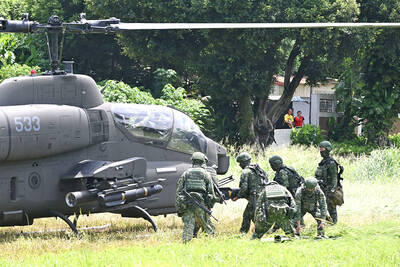
MILITARY ISSUES: A partisan divide between the Cabinet and the legislature ‘raised questions about Taiwan’s ability to adequately fund its defense,’ the report said Taiwan’s defense budget, military personnel numbers and resilience are challenges to its ability to meet national defense goals, the US Naval Institute said in a report published on Tuesday. In response to the perception of a growing military threat posed by China, Taiwan has embarked on an effort to enhance the capabilities needed to deter an attempt by Beijing to annex the nation by force, the institute said in the US Congressional Research Service report, titled Taiwan: Defense and Military Issues, which was filed on Thursday last week. Taiwan’s defense budget increased by about 7.5 percent from 2024 to last year, it

66 FIGHTER JETS: The aircraft is likely undergoing preparations for its transfer to Taiwan — a significant step forward in the nation’s modernization program, a lawmaker said The first of Taiwan’s order of F-16V Block 70 aircraft has been sighted in Texas ahead of delivery, Democratic Progressive Party (DPP) Legislator Wang Ting-yu (王定宇) said. Taiwan’s first F-16V Block 70 two-seat aircraft, tail number 6831, was seen flying from Lockheed Martin’s production facility in Greenville, South Carolina, to Naval Air Station Joint Reserve Base Fort Worth in Texas, Wang wrote on Facebook yesterday. The plane is likely undergoing preparations for its transfer to Taiwan, marking a significant step forward in the Republic of China Air Force’s modernization program, Wang said, citing military analysts. The F-16V Block 70 is a new-build version
NOT JUST NUMBERS: What matters to intelligence work is crucial, reliable information, so even a few credible leads can be highly valuable to national security, a legislator said The National Security Bureau (NSB) yesterday said it has finished the establishment of an information-reporting channel for Chinese nationals, the aim of which is to broaden intelligence gathering on China’s political, military, economic and social developments. Chinese nationals can submit information on the Web page, https://report.nsb.gov.tw, the NSB said in a statement. The move aims to expand the bureau’s diverse intelligence sources and is pursuant to the National Intelligence Services Act (國家情報工作法), it said, adding that it referenced practices adopted by intelligence agencies in the US, the UK and Israel. An increasing number of people are approaching Taiwanese agencies to provide information, as


 RSS
RSS