


China yesterday named an official known for tearing crosses from the roofs of churches to lead the agency that oversees Hong Kong, in the biggest shake-up yet after months of unrest in the territory.
Chinese People’s Political Consultative Conference (CPPCC) Vice Chairman Xia Baolong (夏寶龍), 67, is to replace Zhang Xiaoming (張曉明) as director of the Hong Kong and Macau Affairs Office, the Chinese State Council said, adding that Zhang is to become a vice director.
Xia is a former close aide to Chinese President Xi Jinping (習近平) and served as Chinese Communist Party (CCP) chief of Zhejiang Province during a crackdown on Christian churches.
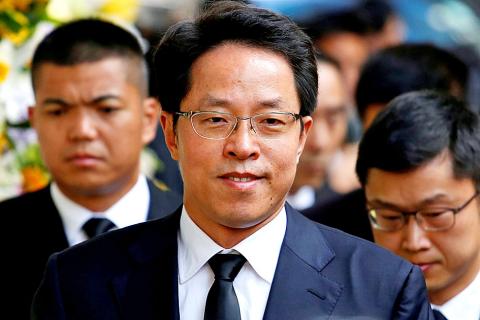
Photo: Reuters
Xia’s installation follows last month’s appointment of Luo Huining (駱惠寧) as head of China’s Liaison Office of the Central People’s Government in Hong Kong.
The choice of Luo, a member of a CCP cadre known for executing Xi’s anti-corruption campaign, was seen as a signal of Beijing’s intention to restore order in Hong Kong after months of violent unrest opposing China’s grip on the territory.
“The reshuffling at this interesting moment may point to a deep distrust from Xi Jinping toward the former faction dealing with Hong Kong affairs,” said Sonny Lo (盧兆興), a Hong Kong-based academic and political commentator.
“It’s clear that Xi Jinping wants to have a clear grasp of the situation in Hong Kong — that’s the major point,” Lo added. “We’ll probably see some adjustment in Chinese policy toward Hong Kong.”
The rare appointment of such a senior official potentially signals a permanent overhaul in how Beijing manages the former British colony.
The CCP late last year issued a communique signaling greater intervention in everything from education in Hong Kong to how the territory picks its leader.
Xia’s push in 2014 and 2015 to tear down crosses on the roofs of churches in eastern Zhejiang was widely criticized by the international community. He was subsequently appointed to a leadership role on the CPPCC, the nation’s political advisory body and a post usually seen as a transition toward retirement for senior leaders.

CROSS-STRAIT COLLABORATION: The new KMT chairwoman expressed interest in meeting the Chinese president from the start, but she’ll have to pay to get in Beijing allegedly agreed to let Chinese Nationalist Party (KMT) Chairwoman Cheng Li-wun (鄭麗文) meet with Chinese President Xi Jinping (習近平) around the Lunar New Year holiday next year on three conditions, including that the KMT block Taiwan’s arms purchases, a source said yesterday. Cheng has expressed interest in meeting Xi since she won the KMT’s chairmanship election in October. A source, speaking on condition of anonymity, said a consensus on a meeting was allegedly reached after two KMT vice chairmen visited China’s Taiwan Affairs Office Director Song Tao (宋濤) in China last month. Beijing allegedly gave the KMT three conditions it had to

STAYING ALERT: China this week deployed its largest maritime show of force to date in the region, prompting concern in Taipei and Tokyo, which Beijing has brushed off Deterring conflict over Taiwan is a priority, the White House said in its National Security Strategy published yesterday, which also called on Japan and South Korea to increase their defense spending to help protect the first island chain. Taiwan is strategically positioned between Northeast and Southeast Asia, and provides direct access to the second island chain, with one-third of global shipping passing through the South China Sea, the report said. Given the implications for the US economy, along with Taiwan’s dominance in semiconductors, “deterring a conflict over Taiwan, ideally by preserving military overmatch, is a priority,” it said. However, the strategy also reiterated

‘BALANCE OF POWER’: Hegseth said that the US did not want to ‘strangle’ China, but to ensure that none of Washington’s allies would be vulnerable to military aggression Washington has no intention of changing the “status quo” in the Taiwan Strait, US Secretary of Defense Pete Hegseth said on Saturday, adding that one of the US military’s main priorities is to deter China “through strength, not through confrontation.” Speaking at the annual Reagan National Defense Forum in Simi Valley, California, Hegseth outlined the US Department of Defense’s priorities under US President Donald Trump. “First, defending the US homeland and our hemisphere. Second, deterring China through strength, not confrontation. Third, increased burden sharing for us, allies and partners. And fourth, supercharging the US defense industrial base,” he said. US-China relations under

The Chien Feng IV (勁蜂, Mighty Hornet) loitering munition is on track to enter flight tests next month in connection with potential adoption by Taiwanese and US armed forces, a government source said yesterday. The kamikaze drone, which boasts a range of 1,000km, debuted at the Taipei Aerospace and Defense Technology Exhibition in September, the official said on condition of anonymity. The Chungshan Institute of Science and Technology and US-based Kratos Defense jointly developed the platform by leveraging the engine and airframe of the latter’s MQM-178 Firejet target drone, they said. The uncrewed aerial vehicle is designed to utilize an artificial intelligence computer


 RSS
RSS