


China yesterday reported a rise in new cases of the 2019 novel coronavirus (2019-nCoV), denting optimism that disease control measures, including isolating major cities, might be working, while Chinese President Xi Jinping (習近平) appeared among the public for the first time since the outbreak started.
Xi has largely kept out of the spotlight during the outbreak, except for meetings with visiting officials, with Chinese Premier Li Keqiang (李克強) taking the lead in efforts to end the crisis.
Xi inspected efforts by community workers in Beijing to contain the outbreak, visited a hospital that offers treatment to 2019-nCoV patients and video-chatted with frontline medical staff in Wuhan.
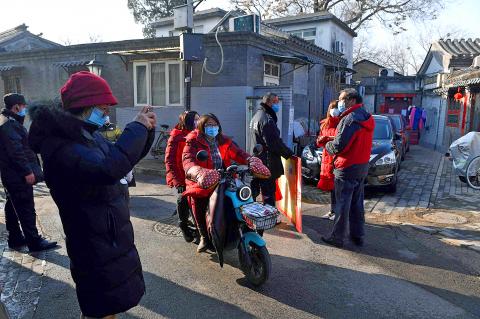
Photo: AFP
Wearing a surgical mask, Xi had his temperature checked by a community worker and waved to residents in their apartments, Central China Television (CCTV) footage showed.
His visit came just hours after Beijing authorities announced stricter measures to control movement in and around the capital.
CCTV reported Xi as saying that China would strive to meet its economic and social targets for the year, and make adjustments to minimize the economic impact of the outbreak, including preventing large-scale layoffs.
China would win the battle against the outbreak, he said, and the government would take more decisive measures to curb its spread in Wuhan and the surrounding Hubei Province.
The Chinese death toll rose by 97 to 908 in the 24 hours through midnight on Sunday and 3,062 new cases were reported. That was up 15 percent from Saturday and broke a string of daily declines.
As part of Beijing’s “closed management” measures, officials said vehicles and individuals arriving from outside a city community would not be allowed to enter, and people arriving from outside Beijing would have to report their health condition and register their personal details.
Those who arrived within the past 14 days from virus-infected areas, or who have come into contact with people from those areas, now need to subject themselves to health examinations or home observation, and would be required to report any changes in their health situation.
Non-essential public spaces within Beijing communities are to be closed, and government agencies and companies would be required to strictly implement body temperature monitoring.
Shanghai Civil Affairs Bureau Director Zhu Qinhao (朱勤浩) told a news conference at the Shanghai Municipal Center for Disease Control and Prevention that the city had already implemented closed management in the majority of its 13,000 residential communities, and non-residents are asked to postpone their visits to the city.

CROSS-STRAIT COLLABORATION: The new KMT chairwoman expressed interest in meeting the Chinese president from the start, but she’ll have to pay to get in Beijing allegedly agreed to let Chinese Nationalist Party (KMT) Chairwoman Cheng Li-wun (鄭麗文) meet with Chinese President Xi Jinping (習近平) around the Lunar New Year holiday next year on three conditions, including that the KMT block Taiwan’s arms purchases, a source said yesterday. Cheng has expressed interest in meeting Xi since she won the KMT’s chairmanship election in October. A source, speaking on condition of anonymity, said a consensus on a meeting was allegedly reached after two KMT vice chairmen visited China’s Taiwan Affairs Office Director Song Tao (宋濤) in China last month. Beijing allegedly gave the KMT three conditions it had to

STAYING ALERT: China this week deployed its largest maritime show of force to date in the region, prompting concern in Taipei and Tokyo, which Beijing has brushed off Deterring conflict over Taiwan is a priority, the White House said in its National Security Strategy published yesterday, which also called on Japan and South Korea to increase their defense spending to help protect the first island chain. Taiwan is strategically positioned between Northeast and Southeast Asia, and provides direct access to the second island chain, with one-third of global shipping passing through the South China Sea, the report said. Given the implications for the US economy, along with Taiwan’s dominance in semiconductors, “deterring a conflict over Taiwan, ideally by preserving military overmatch, is a priority,” it said. However, the strategy also reiterated

‘BALANCE OF POWER’: Hegseth said that the US did not want to ‘strangle’ China, but to ensure that none of Washington’s allies would be vulnerable to military aggression Washington has no intention of changing the “status quo” in the Taiwan Strait, US Secretary of Defense Pete Hegseth said on Saturday, adding that one of the US military’s main priorities is to deter China “through strength, not through confrontation.” Speaking at the annual Reagan National Defense Forum in Simi Valley, California, Hegseth outlined the US Department of Defense’s priorities under US President Donald Trump. “First, defending the US homeland and our hemisphere. Second, deterring China through strength, not confrontation. Third, increased burden sharing for us, allies and partners. And fourth, supercharging the US defense industrial base,” he said. US-China relations under

The Chien Feng IV (勁蜂, Mighty Hornet) loitering munition is on track to enter flight tests next month in connection with potential adoption by Taiwanese and US armed forces, a government source said yesterday. The kamikaze drone, which boasts a range of 1,000km, debuted at the Taipei Aerospace and Defense Technology Exhibition in September, the official said on condition of anonymity. The Chungshan Institute of Science and Technology and US-based Kratos Defense jointly developed the platform by leveraging the engine and airframe of the latter’s MQM-178 Firejet target drone, they said. The uncrewed aerial vehicle is designed to utilize an artificial intelligence computer


 RSS
RSS