


Hong Kong yesterday began enforcing a mandatory two-week quarantine for anyone arriving from mainland China, a dramatic escalation of its bid to stop 2019 novel coronavirus (2019-nCoV) from spreading.
The vast majority of people crossing the border are expected to self-quarantine, and would face daily telephone calls and spot checks by officials, with up to six months in prison for those found in breach of the isolation period.
Authorities hope that the prospect of quarantine will virtually halt cross-border traffic, while allowing the territory to remain stocked with food and goods from the mainland, where the virus has now killed more than 700 people.

Photo: AFP
Arrivals have plummeted by 75 percent in recent weeks, but thousands were lining up in neighboring Shenzhen on Friday night to beat the midnight deadline before the quarantine rules began.
By early yesterday, only a trickle of people were arriving via the Shenzhen Bay crossing.
“I have to come back because my daughter is going to school here,” a woman who gave her surname as Song told reporters after ending a 20-day family holiday in the mainland.
“We will quarantine ourselves, because this is for the public good,” she said.
A security guard who gave his surname as Lam said that arrivals were up about 50 percent in the past few days and most were Hong Kongers.
Hong Kong lawmakers unveiled how the quarantine would work on Friday evening, just six hours before the policy took effect.
Hong Kong residents are allowed to self-quarantine at home, while mainland and international visitors are to stay in hotels or other accommodation they have arranged.
However, those with no planned accommodation would be taken to temporary facilities prepared by the government.
Anyone who has been to mainland China in the 14 days prior to arriving in Hong Kong from another destination also faces quarantine.
Visitors with a visa for fewer than 14 days would be denied entry.
Meanwhile, research by Chinese authors published in the Journal of the American Medical Association on Friday said that diarrhea might be a secondary path of transmission for 2019-nCoV.
The primary path is believed to be virus-laden droplets from an infected person’s cough.
However, “the 2019-nCoV virus found in stool may be transmitted through fecal spread,” said Liao Jiayu, a bioengineer at the University of California, Riverside.
Benjamin Neuman, a virology expert at Texas A&M University-Texarkana, said that while fecal transmission was “certainly worth considering,” “droplets and touching contaminated surfaces then rubbing eyes, nose or mouth” were likely the main way the virus was transmitted based on current data.
The death toll from the outbreak soared to 722 in China yesterday, including the first foreign victim.
A 60-year-old US citizen diagnosed with the virus died on Thursday in Wuhan, the city at the epicenter of the health emergency, said the US embassy, which did not provide more details about the person.
A Japanese man in his 60s with a suspected coronavirus infection also died in a hospital in Wuhan, the Japanese Ministry of Foreign Affairs said, adding that it was “difficult” to confirm whether he had the illness.
Figures from yesterday showed there were more than 34,500 people infected in China.
Outside mainland China, there have been more than 340 infections reported.
In Japan there were 25 cases plus 64 onboard the Diamond Princess cruise ship docked at Yokohama.
Singapore had 33 cases; Thailand 32; Hong Kong 26, including one death; South Korea 24; Malaysia 16; Australia 15; Germany 14; Vietnam 13; the US 12; France 11; Macau 10; the United Arab Emirates seven; Canada five; the Philippines three, including one death; India, Britain and Italy three each; Russia 2; Nepal, Sri Lanka, Cambodia, Finland, Spain, Sweden and Belgium one each.
Taiwan had 17 confirmed cases.

CROSS-STRAIT COLLABORATION: The new KMT chairwoman expressed interest in meeting the Chinese president from the start, but she’ll have to pay to get in Beijing allegedly agreed to let Chinese Nationalist Party (KMT) Chairwoman Cheng Li-wun (鄭麗文) meet with Chinese President Xi Jinping (習近平) around the Lunar New Year holiday next year on three conditions, including that the KMT block Taiwan’s arms purchases, a source said yesterday. Cheng has expressed interest in meeting Xi since she won the KMT’s chairmanship election in October. A source, speaking on condition of anonymity, said a consensus on a meeting was allegedly reached after two KMT vice chairmen visited China’s Taiwan Affairs Office Director Song Tao (宋濤) in China last month. Beijing allegedly gave the KMT three conditions it had to

STAYING ALERT: China this week deployed its largest maritime show of force to date in the region, prompting concern in Taipei and Tokyo, which Beijing has brushed off Deterring conflict over Taiwan is a priority, the White House said in its National Security Strategy published yesterday, which also called on Japan and South Korea to increase their defense spending to help protect the first island chain. Taiwan is strategically positioned between Northeast and Southeast Asia, and provides direct access to the second island chain, with one-third of global shipping passing through the South China Sea, the report said. Given the implications for the US economy, along with Taiwan’s dominance in semiconductors, “deterring a conflict over Taiwan, ideally by preserving military overmatch, is a priority,” it said. However, the strategy also reiterated
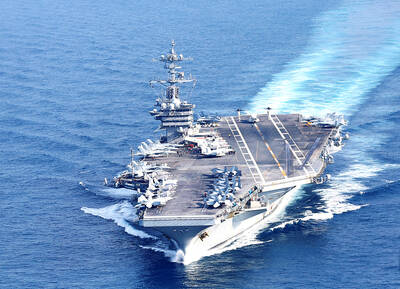
‘BALANCE OF POWER’: Hegseth said that the US did not want to ‘strangle’ China, but to ensure that none of Washington’s allies would be vulnerable to military aggression Washington has no intention of changing the “status quo” in the Taiwan Strait, US Secretary of Defense Pete Hegseth said on Saturday, adding that one of the US military’s main priorities is to deter China “through strength, not through confrontation.” Speaking at the annual Reagan National Defense Forum in Simi Valley, California, Hegseth outlined the US Department of Defense’s priorities under US President Donald Trump. “First, defending the US homeland and our hemisphere. Second, deterring China through strength, not confrontation. Third, increased burden sharing for us, allies and partners. And fourth, supercharging the US defense industrial base,” he said. US-China relations under
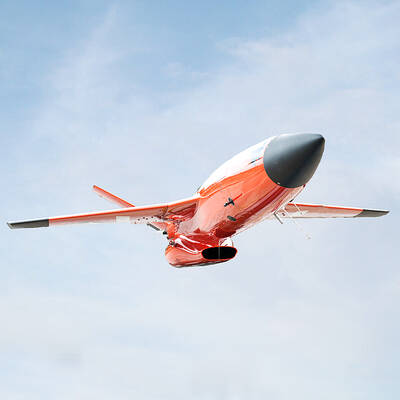
The Chien Feng IV (勁蜂, Mighty Hornet) loitering munition is on track to enter flight tests next month in connection with potential adoption by Taiwanese and US armed forces, a government source said yesterday. The kamikaze drone, which boasts a range of 1,000km, debuted at the Taipei Aerospace and Defense Technology Exhibition in September, the official said on condition of anonymity. The Chungshan Institute of Science and Technology and US-based Kratos Defense jointly developed the platform by leveraging the engine and airframe of the latter’s MQM-178 Firejet target drone, they said. The uncrewed aerial vehicle is designed to utilize an artificial intelligence computer


 RSS
RSS