


Standing before a US Congress and nation sharply divided by impeachment, US President Donald Trump on Tuesday used his State of the Union address to extol a “Great American Comeback” on his watch, just three years after he took office decrying a land of “American carnage” under his predecessor.
The partisan discord was on vivid display as the first president to campaign for re-election while facing impeachment made his case for another term.
Republicans chanted: “Four More Years.”
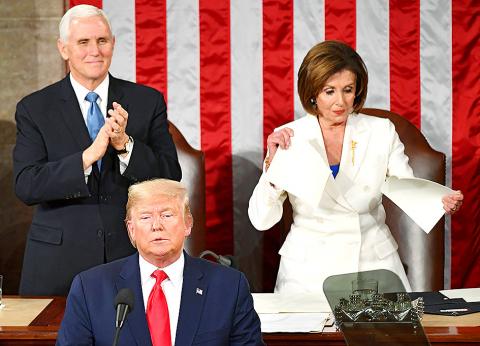
Photo: AFP
US House of Representatives Speaker Nancy Pelosi ripped up her copy of Trump’s speech as he ended his address.
“America’s enemies are on the run, America’s fortunes are on the rise and America’s future is blazing bright,” Trump said. “In just three short years, we have shattered the mentality of American decline and we have rejected the downsizing of America’s destiny. We are moving forward at a pace that was unimaginable just a short time ago, and we are never going back.”
Holding out the nation’s economic success as the chief rationale for a second term, Trump’s speech resembled a lower-volume version of his campaign rallies, providing something for every section of his political base.
However, while he tweets daily assailing his impeachment, Trump never mentioned the “i” word in his 78-minute speech. That followed the lead of former US president Bill Clinton, who did not reference his impeachment when he delivered his State of the Union address in 1999.
Pelosi, a frequent thorn in Trump’s side, created a viral image with her seemingly sarcastic applause of the president a year ago. This time, she was even more explicit with her very text-ripping rebuke.
Trump appeared no more cordial.
When he climbed to the House of Representatives rostrum, he did not take her outstretched hand, though it was not clear he had seen her gesture. Later, as Republicans often cheered, she remained in her seat, at times shaking her head at his remarks.
When Pelosi left, she told reporters that tearing up the speech was “the courteous thing to do considering the alternative.”
Republicans denounced her action as disrespectful.
Trump, the former reality TV star, added a showbiz flavor to the staid event: He had his wife, Melania, present the Presidential Medal of Freedom, the nation’s highest civilian honor, to divisive conservative radio host Rush Limbaugh, who this month announced that he has advanced lung cancer.
He also stunned a young student in the gallery with a scholarship and he orchestrated the surprise tearful reunion of a solider from overseas with his family in the balcony.
Among Trump’s guests in the chamber: Venezuelan National Assembly President Juan Guaido, who has been trying to win face time with Trump, his most important international ally.
The US president offered Guaido exactly the sort of endorsement he has been looking for as he struggles to oust Venezuelan President Nicolas Maduro from power.
Trump called Guaido “the true and legitimate president of Venezuela.”
“Socialism destroys nations,” Trump said.

SILENCING CRITICS: In addition to blocking Taiwan, China aimed to prevent rights activists from speaking out against authoritarian states, a Cabinet department said The Ministry of Foreign Affairs (MOFA) yesterday condemned transnational repression by Beijing after RightsCon, a major digital human rights conference scheduled to be held in Zambia this week, was abruptly canceled due to Chinese pressure over Taiwanese participation. This year’s RightsCon, the world’s largest conference discussing issues “at the intersection of human rights and technology,” was scheduled to take place from tomorrow to Friday in Lusaka, and expected to draw 2,600 in-person attendees from 150 countries, along with 1,100 online participants. However, organizers were forced to cancel the event due to behind-the-scenes pressure from China, the ministry said, expressing its “strongest condemnation”

Taiwan’s economy grew far faster than expected in the first quarter, as booming demand for artificial intelligence (AI) applications drove a surge in exports, spilling over into investment and consumption, the Directorate-General of Budget, Accounting and Statistics (DGBAS) said yesterday. GDP growth was 13.69 percent year-on-year during the January-to-March period, beating the DGBAS’ February forecast by 2.23 percentage points and marking the most robust growth in nearly four decades, DGBAS senior official Chiang Hsin-yi (江心怡) told a news conference in Taipei. The result was powered by exports, which remain the backbone of Taiwan’s economy, Chiang said. Outbound shipments jumped 51.12 percent year-on-year to
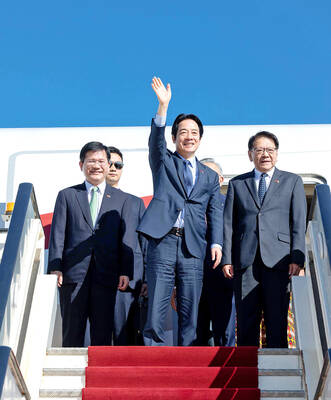
DELAYED BUT DETERMINED: The president’s visit highlights Taiwan’s right to international engagement amid regional pressure from China President Willaim Lai (賴清德) yesterday arrived in Eswatini, more than a week after his planned visit to Taiwan’s sole African ally was suspended because of revoked overflight permits. “The visit, originally scheduled for April 22, was postponed due to unforeseen external factors,” Lai wrote on social media. “After several days of careful arrangements by our diplomatic and national security teams, we successfully arrived today.” Lai said he looked forward to further deepening Taiwan-Eswatini relations through closer cooperation in the economy, agriculture, culture and education, as well as advancing the nation’s international partnerships. The president was initially scheduled to arrive in time to celebrate
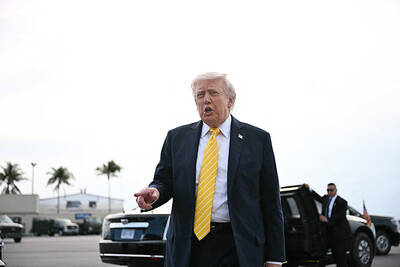
Iran’s Islamic Revolutionary Guard Corp (IRGC) yesterday said the US faced a choice between an “impossible” military operation or a “bad deal” with Tehran, after US President Donald Trump disparaged Iran’s latest peace proposal. Negotiations between the two countries have been deadlocked since a ceasefire came into effect on April 8, with only one round of direct peace talks held so far. Iran’s Tasnim and Fars news agencies reported that Tehran had submitted a 14-point proposal to mediator Pakistan, but Trump was quick to cast doubt on it. “I will soon be reviewing the plan that Iran has just sent to us, but


 RSS
RSS