


US Secretary of State Mike Pompeo yesterday pressed Kazakhstan to be wary of Chinese investment and influence, urging the Central Asian nation and others to join calls demanding an end to China’s repression of minorities.
Bringing a message similar to the one he has delivered repeatedly to other countries, Pompeo told senior Kazakh officials that the attractiveness of Chinese investment comes with a cost to sovereignty and might hurt, instead of help, the country’s long-term development.
“We fully support Kazakhstan’s freedom to choose to do business with whichever country it wants, but I am confident that countries get the best outcomes when they partner with American companies,” he said.
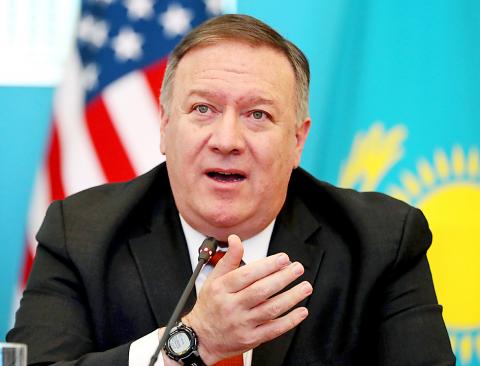
Photo: EPA-EFE
“You get fair deals. You get job creation. You get transparency in contracts. You get companies that care about the environment and you get an unsurpassed commitment to quality work,” he added.
Pompeo began his brief visit to the country by meeting with ethnic Kazakhs whose families have gone missing or been detained in China’s widespread crackdown on Muslims and other ethnic and religious minorities in its western Xinjiang region.
“The protection of basic human rights defines the soul of a nation,” he said, thanking Kazakhstan for taking in those fleeing persecution.
“The United States urges all countries to join us in pressing for immediate end to this repression. We ask simply for them to provide safe refuge and asylum for those seeking to flee China. To protect dignity, just do what’s right,” he added.
Pompeo also congratulated Kazakhstan on its repatriation of Islamic State fighters from Iraq and Syria.
Kazakhstan has taken back nearly 600 fighters and family members detained in areas formerly controlled by the group.
“I have and will continue to commend the Kazakhstani government for its leadership in repatriating foreign terrorists fighters and their families from Iraq and Syria,” he said. “I hope this commitment to justice will inspire other nations to do the same.”
However, Kazakhstan has come under criticism for pressuring an advocate who had campaigned for the release of ethnic Kazakhs in China.
In addition, Pompeo urged senior Kazakh officials to continue reforms that would allow greater US investment in the country.

CROSS-STRAIT COLLABORATION: The new KMT chairwoman expressed interest in meeting the Chinese president from the start, but she’ll have to pay to get in Beijing allegedly agreed to let Chinese Nationalist Party (KMT) Chairwoman Cheng Li-wun (鄭麗文) meet with Chinese President Xi Jinping (習近平) around the Lunar New Year holiday next year on three conditions, including that the KMT block Taiwan’s arms purchases, a source said yesterday. Cheng has expressed interest in meeting Xi since she won the KMT’s chairmanship election in October. A source, speaking on condition of anonymity, said a consensus on a meeting was allegedly reached after two KMT vice chairmen visited China’s Taiwan Affairs Office Director Song Tao (宋濤) in China last month. Beijing allegedly gave the KMT three conditions it had to

STAYING ALERT: China this week deployed its largest maritime show of force to date in the region, prompting concern in Taipei and Tokyo, which Beijing has brushed off Deterring conflict over Taiwan is a priority, the White House said in its National Security Strategy published yesterday, which also called on Japan and South Korea to increase their defense spending to help protect the first island chain. Taiwan is strategically positioned between Northeast and Southeast Asia, and provides direct access to the second island chain, with one-third of global shipping passing through the South China Sea, the report said. Given the implications for the US economy, along with Taiwan’s dominance in semiconductors, “deterring a conflict over Taiwan, ideally by preserving military overmatch, is a priority,” it said. However, the strategy also reiterated

‘BALANCE OF POWER’: Hegseth said that the US did not want to ‘strangle’ China, but to ensure that none of Washington’s allies would be vulnerable to military aggression Washington has no intention of changing the “status quo” in the Taiwan Strait, US Secretary of Defense Pete Hegseth said on Saturday, adding that one of the US military’s main priorities is to deter China “through strength, not through confrontation.” Speaking at the annual Reagan National Defense Forum in Simi Valley, California, Hegseth outlined the US Department of Defense’s priorities under US President Donald Trump. “First, defending the US homeland and our hemisphere. Second, deterring China through strength, not confrontation. Third, increased burden sharing for us, allies and partners. And fourth, supercharging the US defense industrial base,” he said. US-China relations under

The Chien Feng IV (勁蜂, Mighty Hornet) loitering munition is on track to enter flight tests next month in connection with potential adoption by Taiwanese and US armed forces, a government source said yesterday. The kamikaze drone, which boasts a range of 1,000km, debuted at the Taipei Aerospace and Defense Technology Exhibition in September, the official said on condition of anonymity. The Chungshan Institute of Science and Technology and US-based Kratos Defense jointly developed the platform by leveraging the engine and airframe of the latter’s MQM-178 Firejet target drone, they said. The uncrewed aerial vehicle is designed to utilize an artificial intelligence computer


 RSS
RSS