


The WHO declared the outbreak sparked by a new virus in China that has spread to more than a dozen countries a global emergency after the number of cases spiked more than 10-fold in a week, including a record number of deaths in 24 hours reported yesterday.
China counted 9,692 confirmed cases with a death toll of 213, including 43 new fatalities. The vast majority of the cases have been in Hubei Province and its provincial capital, Wuhan, the epicenter of the outbreak. No deaths have been reported outside China.
The WHO defines an international emergency as an “extraordinary event” that constitutes a risk to other countries and requires a coordinated international response.
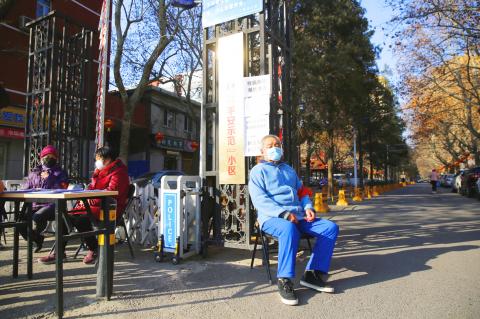
Photo: EPA-EFE
China first informed the WHO about cases of the new virus in late December. Eighteen other countries have since reported cases, as scientists race to understand how exactly the virus is spreading and how severe it is.
Experts have said there is significant evidence that the virus is spreading among people in China and have noted with concern instances in other countries — including the US, France, Japan, Germany, Canada, South Korea and Vietnam — where there have also been isolated cases of human-to-human transmission.
Speaking to reporters in Geneva, Switzerland, on Thursday, WHO director-general Tedros Adhanom Ghebreyesus noted the worrisome spread of the virus between people outside China.
“The main reason for this declaration is not because of what is happening in China, but because of what is happening in other countries,” he said. “Our greatest concern is the potential for this virus to spread to countries with weaker health systems, which are ill-prepared to deal with it.”
“This declaration is not a vote of non-confidence in China,” he said. “On the contrary, WHO continues to have the confidence in China’s capacity to control the outbreak.”
A declaration of a global emergency typically brings greater money and resources, but could also prompt nervous governments to restrict travel and trade to affected countries. The announcement also imposes more disease reporting requirements on countries.
In the wake of numerous airlines canceling flights to China and businesses, including Starbucks and McDonald’s, temporarily closing hundreds of shops, Tedros said that the WHO was not recommending limiting travel or trade to China.
“There is no reason for measures that unnecessarily interfere with international travel and trade,” he said, adding that Chinese President Xi Jinping (習近平) had committed to help stop the spread of the virus beyond China’s borders.
On Thursday, France confirmed that a doctor who was in contact with a patient with the new virus later became infected. The doctor is now being treated in an isolated room at a Paris hospital.
Outbreak specialists worry that the spread of new viruses from patients to health workers can signal that the virus is becoming adapted to human transmission.
Russia announced that it was closing its 4,185km border with China, joining Mongolia and North Korea in barring crossings to guard against the outbreak.
The border had been de facto closed because of the Lunar New Year holiday, but Russian authorities said that the closure would be extended until March 1.
Meanwhile, the US and South Korea confirmed their first cases of person-to-person spread of the virus.
The man in the US is married to a 60-year-old Chicago woman who got sick from the virus after she returned from a trip to Wuhan.
The case in South Korea was a 56-year-old man who had contact with a patient who was earlier diagnosed with the virus.
Although scientists expect to see limited transmission of the virus between people with close contact, like within families, the instances of transmission to people who might have had less exposure to the virus is worrying.
“That’s the kind of transmission chain that we don’t want to see,” said Marion Koopmans, an infectious diseases specialist at Erasmus University Medical Center in the Netherlands and a member of the WHO’s emergency committee.

CROSS-STRAIT COLLABORATION: The new KMT chairwoman expressed interest in meeting the Chinese president from the start, but she’ll have to pay to get in Beijing allegedly agreed to let Chinese Nationalist Party (KMT) Chairwoman Cheng Li-wun (鄭麗文) meet with Chinese President Xi Jinping (習近平) around the Lunar New Year holiday next year on three conditions, including that the KMT block Taiwan’s arms purchases, a source said yesterday. Cheng has expressed interest in meeting Xi since she won the KMT’s chairmanship election in October. A source, speaking on condition of anonymity, said a consensus on a meeting was allegedly reached after two KMT vice chairmen visited China’s Taiwan Affairs Office Director Song Tao (宋濤) in China last month. Beijing allegedly gave the KMT three conditions it had to

STAYING ALERT: China this week deployed its largest maritime show of force to date in the region, prompting concern in Taipei and Tokyo, which Beijing has brushed off Deterring conflict over Taiwan is a priority, the White House said in its National Security Strategy published yesterday, which also called on Japan and South Korea to increase their defense spending to help protect the first island chain. Taiwan is strategically positioned between Northeast and Southeast Asia, and provides direct access to the second island chain, with one-third of global shipping passing through the South China Sea, the report said. Given the implications for the US economy, along with Taiwan’s dominance in semiconductors, “deterring a conflict over Taiwan, ideally by preserving military overmatch, is a priority,” it said. However, the strategy also reiterated
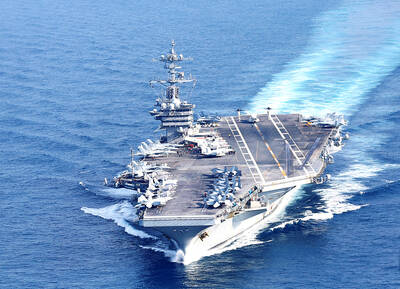
‘BALANCE OF POWER’: Hegseth said that the US did not want to ‘strangle’ China, but to ensure that none of Washington’s allies would be vulnerable to military aggression Washington has no intention of changing the “status quo” in the Taiwan Strait, US Secretary of Defense Pete Hegseth said on Saturday, adding that one of the US military’s main priorities is to deter China “through strength, not through confrontation.” Speaking at the annual Reagan National Defense Forum in Simi Valley, California, Hegseth outlined the US Department of Defense’s priorities under US President Donald Trump. “First, defending the US homeland and our hemisphere. Second, deterring China through strength, not confrontation. Third, increased burden sharing for us, allies and partners. And fourth, supercharging the US defense industrial base,” he said. US-China relations under
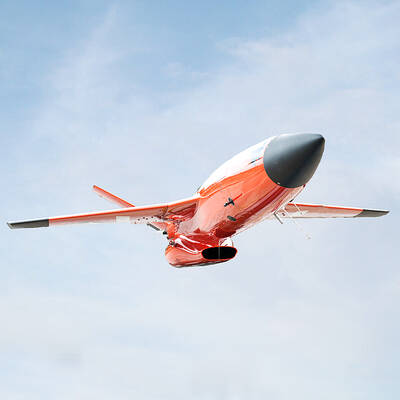
The Chien Feng IV (勁蜂, Mighty Hornet) loitering munition is on track to enter flight tests next month in connection with potential adoption by Taiwanese and US armed forces, a government source said yesterday. The kamikaze drone, which boasts a range of 1,000km, debuted at the Taipei Aerospace and Defense Technology Exhibition in September, the official said on condition of anonymity. The Chungshan Institute of Science and Technology and US-based Kratos Defense jointly developed the platform by leveraging the engine and airframe of the latter’s MQM-178 Firejet target drone, they said. The uncrewed aerial vehicle is designed to utilize an artificial intelligence computer


 RSS
RSS