


The Asia-Pacific region has been dominated by repression, but also resistance, as the two largest nations on Earth sought to impose a “bleak domineering vision” for the region, Amnesty International’s annual human rights review for last year says.
The review, released yesterday, paints a bleak picture for minorities across the region, with Uighurs in China interned in “re-education camps,” and a siege imposed across Kashmir, India’s only Muslim-majority state.
However, Amnesty said that while governments became increasingly repressive, they were countered by emerging public resistance; in Hong Kong, where protests against a proposed extradition law metamorphosed into broader demands around respect for democracy, human rights, free expression and peaceful assembly; in India, where millions turned out to resist new laws that discriminate against Muslims taking citizenship; and in West Papua, where people demonstrated against racist and discriminatory treatment, and reaffirmed demands for independence from Indonesia.
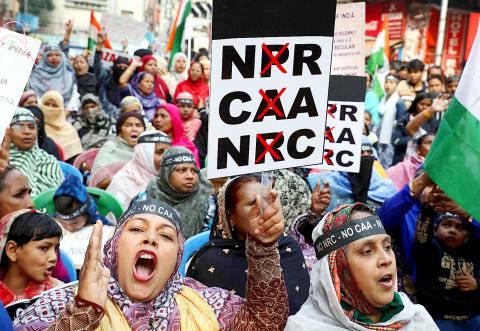
Photo: Reuters
The region is increasingly governed by strongman leaders; in Sri Lanka, former military chief Gotabaya Rajapaksa was elected president; in the Philippines, President Rodrigo Duterte’s “war on drugs” claimed hundreds more lives through extrajudicial killings; and Prime Minister Hun Sen consolidated his grip on power in Cambodia as political violence worsened.
“Across Southeast Asia, repressive governments entrenched themselves further, silenced their opponents, muzzled the media, and shrank civic space to the point where, in many countries, even participation in a peaceful protest can trigger arrest,” the report said. “In South Asia, governments appeared anxious to keep up, innovating new ways to perpetuate old patterns of repression — especially through the introduction of draconian laws that punish dissent online.”
Amnesty said that repression is often legitimized by governments demonizing critics as “as pawns of ‘foreign forces,’ who are at best ‘naive’ and at worst ‘treasonous.’”
While governments across the Asia-Pacific region sought to suppress dissent, protests and civil resistance have had an effect.
In Taiwan, the fight for equality for LGBT people resulted in same-sex marriage becoming legal in March last year.
In Sri Lanka, lawyers and activists successfully prevented the resumption of executions.
Pakistan passed laws to tackle climate change and air pollution in the interests of its citizens, while a massive, months-long campaign of protests on the streets of Hong Kong resulted in the withdrawal of a proposed extradition bill with China, which had become emblematic of widespread dissatisfaction among residents of the territory.
“The wheels of justice slowly began to turn for the Rohingya, as the International Criminal Court [ICC] authorized an investigation into crimes committed by the Myanmar military in 2017,” Amnesty wrote. “This followed a decision by Gambia to take Myanmar to the International Court of Justice for the crime of genocide.”
“There are also hopes that the ICC will revisit its decision to not authorize an investigation into war crimes and crimes against humanity committed by all sides in Afghanistan, after capitulating to pressure from the US administration” of President Donald Trump, the report said.

CROSS-STRAIT COLLABORATION: The new KMT chairwoman expressed interest in meeting the Chinese president from the start, but she’ll have to pay to get in Beijing allegedly agreed to let Chinese Nationalist Party (KMT) Chairwoman Cheng Li-wun (鄭麗文) meet with Chinese President Xi Jinping (習近平) around the Lunar New Year holiday next year on three conditions, including that the KMT block Taiwan’s arms purchases, a source said yesterday. Cheng has expressed interest in meeting Xi since she won the KMT’s chairmanship election in October. A source, speaking on condition of anonymity, said a consensus on a meeting was allegedly reached after two KMT vice chairmen visited China’s Taiwan Affairs Office Director Song Tao (宋濤) in China last month. Beijing allegedly gave the KMT three conditions it had to

STAYING ALERT: China this week deployed its largest maritime show of force to date in the region, prompting concern in Taipei and Tokyo, which Beijing has brushed off Deterring conflict over Taiwan is a priority, the White House said in its National Security Strategy published yesterday, which also called on Japan and South Korea to increase their defense spending to help protect the first island chain. Taiwan is strategically positioned between Northeast and Southeast Asia, and provides direct access to the second island chain, with one-third of global shipping passing through the South China Sea, the report said. Given the implications for the US economy, along with Taiwan’s dominance in semiconductors, “deterring a conflict over Taiwan, ideally by preserving military overmatch, is a priority,” it said. However, the strategy also reiterated

‘BALANCE OF POWER’: Hegseth said that the US did not want to ‘strangle’ China, but to ensure that none of Washington’s allies would be vulnerable to military aggression Washington has no intention of changing the “status quo” in the Taiwan Strait, US Secretary of Defense Pete Hegseth said on Saturday, adding that one of the US military’s main priorities is to deter China “through strength, not through confrontation.” Speaking at the annual Reagan National Defense Forum in Simi Valley, California, Hegseth outlined the US Department of Defense’s priorities under US President Donald Trump. “First, defending the US homeland and our hemisphere. Second, deterring China through strength, not confrontation. Third, increased burden sharing for us, allies and partners. And fourth, supercharging the US defense industrial base,” he said. US-China relations under
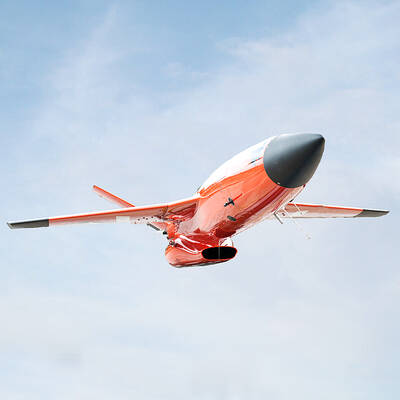
The Chien Feng IV (勁蜂, Mighty Hornet) loitering munition is on track to enter flight tests next month in connection with potential adoption by Taiwanese and US armed forces, a government source said yesterday. The kamikaze drone, which boasts a range of 1,000km, debuted at the Taipei Aerospace and Defense Technology Exhibition in September, the official said on condition of anonymity. The Chungshan Institute of Science and Technology and US-based Kratos Defense jointly developed the platform by leveraging the engine and airframe of the latter’s MQM-178 Firejet target drone, they said. The uncrewed aerial vehicle is designed to utilize an artificial intelligence computer


 RSS
RSS